The Tale of Mrs. Tiggy-Winkle
A free B1-level English story for language learners, readable online in 7 languages, with an option to listen via the free Storyteller app.
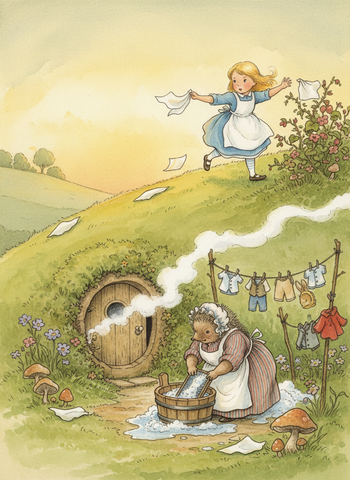
Chasing her lost handkerchiefs up a hillside, Lucie finds a tiny door into the hill — and the strangest, prickliest washerwoman imaginable, doing laundry for all the animals of the valley.
Once upon a time there was a little girl called Lucie, who lived at a farm called Little-town. She was a good little girl—only she was always losing her pocket-handkerchiefs!
Era uma vez uma menininha chamada Lucie, que morava numa fazenda chamada Little-town. Ela era uma menina boazinha—só que vivia perdendo seus lencinhos de bolso!
One day little Lucie came into the farm-yard crying—oh, she did cry so! "I've lost my pocket-handkin! Three handkins and a pinny! Have _you_ seen them, Tabby Kitten?"
Um dia, a pequena Lucie chegou ao quintal da fazenda chorando—ah, como ela chorava! "Perdi meu lenço de bolso! Três lencinhos e um avental! Você já viu eles, Gatinha Tabby?"
The Kitten went on washing her white paws; so Lucie asked a speckled hen—
A Gatinha continuou lavando suas patinhas brancas; então Lucie perguntou a uma galinha sardenta—
"Sally Henny-penny, have _you_ found three pocket-handkins?"
"Sally Galinha-mimosa, você já encontrou três lencinhos de bolso?"
But the speckled hen ran into a barn, clucking—
Mas a galinha sardenta correu para dentro do celeiro, cacarejando—
"I go barefoot, barefoot, barefoot!"
"Eu ando descalça, descalça, descalça!"
And then Lucie asked Cock Robin sitting on a twig.
E então Lucie perguntou ao Pintarroxo, sentado num galho.
Cock Robin looked sideways at Lucie with his bright black eye, and he flew over a stile and away.
O Pintarroxo olhou de lado para Lucie com seu olhinho preto e brilhante, e voou por cima de uma cerca e sumiu.
Lucie climbed upon the stile and looked up at the hill behind Little-town—a hill that goes up—up—into the clouds as though it had no top!
Lucie subiu na cerca e olhou para a colina atrás de Little-town—uma colina que sobe—sobe—até as nuvens, como se não tivesse topo!
And a great way up the hill-side she thought she saw some white things spread upon the grass.
E lá bem no alto da encosta, ela achou que via umas coisas brancas espalhadas na grama.
Lucie scrambled up the hill as fast as her stout legs would carry her; she ran along a steep path-way—up and up—until Little-town was right away down below—she could have dropped a pebble down the chimney!
Lucie subiu a colina o mais rápido que suas perninhas fortes conseguiam levá-la; ela correu por um caminho íngreme—subindo e subindo—até que Little-town ficasse bem lá embaixo—ela poderia ter deixado cair uma pedrinha dentro da chaminé!
Presently she came to a spring, bubbling out from the hill-side.
Logo depois ela chegou a uma nascente, que borbulhava saindo da encosta.
Some one had stood a tin can upon a stone to catch the water—but the water was already running over, for the can was no bigger than an egg-cup! And where the sand upon the path was wet—there were foot-marks of a _very_ small person.
Alguém tinha colocado uma lata em cima de uma pedra para pegar a água—mas a água já estava transbordando, pois a lata não era maior que uma xícara de ovo! E onde a areia do caminho estava molhada—havia pegadas de uma pessoa muito pequena.
Lucie ran on, and on.
Lucie correu, e correu.
The path ended under a big rock. The grass was short and green, and there were clothes—props cut from bracken stems, with lines of plaited rushes, and a heap of tiny clothes pins—but no pocket-handkerchiefs!
O caminho terminava embaixo de uma pedra grande. A grama era curta e verde, e havia varais—suportes cortados de talos de samambaia, com linhas de junco trançado, e um monte de prendedorzinhos de roupa—mas nenhum lencinho de bolso!
But there was something else—a door! straight into the hill; and inside it some one was singing—
Mas havia outra coisa—uma porta! bem na encosta da colina; e lá dentro alguém estava cantando—
"Lily-white and clean, oh! With little frills between, oh! Smooth and hot—red rusty spot Never here be seen, oh!"
"Branco de lírio e limpo, oh! Com folhinhos entre, oh! Liso e quente—manchinha vermelha enferrujada Nunca aqui se vê, oh!"
Lucie, knocked—once—twice, and interrupted the song. A little frightened voice called out "Who's that?"
Lucie bateu—uma vez—duas vezes—e interrompeu a canção. Uma vozinha assustada gritou "Quem é?"
Lucie opened the door: and what do you think there was inside the hill?—a nice clean kitchen with a flagged floor and wooden beams—just like any other farm kitchen. Only the ceiling was so low that Lucie's head nearly touched it; and the pots and pans were small, and so was everything there.
Lucie abriu a porta: e o que vocês acham que havia dentro da colina?—uma cozinha bem limpa, com piso de lajes e vigas de madeira—igualzinha a qualquer outra cozinha de fazenda. Só que o teto era tão baixo que a cabeça de Lucie quase o tocava; e as panelas e frigideiras eram pequenas, e tudo ali também era pequeno.
There was a nice hot singey smell; and at the table, with an iron in her hand stood a very stout short person staring anxiously at Lucie.
Havia um bom cheiro quente de passar roupa; e à mesa, com um ferro na mão, estava uma pessoa muito baixinha e roliça, olhando ansiosamente para Lucie.
Her print gown was tucked up, and she was wearing a large apron over her striped petticoat. Her little black nose went sniffle, sniffle, snuffle, and her eyes went twinkle, twinkle; and underneath her cap—where Lucie had yellow curls—that little person had PRICKLES!
Seu vestido estampado estava arregaçado, e ela usava um grande avental sobre a anágua listrada. Seu narizinho preto fazia fungo, fungo, fungo, e seus olhos brilhavam, brilhavam; e por baixo de sua touca—onde Lucie tinha cachinhos loiros—aquela pessoinha tinha ESPINHOS!
"Who are you?" said Lucie. "Have you seen my pocket-handkins?"
"Quem é você?" disse Lucie. "Você viu meus lencinhos de bolso?"
The little person made a bob-curtsey—"Oh, yes, if you please'm; my name is Mrs. Tiggy-winkle; oh, yes if you please'm, I'm an excellent clear-starcher!" And she took something out of a clothes-basket, and spread it on the ironing-blanket.
A pessoinha fez uma reverência—"Ah, sim, com sua licença; meu nome é Senhora Tiggy-winkle; ah, sim, com sua licença, sou uma excelente engomadeira!" E ela tirou algo de um cesto de roupas, e estendeu na tábua de passar.
"What's that thing?" said Lucie—"that's not my pocket-handkin?"
"O que é aquilo?" disse Lucie—"não é o meu lencinho de bolso?"
"Oh no, if you please'm; that's a little scarlet waist-coat belonging to Cock Robin!"
"Ah, não, com sua licença; isso é um coletinho vermelho que pertence ao Pintarroxo!"
And she ironed it and folded it, and put it on one side.
E ela passou e dobrou, e colocou de lado.
Then she took something else off a clothes-horse—
Depois pegou outra coisa do varal de secar roupa—
"That isn't my pinny?" said Lucie.
"Isso não é o meu avental?" disse Lucie.
"Oh no, if you please'm; that's a damask table-cloth belonging to Jenny Wren; look how it's stained with currant wine! It's very bad to wash!" said Mrs. Tiggy-winkle.
"Ah, não, com sua licença; isso é uma toalha de mesa de damasco que pertence à Jenny Wren; olhe só como está manchada de vinho de groselha! É muito difícil de lavar!" disse a Senhora Tiggy-winkle.
Mrs. Tiggy-winkle's nose went sniffle, sniffle, snuffle, and her eyes went twinkle, twinkle; and she fetched another hot iron from the fire.
O nariz da Senhora Tiggy-winkle fazia fungo, fungo, fungo, e seus olhos brilhavam, brilhavam; e ela pegou outro ferro quente do fogo.
"There's one of my pocket-handkins!" cried Lucie—"and there's my pinny!"
"Ali está um dos meus lencinhos de bolso!" gritou Lucie—"e ali está meu avental!"
Mrs. Tiggy-winkle ironed it, and goffered it, and shook out the frills.
A Senhora Tiggy-winkle passou, pregueou, e sacudiu os folhinhos.
"Oh that _is_ lovely!" said Lucie.
"Ah, que lindo!" disse Lucie.
"And what are those long yellow things with fingers like gloves?"
"E o que são aquelas coisas amarelas compridas com dedos, feito luvas?"
"Oh, that's a pair of stockings belonging to Sally Henny-penny—look how she's worn the heels out with scratching in the yard! She'll very soon go barefoot!" said Mrs. Tiggy-winkle.
"Ah, é um par de meias que pertence à Sally Galinha-mimosa—olhe como ela gastou os calcanhares de tanto ciscar no quintal! Ela logo vai andar descalça!" disse a Senhora Tiggy-winkle.
"Why, there's another handkersniff—but it isn't mine; it's red?"
"Ora, ali está outro lencinho—mas não é meu; é vermelho?"
"Oh no, if you please'm; that one belongs to old Mrs. Rabbit; and it _did_ so smell of onions! I've had to wash it separately, I can't get out the smell."
"Ah, não, com sua licença; esse pertence à velha Senhora Coelha; e como cheirava a cebola! Tive que lavar separado, não consigo tirar o cheiro."
"There's another one of mine," said Lucie.
"Ali está mais um dos meus," disse Lucie.
"What are those funny little white things?"
"O que são aquelas coisinhas brancas engraçadas?"
"That's a pair of mittens belonging to Tabby Kitten; I only have to iron them; she washes them herself."
"São um par de luvinhas que pertencem à Gatinha Tabby; só preciso passá-las; ela mesma as lava."
"There's my last pocket-handkin!" said Lucie.
"Ali está meu último lencinho de bolso!" disse Lucie.
"And what are you dipping into the basin of starch?"
"E o que você está mergulhando na tigela de goma?"
"They're little dicky shirt-fronts belonging to Tom Titmouse—most terrible particular!" said Mrs. Tiggy-winkle. "Now I've finished my ironing; I'm going to air some clothes."
"São umas peitilhos de camisa que pertencem ao Tom Chapim—é terrivelmente exigente!" disse a Senhora Tiggy-winkle. "Agora terminei de passar; vou arejar umas roupas."
"What are these dear soft fluffy things?" said Lucie.
"O que são essas coisinhas macias e fofas?" disse Lucie.
"Oh those are woolly coats belonging to the little lambs at Skelghyl."
"Ah, são casaquinhos de lã que pertencem aos cordeirinhos de Skelghyl."
"Will their jackets take off?" asked Lucie.
"Os casaquinhos deles se tiram?" perguntou Lucie.
"Oh yes, if you please'm; look at the sheep-mark on the shoulder. And here's one marked for Gatesgarth, and three that come from Little-town. They're _always_ marked at washing!" said Mrs. Tiggy-winkle.
"Ah, sim, com sua licença; olhe a marca do rebanho no ombro. E aqui está um marcado para Gatesgarth, e três que vêm de Little-town. Eles são sempre marcados na hora da lavagem!" disse a Senhora Tiggy-winkle.
And she hung up all sorts and sizes of clothes—small brown coats of mice; and one velvety black moleskin waist-coat; and a red tailcoat with no tail belonging to Squirrel Nutkin; and a very much shrunk blue jacket belonging to Peter Rabbit; and a petticoat, not marked, that had gone lost in the washing—and at last the basket was empty!
E ela pendurou roupas de todo tipo e tamanho—casaquinhos marrons de camundongos; um coletinho de pele de toupeira aveludado e preto; um fraque vermelho sem rabo que pertencia ao Esquilo Nutkin; e um casaquinho azul muito encolhido que pertencia ao Pedro Coelho; e uma anágua, sem marca, que se tinha perdido na lavagem—e por fim o cesto ficou vazio!
"Then Mrs. Tiggy-winkle made tea—a cup for herself and a cup for Lucie. They sat before the fire on a bench and looked sideways at one another. Mrs. Tiggy-winkle's hand, holding the tea-cup, was very very brown, and very very wrinkly with the soap-suds; and all through her gown and her cap, there were _hair-pins_ sticking wrong end out; so that Lucie didn't like to sit too near her.
Então a Senhora Tiggy-winkle fez chá—uma xícara para ela e uma xícara para Lucie. Sentaram-se diante do fogo num banco e se olharam de lado. A mão da Senhora Tiggy-winkle, segurando a xícara de chá, era muito, muito morena, e muito, muito enrugada por causa da espuma de sabão; e por todo o seu vestido e sua touca, havia grampos de cabelo espetados com a ponta errada para fora; de modo que Lucie não gostava de sentar muito perto dela.
When they had finished tea, they tied up the clothes in bundles; and Lucie's pocket-handkerchiefs were folded up inside her clean pinny, and fastened with a silver safety-pin.
Quando terminaram o chá, amarraram as roupas em trouxas; e os lencinhos de bolso de Lucie foram dobrados dentro de seu avental limpo, e presos com um alfinete de segurança de prata.
And then they made up the fire with turf, and came out and locked the door, and hid the key under the door-sill.
E então avivaram o fogo com turfa, saíram e trancaram a porta, e esconderam a chave debaixo do soleiro.
Then away down the hill trotted Lucie and Mrs. Tiggy-winkle with the bundles of clothes!
Então, descendo a colina, foram trotando Lucie e a Senhora Tiggy-winkle com as trouxas de roupa!
All the way down the path little animals came out of the fern to meet them; the very first that they met were Peter Rabbit and Benjamin Bunny!
Por todo o caminho, bichinhos saíam das samambaias para encontrá-las; os primeiros que encontraram foram Pedro Coelho e Benjamin Bunny!
And she gave them their nice clean clothes; and all the little animals and birds were so very much obliged to dear Mrs. Tiggy-winkle.
E ela deu a eles suas roupinhas limpas; e todos os bichinhos e passarinhos ficaram muitíssimo agradecidos à querida Senhora Tiggy-winkle.
So that at the bottom of the hill when they came to the stile, there was nothing left to carry except Lucie's one little bundle.
De modo que, ao pé da colina, quando chegaram à cerca, não havia mais nada para carregar, exceto a trouxinha de Lucie.
Lucie scrambled up the stile with the bundle in her hand; and then she turned to say "Good-night," and to thank the washer-woman—But what a _very_ odd thing! Mrs. Tiggy-winkle had not waited either for thanks or for the washing bill!
Lucie subiu na cerca com a trouxa na mão; e então se virou para dizer "Boa noite," e agradecer à lavadeira—Mas que coisa muito estranha! A Senhora Tiggy-winkle não tinha esperado nem pelos agradecimentos nem pela conta da lavagem!
She was running running running up the hill—and where was her white frilled cap? and her shawl? and her gown—and her petticoat?
Ela estava correndo, correndo, correndo colina acima—e onde estava sua touca branca de folhinhos? e seu xale? e seu vestido—e sua anágua?
And _how_ small she had grown—and _how_ brown—and covered with PRICKLES!
E como ela tinha ficado pequena—e como tinha ficado marrom—e coberta de ESPINHOS!
Why! Mrs. Tiggy-winkle was nothing but a HEDGEHOG.
Ora! A Senhora Tiggy-winkle não era nada mais que um OURIÇO.
(Now some people say that little Lucie had been asleep upon the stile—but then how could she have found three clean pocket-handkins and a pinny, pinned with a silver safety-pin?
(Agora, algumas pessoas dizem que a pequena Lucie tinha dormido em cima da cerca—mas então como ela poderia ter encontrado três lencinhos de bolso limpos e um avental, preso com um alfinete de segurança de prata?
And besides—_I_ have seen that door into the back of the hill called Cat Bells—and besides _I_ am very well acquainted with dear Mrs. Tiggy-winkle!)
E além disso—eu já vi aquela porta na parte de trás da colina chamada Cat Bells—e além disso, eu conheço muito bem a querida Senhora Tiggy-winkle!)
