The Companions of Ulysses
A free B2-level English story for language learners, readable online in 7 languages, with an option to listen via the free Storyteller app.
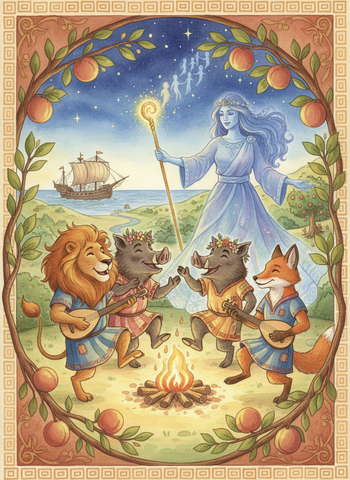
Circe transforms Ulysses' companions into animals, but when offered a chance to become human again, they refuse — choosing freedom and passion over their former lives.
That great hero-wanderer Ulysses had been with his companions driven hither and thither at the will of the winds for ten years, never knowing what their ultimate fate was to be. At length they disembarked upon a shore where Circe, the daughter of Apollo, held her court. Receiving them she brewed a delicious but baneful liquor, which she made them drink. The result of this was that first they lost their reason, and a few moments after, their bodies took the forms and features of various animals; some unwieldy, some small. Ulysses alone, having the wisdom to withstand the temptation of the treacherous cup, escaped the metamorphosis.
Aquele grande herói-viajante Ulisses tinha sido levado com seus companheiros de um lado para outro à vontade dos ventos por dez anos, sem nunca saber qual seria seu destino final. Por fim desembarcaram numa costa onde Circe, filha de Apolo, mantinha sua corte. Recebendo-os, ela preparou uma bebida deliciosa mas funesta, que os fez beber. O resultado disso foi que primeiro perderam a razão, e poucos momentos depois, seus corpos tomaram as formas e feições de vários animais; alguns desajeitados, alguns pequenos. Somente Ulisses, tendo a sabedoria de resistir à tentação da taça traiçoeira, escapou da metamorfose.
He, besides possessing wisdom, bore the look of a hero and had the gift of honeyed speech, so that it came about that the goddess herself imbibed a poison little different from her own; that is to say, she became enamoured of the hero and declared her love to him. Now was the time for Ulysses to profit by this turn of events, and he was too cunning to miss the opportunity, so he begged and obtained the boon that his friends should be restored to their natural shapes.
Ele, além de possuir sabedoria, tinha o porte de um herói e o dom da fala melosa, de modo que aconteceu que a própria deusa absorveu um veneno pouco diferente do seu; isto é, ela se apaixonou pelo herói e lhe declarou seu amor. Agora era hora de Ulisses tirar proveito dessa reviravolta, e ele era astuto demais para perder a oportunidade, então implorou e obteve a graça de que seus amigos fossem restaurados às suas formas naturais.
"But will they be willing to accept their own forms again?" asked the nymph. "Go to them and make them the offer."
"Mas eles vão querer aceitar suas próprias formas de novo?" perguntou a ninfa. "Vá até eles e faça-lhes a oferta."
Ulysses, glad and eager, ran to his Greeks and cried, "The poisoned cup has its remedy, and I come to offer it to you. Dear friends of mine, will you not be glad to have your manly forms again? Speak, for your speech is already restored."
Ulisses, feliz e ansioso, correu até seus gregos e gritou: "A taça envenenada tem seu remédio, e venho oferecê-lo a vocês. Meus caros amigos, não ficariam felizes de ter suas formas viris de volta? Falem, pois sua fala já está restaurada."
The lion was the first to reply. Making an effort to roar he said, "I, for one, am not such a fool. What! renounce all the great advantages that have just been given me? I have teeth. I have claws. I can pull to pieces anything that attacks me. I am, in fact, a king. Do you think it would suit me to become a citizen of Ithaca once more? Who knows but that you might make of me a common soldier again. Thank you; but I will remain as I am."
O leão foi o primeiro a responder. Fazendo um esforço para rugir, disse: "Eu, por mim, não sou tão tolo. Como! renunciar a todas as grandes vantagens que acabaram de me ser dadas? Tenho dentes. Tenho garras. Posso despedaçar qualquer coisa que me ataque. Sou, de fato, um rei. Você acha que ficaria bem para mim voltar a ser um cidadão de Ítaca? Quem sabe você não faria de mim um simples soldado de novo. Obrigado; mas vou continuar como estou."
Ulysses, in sad surprise, turned to the bear. "Ah, brother! what form is this you have taken, you who used to be so handsome?"
Ulisses, em triste surpresa, se voltou para o urso. "Ah, irmão! que forma é essa que você tomou, você que costumava ser tão bonito?"
"Well, really! I like that!" said the bear in his way. "What form is this? you ask. Why it is the form that a bear should have. Pray who instructed you that one form is more handsome than another? Is it your business to judge between us?
"Bem, francamente! gostei disso!" disse o urso à sua maneira. "Que forma é essa? você pergunta. Ora, é a forma que um urso deve ter. Diga-me quem te ensinou que uma forma é mais bonita do que outra? É trabalho seu julgar entre nós?
I prefer to appeal to the sight of the gentler sex in our ursine race. Do I displease you? Then pass on. Go your ways and leave me to mine. I am free and content as I am, and I tell you frankly and flatly that I will not change my state."
Prefiro apelar à visão do sexo mais gentil da nossa raça ursina. Eu te desagrado? Então siga em frente. Vá pelo seu caminho e me deixe pelo meu. Estou livre e contente como estou, e te digo com franqueza e clareza que não vou mudar meu estado."
The princely Greek then turned to a wolf with the same proposals, and risking a similar rebuff said: "Comrade, it overwhelms me that a sweet young shepherdess should be driven to complain to the echoing crags of the gluttonous appetite that impelled you to devour her sheep. Time was when you would have protected her sheepfold. In those days you led an honest life. Leave your lairs and become, instead of a wolf, an honest man again."
O nobre grego então se voltou para um lobo com as mesmas propostas, e arriscando uma recusa semelhante, disse: "Camarada, me esmaga saber que uma doce jovem pastora foi levada a lamentar aos rochedos ecoantes o apetite glutão que te impeliu a devorar suas ovelhas. Houve um tempo em que você teria protegido seu aprisco. Naqueles dias você levava uma vida honesta. Deixe suas tocas e volte a ser, em vez de um lobo, um homem honesto de novo."
"What is that?" answered the wolf. "I don't see your point. You come here treating me as though I were a carnivorous beast. But what are you, who are talking in this strain? Would not you and yours have eaten these sheep, which all the village is deploring, if I had not? Now say, on your oath, do you really think I should have loved slaughter any less if I had remained a man?
"O que é isso?" respondeu o lobo. "Não entendo seu ponto. Você vem aqui me tratando como se eu fosse uma fera carnívora. Mas o que é você, que fala desse jeito? Você e os seus não teriam comido essas ovelhas, que toda a aldeia lamenta, se eu não o tivesse feito? Agora diga, sob juramento, você realmente acha que eu teria amado a matança menos se tivesse permanecido homem?
For a mere word, you men are at times ready to strangle each other. Are you not, therefore, as wolves one to another? All things considered, I maintain as a matter of fact that, rascal for rascal, it is better to be a wolf than a man. I decline to make any change in my condition."
Por uma simples palavra, vocês homens às vezes estão prontos para estrangular uns aos outros. Não são vocês, portanto, lobos uns para os outros? Considerando tudo, mantenho como fato que, patife por patife, é melhor ser lobo do que homem. Recuso-me a fazer qualquer mudança na minha condição."
In this way did Ulysses go from one to another making the same representations and receiving from all, large and small alike, the same refusals. Liberty, unbridled lust of appetite, the ambushes of the woods, all these things were their supreme delight. They all renounced the glory attaching to great deeds.
Desta maneira Ulisses foi de um a outro fazendo as mesmas propostas e recebendo de todos, grandes e pequenos igualmente, as mesmas recusas. Liberdade, apetite desenfreado, as emboscadas dos bosques, todas essas coisas eram seu supremo deleite. Todos renunciaram à glória ligada aos grandes feitos.
They thought that in following their passions they were enjoying freedom, not seeing that they were but slaves to themselves.
Achavam que, seguindo suas paixões, estavam desfrutando da liberdade, sem ver que eram apenas escravos de si mesmos.
