The Quarrel of the Monkey and the Crab
A free B1-level English story for language learners, readable online in 7 languages, with an option to listen via the free Storyteller app.
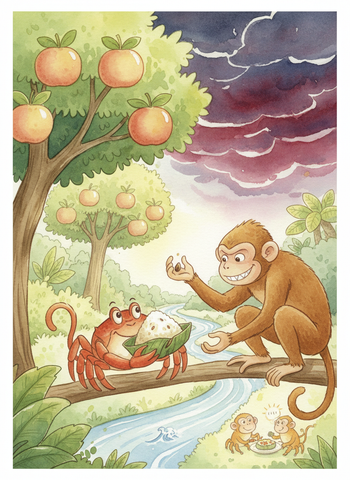
A crab trades her rice-dumpling for a monkey's worthless seed, trusting his promise of future fruit — but greed turns their old friendship into a deadly betrayal.
Long, long ago, one bright autumn day in Japan, it happened, that a pink-faced monkey and a yellow crab were playing together along the bank of a river. As they were running about, the crab found a rice-dumpling and the monkey a persimmon-seed.
Dahulu kala, pada suatu hari musim gugur yang cerah di Jepang, terjadilah seekor monyet berwajah merah muda dan seekor kepiting kuning sedang bermain bersama di tepi sebuah sungai. Sambil berlari-lari ke sana kemari, kepiting itu menemukan sebuah bola nasi, dan monyet itu menemukan sebuah biji kesemek.
The crab picked up the rice-dumpling and showed it to the monkey, saying:
Kepiting mengambil bola nasi itu dan memperlihatkannya kepada monyet, sambil berkata:
“Look what a nice thing I have found!”
"Lihat apa yang kutemukan, bagus sekali!"
Then the monkey held up his persimmon-seed and said:
Kemudian monyet mengangkat biji kesemeknya dan berkata:
“I also have found something good! Look!”
"Aku juga menemukan sesuatu yang bagus! Lihat!"
Now though the monkey is always very fond of persimmon fruit, he had no use for the seed he had just found. The persimmon-seed is as hard and uneatable as a stone. He, therefore, in his greedy nature, felt very envious of the crab’s nice dumpling, and he proposed an exchange. The crab naturally did not see why he should give up his prize for a hard stone-like seed, and would not consent to the monkey’s proposition.
Meskipun monyet selalu sangat menyukai buah kesemek, ia tak ada gunanya dengan biji yang baru saja ia temukan itu. Biji kesemek keras dan tak bisa dimakan, seperti batu. Karena itu, dengan sifatnya yang serakah, ia merasa sangat iri melihat bola nasi kepiting yang enak itu, dan ia mengusulkan pertukaran. Kepiting tentu saja tak melihat alasan mengapa ia harus melepaskan hasil temuannya demi sebuah biji yang keras seperti batu, dan ia tak mau menyetujui usulan monyet itu.
Then the cunning monkey began to persuade the crab, saying:
Maka monyet yang licik itu pun mulai membujuk kepiting, sambil berkata:
“How unwise you are not to think of the future! Your rice-dumpling can be eaten now, and is certainly much bigger than my seed; but if you sow this seed in the ground it will soon grow and become a great tree in a few years, and bear an abundance of fine ripe persimmons year after year. If only I could show it to you then with the yellow fruit hanging on its branches! Of course, if you don’t believe me I shall sow it myself; though I am sure, later on, you will be very sorry that you did not take my advice.”
"Alangkah tidak bijaksananya kau tidak memikirkan masa depan! Bola nasimu bisa dimakan sekarang juga, dan memang jauh lebih besar daripada bijiku; tapi jika kau tanam biji ini di tanah, ia akan segera tumbuh dan menjadi pohon besar dalam beberapa tahun, dan berbuah kesemek matang yang berlimpah tahun demi tahun. Andai saja aku bisa menunjukkan kepadamu nanti, dengan buah kuning bergantungan di dahan-dahannya! Tentu saja, kalau kau tak percaya kepadaku, akan kutanam sendiri saja; meskipun aku yakin, nanti, kau akan sangat menyesal karena tidak mengikuti nasihatku."
The simple-minded crab could not resist the monkey’s clever persuasion. He at last gave in and consented to the monkey’s proposal, and the exchange was made. The greedy monkey soon gobbled up the dumpling, and with great reluctance gave up the persimmon-seed to the crab. He would have liked to keep that too, but he was afraid of making the crab angry and of being pinched by his sharp scissor-like claws. They then separated, the monkey going home to his forest trees and the crab to his stones along the river-side. As soon as the crab reached home he put the persimmon-seed in the ground as the monkey had told him.
Kepiting yang berhati sederhana itu tak bisa menahan bujukan licik monyet itu. Akhirnya ia pun menyerah dan menyetujui usulan monyet, dan pertukaran pun terjadi. Monyet yang serakah itu segera melahap bola nasi itu, dan dengan sangat enggan menyerahkan biji kesemek kepada kepiting. Ia sebenarnya ingin menyimpan biji itu juga, tapi ia takut membuat kepiting marah dan takut dicubit oleh cakarnya yang tajam seperti gunting. Kemudian mereka pun berpisah, monyet pulang ke pohon-pohon hutannya dan kepiting kembali ke bebatuannya di tepi sungai. Begitu kepiting tiba di rumah, ia menanam biji kesemek itu ke dalam tanah seperti yang dikatakan monyet kepadanya.
In the following spring the crab was delighted to see the shoot of a young tree push its way up through the ground. Each year it grew bigger, till at last it blossomed one spring, and in the following autumn bore some fine large persimmons. Among the broad smooth green leaves the fruit hung like golden balls, and as they ripened they mellowed to a deep orange. It was the little crab’s pleasure to go out day by day and sit in the sun and put out his long eyes in the same way as a snail puts out its horn, and watch the persimmons ripening to perfection.
Pada musim semi berikutnya, kepiting sangat senang melihat tunas sebuah pohon muda mendorong keluar dari tanah. Setiap tahun pohon itu tumbuh semakin besar, sampai akhirnya ia berbunga pada suatu musim semi, dan pada musim gugur berikutnya berbuah kesemek-kesemek besar yang bagus. Di antara daun-daun hijau yang lebar dan licin itu, buah-buahnya bergantungan seperti bola-bola emas, dan seiring matangnya, warnanya berubah menjadi jingga tua. Kesenangan kepiting kecil itu adalah pergi keluar hari demi hari dan duduk di bawah sinar matahari sambil menjulurkan matanya yang panjang, sama seperti siput menjulurkan tanduknya, dan mengamati kesemek-kesemek itu matang sempurna.
“How delicious they will be to eat!” he said to himself.
"Alangkah lezatnya nanti buah-buah itu untuk dimakan!" katanya dalam hati.
At last, one day, he knew the persimmons must be quite ripe and he wanted very much to taste one. He made several attempts to climb the tree, in the vain hope of reaching one of the beautiful persimmons hanging above him; but he failed each time, for a crab’s legs are not made for climbing trees but only for running along the ground and over stones, both of which he can do most cleverly. In his dilemma he thought of his old playmate the monkey, who, he knew, could climb trees better than any one else in the world. He determined to ask the monkey to help him, and set out to find him.
Akhirnya, pada suatu hari, ia tahu bahwa kesemek-kesemek itu pasti sudah cukup matang dan ia sangat ingin mencicipi salah satunya. Ia mencoba beberapa kali memanjat pohon itu, dengan harapan sia-sia untuk mencapai salah satu kesemek indah yang bergantungan di atasnya; tetapi ia selalu gagal, sebab kaki kepiting bukan dibuat untuk memanjat pohon, melainkan hanya untuk berlari di atas tanah dan bebatuan, dan kedua hal itu bisa ia lakukan dengan sangat cekatan. Dalam kebingungannya, ia teringat pada teman lamanya, si monyet, yang ia tahu bisa memanjat pohon lebih baik daripada siapa pun di dunia ini. Ia memutuskan untuk meminta bantuan monyet, dan berangkat mencarinya.
Running crab-fashion up the stony river bank, over the pathways into the shadowy forest, the crab at last found the monkey taking an afternoon nap in his favorite pine-tree, with his tail curled tight around a branch to prevent him from falling off in his dreams. He was soon wide awake, however, when he heard himself called, and eagerly listening to what the crab told him. When he heard that the seed which he had long ago exchanged for a rice-dumpling had grown into a tree and was now bearing good fruit, he was delighted, for he at once devised a cunning plan which would give him all the persimmons for himself.
Berlari dengan gaya khas kepiting menyusuri tepi sungai yang berbatu, melewati jalan-jalan setapak masuk ke dalam hutan yang teduh, kepiting akhirnya menemukan monyet sedang tidur siang di pohon pinus kesayangannya, dengan ekornya melilit erat di sebuah dahan agar tidak jatuh saat bermimpi. Namun ia segera terjaga sepenuhnya ketika mendengar namanya dipanggil, dan mendengarkan dengan penuh perhatian apa yang diceritakan kepiting kepadanya. Ketika ia mendengar bahwa biji yang dulu ia tukarkan dengan sebuah bola nasi telah tumbuh menjadi pohon dan kini berbuah lebat, ia pun sangat senang, sebab ia segera merancang sebuah rencana licik yang akan membuat semua kesemek itu menjadi miliknya sendiri.
He consented to go with the crab to pick the fruit for him. When they both reached the spot, the monkey was astonished to see what a fine tree had sprung from the seed, and with what a number of ripe persimmons the branches were loaded.
Ia setuju untuk pergi bersama kepiting memetikkan buah-buahan itu untuknya. Ketika mereka berdua tiba di tempat itu, monyet terkejut melihat pohon yang begitu bagus telah tumbuh dari biji itu, dan betapa banyak kesemek matang yang membebani dahan-dahannya.
He quickly climbed the tree and began to pluck and eat, as fast as he could, one persimmon after another. Each time he chose the best and ripest he could find, and went on eating till he could eat no more. Not one would he give to the poor hungry crab waiting below, and when he had finished there was little but the hard, unripe fruit left.
Ia segera memanjat pohon itu dan mulai memetik dan memakan, secepat yang ia bisa, satu kesemek demi satu kesemek. Setiap kali ia memilih yang terbaik dan termatang yang bisa ia temukan, dan terus makan sampai ia tak sanggup lagi. Tak satu pun ia berikan kepada kepiting malang yang lapar menunggu di bawah, dan ketika ia selesai, yang tersisa hanyalah buah-buah keras yang belum matang.
You can imagine the feelings of the poor crab after waiting patiently, for so long as he had done, for the tree to grow and the fruit to ripen, when he saw the monkey devouring all the good persimmons. He was so disappointed that he ran round and round the tree calling to the monkey to remember his promise. The monkey at first took no notice of the crab’s complaints, but at last he picked out the hardest, greenest persimmon he could find and aimed it at the crab’s head.
Kau bisa bayangkan perasaan kepiting malang itu, setelah menunggu dengan sabar sekian lama untuk pohon itu tumbuh dan buahnya matang, ketika ia melihat monyet melahap semua kesemek yang bagus itu. Ia begitu kecewa sehingga ia berlari mengelilingi pohon itu berulang-ulang sambil berteriak kepada monyet agar mengingat janjinya. Mula-mula monyet tak mengacuhkan keluhan kepiting itu, tetapi akhirnya ia memilih kesemek yang paling keras dan paling hijau yang bisa ia temukan dan melemparkannya ke arah kepala kepiting itu.
The persimmon is as hard as stone when it is unripe. The monkey’s missile struck home and the crab was sorely hurt by the blow. Again and again, as fast as he could pick them, the monkey pulled off the hard persimmons and threw them at the defenseless crab till he dropped dead, covered with wounds all over his body. There he lay a pitiful sight at the foot of the tree he had himself planted.
Kesemek keras seperti batu ketika masih belum matang. Lemparan monyet itu tepat mengenai sasaran dan kepiting itu terluka parah oleh pukulan itu. Berkali-kali, secepat yang bisa ia petik, monyet itu mencabuti kesemek-kesemek keras itu dan melemparkannya ke arah kepiting yang tak berdaya, sampai kepiting itu jatuh tak bernyawa, tubuhnya penuh luka. Di sanalah ia terbaring, pemandangan yang menyedihkan, di kaki pohon yang ia tanam sendiri.
When the wicked monkey saw that he had killed the crab he ran away from the spot as fast as he could, in fear and trembling, like a coward as he was.
Ketika monyet jahat itu melihat bahwa ia telah membunuh kepiting itu, ia lari secepat mungkin meninggalkan tempat itu, dalam ketakutan dan gemetar, seperti seorang pengecut yang memang ia adanya.
Now the crab had a son who had been playing with a friend not far from the spot where this sad work had taken place. On the way home he came across his father dead, in a most dreadful condition—his head was smashed and his shell broken in several places, and around his body lay the unripe persimmons which had done their deadly work. At this dreadful sight the poor young crab sat down and wept.
Kepiting itu punya seorang anak yang sedang bermain bersama seorang teman tidak jauh dari tempat kejadian yang menyedihkan itu terjadi. Dalam perjalanan pulang ia bertemu ayahnya yang telah tewas, dalam keadaan yang sangat mengerikan—kepalanya remuk dan cangkangnya pecah di beberapa tempat, dan di sekitar tubuhnya tergeletak kesemek-kesemek mentah yang telah melakukan pekerjaan mematikan itu. Melihat pemandangan mengerikan ini, kepiting muda yang malang itu duduk dan menangis.
But when he had wept for some time he told himself that this crying would do no good; it was his duty to avenge his father’s murder, and this he determined to do. He looked about for some clue which would lead him to discover the murderer. Looking up at the tree he noticed that the best fruit had gone, and that all around lay bits of peel and numerous seeds strewn on the ground as well as the unripe persimmons which had evidently been thrown at his father.
Tetapi setelah menangis untuk beberapa lama, ia berkata pada dirinya sendiri bahwa menangis tak akan ada gunanya; adalah kewajibannya untuk membalaskan dendam pembunuhan ayahnya, dan ini yang ia putuskan untuk lakukan. Ia mencari-cari petunjuk apa pun yang bisa menuntunnya menemukan pembunuh itu. Melihat ke atas pohon itu, ia memperhatikan bahwa buah-buah terbaik telah lenyap, dan bahwa di sekelilingnya tergeletak potongan-potongan kulit dan banyak biji berserakan di tanah, serta kesemek-kesemek mentah yang tampaknya telah dilemparkan ke arah ayahnya.
Then he understood that the monkey was the murderer, for he now remembered that his father had once told him the story of the rice-dumpling and the persimmon-seed. The young crab knew that monkeys liked persimmons above all other fruit, and he felt sure that his greed for the coveted fruit had been the cause of the old crab’s death. Alas!
Kemudian ia mengerti bahwa monyet itulah pembunuhnya, sebab ia kini teringat bahwa ayahnya pernah menceritakan kisah tentang bola nasi dan biji kesemek itu kepadanya. Kepiting muda itu tahu bahwa monyet menyukai kesemek lebih dari buah apa pun, dan ia yakin bahwa keserakahan monyet akan buah yang diinginkannya itulah yang menjadi penyebab kematian kepiting tua itu. Sungguh malang!
He at first thought of going to attack the monkey at once, for he burned with rage. Second thoughts, however, told him that this was useless, for the monkey was an old and cunning animal and would be hard to overcome. He must meet cunning with cunning and ask some of his friends to help him, for he knew it would be quite out of his power to kill him alone.
Mula-mula ia berpikir untuk langsung menyerang monyet itu, sebab ia membara karena amarah. Namun pikiran keduanya mengatakan bahwa itu sia-sia, sebab monyet adalah binatang tua yang licik dan akan sulit dikalahkan. Ia harus melawan kelicikan dengan kelicikan dan meminta bantuan beberapa temannya, sebab ia tahu benar bahwa mustahil baginya untuk membunuhnya sendirian.
The young crab set out at once to call on the mortar, his father’s old friend, and told him of all that had happened. He besought the mortar with tears to help him avenge his father’s death. The mortar was very sorry when he heard the woful tale and promised at once to help the young crab punish the monkey to death. He warned him that he must be very careful in what he did, for the monkey was a strong and cunning enemy.
Kepiting muda itu segera berangkat mengunjungi lesung batu, sahabat lama ayahnya, dan menceritakan segala yang telah terjadi kepadanya. Ia memohon dengan air mata kepada lesung batu itu untuk membantunya membalaskan dendam kematian ayahnya. Lesung batu itu sangat sedih mendengar kisah yang menyedihkan itu dan segera berjanji untuk membantu kepiting muda menghukum mati monyet itu. Ia memperingatkannya bahwa ia harus sangat berhati-hati dalam bertindak, sebab monyet adalah musuh yang kuat dan licik.
The mortar now sent to fetch the bee and the chestnut (also the crab’s old friends) to consult them about the matter. In a short time the bee and the chestnut arrived. When they were told all the details of the old crab’s death and of the monkey’s wickedness and greed, they both gladly consented to help the young crab in his revenge.
Lesung batu itu kemudian mengirim seseorang untuk memanggil lebah dan buah berangan (juga sahabat-sahabat lama kepiting itu) untuk membicarakan masalah ini bersama. Dalam waktu singkat, lebah dan buah berangan pun tiba. Ketika mereka diberitahu segala rincian tentang kematian kepiting tua itu dan kejahatan serta keserakahan monyet itu, keduanya dengan senang hati setuju untuk membantu kepiting muda dalam pembalasan dendamnya.
After talking for a long time as to the ways and means of carrying out their plans they separated, and Mr. Mortar went home with the young crab to help him bury his poor father.
Setelah berbincang lama tentang cara dan sarana untuk melaksanakan rencana mereka, mereka pun berpisah, dan Tuan Lesung pulang bersama kepiting muda untuk membantunya menguburkan ayahnya yang malang.
While all this was taking place the monkey was congratulating himself (as the wicked often do before their punishment comes upon them) on all he had done so neatly. He thought it quite a fine thing that he had robbed his friend of all his ripe persimmons and then that he had killed him. Still, smile as hard as he might, he could not banish altogether the fear of the consequences should his evil deeds be discovered.
Sementara semua ini terjadi, monyet itu sedang bertepuk dada (sebagaimana yang sering dilakukan orang jahat sebelum hukuman menimpa mereka) atas segala yang telah ia lakukan dengan begitu rapi. Ia merasa itu perbuatan yang sangat cerdik karena telah merampas semua kesemek matang milik temannya lalu membunuhnya. Namun, betapa pun kerasnya ia tersenyum, ia tak bisa sepenuhnya mengusir rasa takut akan akibatnya seandainya perbuatan jahatnya itu terbongkar.
If he were found out (and he told himself that this could not be for he had escaped unseen) the crab’s family would be sure to bear him hatred and seek to take revenge on him. So he would not go out, and kept himself at home for several days. He found this kind of life, however, extremely dull, accustomed as he was to the free life of the woods, and at last he said:
Jika ia ketahuan (dan ia meyakinkan dirinya bahwa itu tak mungkin terjadi karena ia telah lolos tanpa terlihat) keluarga kepiting itu pasti akan membencinya dan mencari cara untuk membalas dendam kepadanya. Maka ia pun tidak keluar rumah, dan mengurung diri selama beberapa hari. Namun ia merasa kehidupan semacam ini sangat membosankan, karena ia terbiasa dengan kehidupan bebas di hutan, dan akhirnya ia berkata:
“No one knows that it was I who killed the crab! I am sure that the old thing breathed his last before I left him. Dead crabs have no mouths! Who is there to tell that I am the murderer? Since no one knows, what is the use of shutting myself up and brooding over the matter? What is done cannot be undone!”
"Tak seorang pun tahu bahwa akulah yang membunuh kepiting itu! Aku yakin makhluk tua itu sudah menghembuskan napas terakhirnya sebelum aku meninggalkannya. Kepiting mati tak punya mulut! Siapa yang bisa memberitahu bahwa akulah pembunuhnya? Karena tak ada yang tahu, apa gunanya aku mengurung diri dan merenungi masalah ini? Apa yang telah terjadi tak bisa diubah lagi!"
With this he wandered out into the crab settlement and crept about as slyly as possible near the crab’s house and tried to hear the neighbors’ gossip round about. He wanted to find out what the crabs were saving about their chief’s death, for the old crab had been the chief of the tribe. But he heard nothing and said to himself:
Dengan pikiran itu ia pun berjalan-jalan keluar menuju perkampungan kepiting dan mengendap-endap sedekat mungkin ke rumah kepiting itu, mencoba mendengarkan gosip para tetangga di sekitarnya. Ia ingin tahu apa yang dibicarakan para kepiting tentang kematian pemimpin mereka, sebab kepiting tua itu adalah pemimpin suku mereka. Tetapi ia tak mendengar apa-apa dan berkata pada dirinya sendiri:
“They are all such fools that they don’t know and don’t care who murdered their chief!”
"Mereka semua begitu bodoh sehingga tak tahu dan tak peduli siapa yang membunuh pemimpin mereka!"
Little did he know in his so-called “monkey’s wisdom” that this seeming unconcern was part of the young crab’s plan. He purposely pretended not to know who killed his father, and also to believe that he had met his death through his own fault. By this means he could the better keep secret the revenge on the monkey, which he was meditating.
Sedikit pun ia tak menyangka, dalam apa yang disebutnya "kebijaksanaan monyet"-nya, bahwa sikap acuh tak acuh yang tampak itu adalah bagian dari rencana kepiting muda itu. Ia sengaja berpura-pura tidak tahu siapa yang membunuh ayahnya, dan juga berpura-pura percaya bahwa ayahnya mati karena kesalahannya sendiri. Dengan cara ini ia bisa lebih baik menyembunyikan rencana pembalasan dendam terhadap monyet itu, yang sedang ia rancang.
So the monkey returned home from his walk quite content. He told himself he had nothing now to fear.
Maka monyet itu pun pulang dari jalan-jalannya dengan hati puas. Ia meyakinkan dirinya bahwa kini ia tak punya apa pun lagi untuk ditakutkan.
One fine day, when the monkey was sitting at home, he was surprised by the appearance of a messenger from the young crab. While he was wondering what this might mean, the messenger bowed before him and said:
Pada suatu hari yang cerah, ketika monyet sedang duduk di rumah, ia terkejut oleh kedatangan seorang utusan dari kepiting muda itu. Sementara ia bertanya-tanya apa maksudnya, utusan itu membungkuk di hadapannya dan berkata:
“I have been sent by my master to inform you that his father died the other day in falling from a persimmon tree while trying to climb the tree after fruit. This, being the seventh day, is the first anniversary after his death, and my master has prepared a little festival in his father’s honor, and bids you come to participate in it as you were one of his best friends. My master hopes you will honor his house with your kind visit.”
"Aku diutus oleh tuanku untuk memberitahumu bahwa ayahnya meninggal beberapa hari lalu karena jatuh dari pohon kesemek saat mencoba memanjatnya untuk mengambil buah. Karena ini adalah hari ketujuh, inilah peringatan pertama setelah kematiannya, dan tuanku telah menyiapkan sebuah perayaan kecil untuk menghormati ayahnya, dan memintamu datang untuk turut serta, sebab kau adalah salah satu sahabat terbaiknya. Tuanku berharap kau berkenan menghormati rumahnya dengan kunjungan baikmu."
When the monkey heard these words he rejoiced in his inmost heart, for all his fears of being suspected were now at rest. He could not guess that a plot had just been set in motion against him. He pretended to be very surprised at the news of the crab’s death, and said:
Ketika monyet mendengar kata-kata ini ia bersukacita di lubuk hatinya yang paling dalam, sebab segala kekhawatirannya tentang dicurigai kini telah reda. Ia tak bisa menduga bahwa sebuah rencana baru saja dijalankan untuk melawannya. Ia berpura-pura sangat terkejut mendengar kabar kematian kepiting itu, dan berkata:
“I am, indeed, very sorry to hear of your chief’s death. We were great friends as you know. I remember that we once exchanged a rice-dumpling for a persimmon-seed. It grieves me much to think that that seed was in the end the cause of his death. I accept your kind invitation with many thanks. I shall be delighted to do honor to my poor old friend!” And he screwed some false tears from his eyes.
"Aku sungguh sangat sedih mendengar kematian pemimpin kalian. Kami adalah sahabat karib, seperti yang kau tahu. Aku ingat kami pernah bertukar sebuah bola nasi dengan sebuah biji kesemek. Sangat menyedihkan bagiku memikirkan bahwa biji itu pada akhirnya menjadi penyebab kematiannya. Aku menerima undangan baik kalian dengan banyak terima kasih. Aku akan sangat senang bisa memberi penghormatan kepada sahabat lamaku yang malang itu!" Dan ia pun memeras beberapa tetes air mata palsu dari matanya.
The messenger laughed inwardly and thought, “The wicked monkey is now dropping false tears, but within a short time he shall shed real ones.” But aloud he thanked the monkey politely and went home.
Utusan itu tertawa dalam hati dan berpikir, "Monyet jahat itu kini meneteskan air mata palsu, tapi dalam waktu singkat ia akan menumpahkan air mata yang sungguhan." Tetapi dengan suara keras ia berterima kasih kepada monyet dengan sopan dan pulang.
When he had gone, the wicked monkey laughed aloud at what he thought was the young crab’s innocence, and without the least feeling began to look forward to the feast to be held that day in honor of the dead crab, to which he had been invited. He changed his dress and set out solemnly to visit the young crab.
Setelah ia pergi, monyet jahat itu tertawa keras-keras memikirkan apa yang ia kira adalah kepolosan kepiting muda itu, dan tanpa sedikit pun rasa bersalah ia mulai menantikan perjamuan yang akan diadakan hari itu untuk menghormati kepiting yang telah tiada, di mana ia telah diundang. Ia mengganti pakaiannya dan berangkat dengan khidmat untuk mengunjungi kepiting muda itu.
He found all the members of the crab’s family and his relatives waiting to receive and welcome him. As soon as the bows of meeting were over they led him to a hall. Here the young chief mourner came to receive him. Expressions of condolence and thanks were exchanged between them, and then they all sat down to a luxurious feast and entertained the monkey as the guest of honor.
Ia mendapati seluruh anggota keluarga kepiting dan sanak saudaranya menunggu untuk menyambut dan menerimanya. Segera setelah upacara membungkuk selesai, mereka mengantarnya ke sebuah ruangan. Di sini pelayat utama yang masih muda itu datang untuk menyambutnya. Ucapan belasungkawa dan terima kasih pun saling dipertukarkan di antara mereka, dan kemudian mereka semua duduk untuk menikmati perjamuan yang mewah dan menghibur monyet itu sebagai tamu kehormatan.
The feast over, he was next invited to the tea-ceremony room to drink a cup of tea. When the young crab had conducted the monkey to the tearoom he left him and retired. Time passed and still he did not return. At last the monkey became impatient. He said to himself:
Setelah perjamuan usai, ia kemudian diundang ke ruang upacara minum teh untuk menikmati secangkir teh. Setelah kepiting muda mengantarkan monyet ke ruang teh itu, ia pun meninggalkannya dan mengundurkan diri. Waktu berlalu dan ia belum juga kembali. Akhirnya monyet itu mulai tak sabar. Ia berkata pada dirinya sendiri:
“This tea ceremony is always a very slow affair. I am tired of waiting so long. I am very thirsty after drinking so much sake at the dinner!”
"Upacara minum teh ini selalu berlangsung sangat lambat. Aku bosan menunggu selama ini. Aku sangat haus setelah minum begitu banyak sake saat makan malam tadi!"
He then approached the charcoal fire-place and began to pour out some hot water from the kettle boiling there, when something burst out from the ashes with a great pop and hit the monkey right in the neck. It was the chestnut, one of the crab’s friends, who had hidden himself in the fireplace. The monkey, taken by surprise, jumped backward, and then started to run out of the room.
Ia pun mendekati perapian arang dan mulai menuangkan air panas dari ketel yang sedang mendidih di sana, ketika sesuatu meletus keluar dari abu dengan bunyi keras dan mengenai leher monyet itu tepat sasaran. Itu adalah buah berangan, salah satu sahabat kepiting itu, yang telah bersembunyi di dalam perapian. Monyet itu, yang terkejut sekali, melompat ke belakang, lalu mulai berlari keluar ruangan.
The bee, who was hiding outside the screens, now flew out and stung him on the cheek. The monkey was in great pain, his neck was burned by the chestnut and his face badly stung by the bee, but he ran on screaming and chattering with rage.
Lebah, yang bersembunyi di luar sekat ruangan, kini terbang keluar dan menyengat pipinya. Monyet itu kesakitan sekali, lehernya terbakar oleh buah berangan itu dan wajahnya disengat parah oleh lebah, tapi ia terus berlari sambil menjerit dan bergemeretak gigi karena marah.
Now the stone mortar had hidden himself with several other stones on the top of the crab’s gate, and as the monkey ran underneath, the mortar and all fell down on the top of the monkey’s head. Was it possible for the monkey to bear the weight of the mortar falling on him from the top of the gate? He lay crushed and in great pain, quite unable to get up. As he lay there helpless the young crab came up, and, holding his great claw scissors over the monkey, he said:
Kini lesung batu itu telah bersembunyi bersama beberapa batu lain di atas gerbang rumah kepiting itu, dan ketika monyet berlari di bawahnya, lesung itu bersama batu-batu lainnya jatuh menimpa kepala monyet itu. Mungkinkah monyet itu sanggup menahan beban lesung yang jatuh menimpanya dari atas gerbang itu? Ia pun terbaring hancur dan sangat kesakitan, sama sekali tak mampu bangkit. Sementara ia terbaring tak berdaya di sana, kepiting muda itu datang mendekat, dan sambil mengacungkan cakar guntingnya yang besar di atas monyet itu, ia berkata:
“Do you now remember that you murdered my father?”
"Apakah kau kini ingat bahwa kau telah membunuh ayahku?"
“Then you—are—my—enemy?” gasped the monkey brokenly.
"Jadi kau—musuhku?" monyet itu terengah-engah dengan terputus-putus.
“Of course,” said the young crab.
"Tentu saja," kata kepiting muda itu.
“It—was—your—father’s—fault—not—mine!” gasped the unrepentant monkey.
"Itu—salah—ayahmu—bukan—salahku!" desah monyet yang tak menyesal itu.
“Can you still lie? I will soon put an end to your breath!” and with that he cut off the monkey’s head with his pitcher claws. Thus the wicked monkey met his well-merited punishment, and the young crab avenged his father’s death.
"Masih bisa kau berbohong? Akan segera kuakhiri napasmu!" dan dengan itu ia memotong kepala monyet itu dengan cakar guntingnya. Demikianlah monyet jahat itu menerima hukuman yang setimpal, dan kepiting muda itu pun membalaskan dendam kematian ayahnya.
This is the end of the story of the monkey, the crab, and the persimmon-seed.
Inilah akhir kisah tentang monyet, kepiting, dan biji kesemek itu.
