The Quarrel of the Monkey and the Crab
A free B1-level English story for language learners, readable online in 7 languages, with an option to listen via the free Storyteller app.
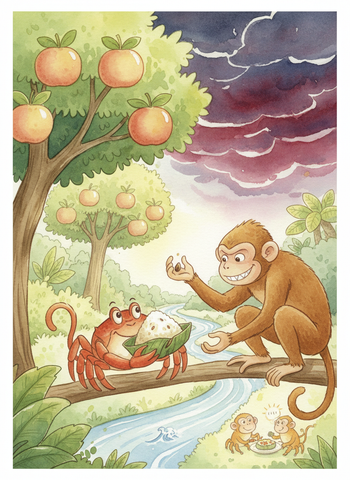
A crab trades her rice-dumpling for a monkey's worthless seed, trusting his promise of future fruit — but greed turns their old friendship into a deadly betrayal.
Long, long ago, one bright autumn day in Japan, it happened, that a pink-faced monkey and a yellow crab were playing together along the bank of a river. As they were running about, the crab found a rice-dumpling and the monkey a persimmon-seed.
Hace mucho, mucho tiempo, un luminoso día de otoño en Japón, sucedió que un mono de cara rosada y un cangrejo amarillo jugaban juntos a la orilla de un río. Mientras correteaban de un lado a otro, el cangrejo encontró una bola de arroz y el mono, una semilla de caqui.
The crab picked up the rice-dumpling and showed it to the monkey, saying:
El cangrejo recogió la bola de arroz y se la mostró al mono, diciendo:
“Look what a nice thing I have found!”
«¡Mira qué cosa tan buena he encontrado!»
Then the monkey held up his persimmon-seed and said:
Entonces el mono levantó su semilla de caqui y dijo:
“I also have found something good! Look!”
«¡Yo también he encontrado algo bueno! ¡Mira!»
Now though the monkey is always very fond of persimmon fruit, he had no use for the seed he had just found. The persimmon-seed is as hard and uneatable as a stone. He, therefore, in his greedy nature, felt very envious of the crab’s nice dumpling, and he proposed an exchange. The crab naturally did not see why he should give up his prize for a hard stone-like seed, and would not consent to the monkey’s proposition.
Aunque al mono le encantaba el fruto del caqui, no tenía ningún uso para la semilla que acababa de encontrar. La semilla de caqui es tan dura e incomible como una piedra. Por eso, con su naturaleza codiciosa, sintió mucha envidia de la buena bola de arroz del cangrejo, y propuso un intercambio. El cangrejo, como es natural, no veía por qué debía renunciar a su premio por una semilla dura como una piedra, y no aceptó la propuesta del mono.
Then the cunning monkey began to persuade the crab, saying:
Entonces el astuto mono empezó a persuadir al cangrejo, diciendo:
“How unwise you are not to think of the future! Your rice-dumpling can be eaten now, and is certainly much bigger than my seed; but if you sow this seed in the ground it will soon grow and become a great tree in a few years, and bear an abundance of fine ripe persimmons year after year. If only I could show it to you then with the yellow fruit hanging on its branches! Of course, if you don’t believe me I shall sow it myself; though I am sure, later on, you will be very sorry that you did not take my advice.”
«¡Qué poco sensato eres al no pensar en el futuro! Tu bola de arroz se puede comer ahora, y desde luego es mucho más grande que mi semilla; pero si siembras esta semilla en la tierra, pronto crecerá y en pocos años se convertirá en un gran árbol, que dará abundantes y hermosos caquis maduros año tras año. ¡Ojalá pudiera enseñártelo entonces, con el fruto amarillo colgando de sus ramas! Por supuesto, si no me crees, la sembraré yo mismo; aunque estoy seguro de que, más adelante, lamentarás mucho no haber seguido mi consejo.»
The simple-minded crab could not resist the monkey’s clever persuasion. He at last gave in and consented to the monkey’s proposal, and the exchange was made. The greedy monkey soon gobbled up the dumpling, and with great reluctance gave up the persimmon-seed to the crab. He would have liked to keep that too, but he was afraid of making the crab angry and of being pinched by his sharp scissor-like claws. They then separated, the monkey going home to his forest trees and the crab to his stones along the river-side. As soon as the crab reached home he put the persimmon-seed in the ground as the monkey had told him.
El ingenuo cangrejo no pudo resistir la hábil persuasión del mono. Al final cedió y aceptó la propuesta del mono, y se hizo el intercambio. El codicioso mono se tragó enseguida la bola de arroz, y con gran desgana entregó la semilla de caqui al cangrejo. Le habría gustado quedarse también con eso, pero temía enfadar al cangrejo y que le pellizcaran sus afiladas tenazas. Después se separaron: el mono volvió a su hogar entre los árboles del bosque, y el cangrejo, a sus piedras junto al río. En cuanto el cangrejo llegó a casa, plantó la semilla de caqui en la tierra, tal como el mono le había dicho.
In the following spring the crab was delighted to see the shoot of a young tree push its way up through the ground. Each year it grew bigger, till at last it blossomed one spring, and in the following autumn bore some fine large persimmons. Among the broad smooth green leaves the fruit hung like golden balls, and as they ripened they mellowed to a deep orange. It was the little crab’s pleasure to go out day by day and sit in the sun and put out his long eyes in the same way as a snail puts out its horn, and watch the persimmons ripening to perfection.
En la primavera siguiente, el cangrejo se alegró mucho al ver que el brote de un árbol joven asomaba por la tierra. Cada año crecía más, hasta que por fin, una primavera, floreció, y en el otoño siguiente dio unos caquis grandes y hermosos. Entre las anchas hojas verdes y lisas, el fruto colgaba como bolas doradas, y a medida que maduraban se volvían de un naranja intenso. Era el placer del pequeño cangrejo salir día tras día a sentarse al sol y sacar sus largos ojos, igual que un caracol saca sus cuernos, para observar cómo maduraban a la perfección los caquis.
“How delicious they will be to eat!” he said to himself.
«¡Qué deliciosos estarán para comer!», se decía a sí mismo.
At last, one day, he knew the persimmons must be quite ripe and he wanted very much to taste one. He made several attempts to climb the tree, in the vain hope of reaching one of the beautiful persimmons hanging above him; but he failed each time, for a crab’s legs are not made for climbing trees but only for running along the ground and over stones, both of which he can do most cleverly. In his dilemma he thought of his old playmate the monkey, who, he knew, could climb trees better than any one else in the world. He determined to ask the monkey to help him, and set out to find him.
Por fin, un día, supo que los caquis debían de estar bien maduros y sintió muchas ganas de probar uno. Hizo varios intentos de trepar al árbol, con la vana esperanza de alcanzar uno de los hermosos caquis que colgaban sobre él; pero fracasó cada vez, pues las patas de un cangrejo no están hechas para trepar árboles, sino solo para correr por el suelo y sobre las piedras, algo que él podía hacer con gran habilidad. En su apuro, pensó en su viejo compañero de juegos, el mono, que, según sabía, podía trepar árboles mejor que nadie en el mundo. Decidió pedirle ayuda al mono, y salió a buscarlo.
Running crab-fashion up the stony river bank, over the pathways into the shadowy forest, the crab at last found the monkey taking an afternoon nap in his favorite pine-tree, with his tail curled tight around a branch to prevent him from falling off in his dreams. He was soon wide awake, however, when he heard himself called, and eagerly listening to what the crab told him. When he heard that the seed which he had long ago exchanged for a rice-dumpling had grown into a tree and was now bearing good fruit, he was delighted, for he at once devised a cunning plan which would give him all the persimmons for himself.
Corriendo a su manera de cangrejo por la orilla pedregosa del río, por los senderos hasta el bosque sombrío, el cangrejo por fin encontró al mono durmiendo la siesta de la tarde en su pino favorito, con la cola bien enroscada alrededor de una rama para no caerse mientras soñaba. Sin embargo, se despertó enseguida al oír que lo llamaban, y escuchó con avidez lo que el cangrejo le contaba. Cuando supo que la semilla que había cambiado hacía tiempo por una bola de arroz se había convertido en un árbol que ahora daba buen fruto, se alegró mucho, pues enseguida ideó un plan astuto para quedarse con todos los caquis para él solo.
He consented to go with the crab to pick the fruit for him. When they both reached the spot, the monkey was astonished to see what a fine tree had sprung from the seed, and with what a number of ripe persimmons the branches were loaded.
Aceptó ir con el cangrejo a recoger el fruto para él. Cuando ambos llegaron al lugar, el mono se asombró al ver qué árbol tan hermoso había brotado de la semilla, y con cuántos caquis maduros estaban cargadas sus ramas.
He quickly climbed the tree and began to pluck and eat, as fast as he could, one persimmon after another. Each time he chose the best and ripest he could find, and went on eating till he could eat no more. Not one would he give to the poor hungry crab waiting below, and when he had finished there was little but the hard, unripe fruit left.
Trepó rápidamente al árbol y empezó a arrancar y comer, tan deprisa como podía, un caqui tras otro. Cada vez elegía el mejor y más maduro que encontraba, y siguió comiendo hasta que no pudo más. No le dio ni uno solo al pobre cangrejo hambriento que esperaba abajo, y cuando terminó, apenas quedaban más que los frutos duros y verdes.
You can imagine the feelings of the poor crab after waiting patiently, for so long as he had done, for the tree to grow and the fruit to ripen, when he saw the monkey devouring all the good persimmons. He was so disappointed that he ran round and round the tree calling to the monkey to remember his promise. The monkey at first took no notice of the crab’s complaints, but at last he picked out the hardest, greenest persimmon he could find and aimed it at the crab’s head.
Pueden imaginarse los sentimientos del pobre cangrejo, que había esperado con tanta paciencia y durante tanto tiempo a que el árbol creciera y el fruto madurara, al ver al mono devorando todos los buenos caquis. Estaba tan decepcionado que corrió una y otra vez alrededor del árbol, gritándole al mono que recordara su promesa. Al principio el mono no hizo caso a las quejas del cangrejo, pero por fin escogió el caqui más duro y más verde que pudo encontrar y lo lanzó contra la cabeza del cangrejo.
The persimmon is as hard as stone when it is unripe. The monkey’s missile struck home and the crab was sorely hurt by the blow. Again and again, as fast as he could pick them, the monkey pulled off the hard persimmons and threw them at the defenseless crab till he dropped dead, covered with wounds all over his body. There he lay a pitiful sight at the foot of the tree he had himself planted.
El caqui, cuando no está maduro, es tan duro como una piedra. El proyectil del mono dio en el blanco, y el cangrejo quedó gravemente herido por el golpe. Una y otra vez, tan deprisa como podía arrancarlos, el mono arrancaba los caquis duros y se los lanzaba al indefenso cangrejo, hasta que este cayó muerto, cubierto de heridas por todo el cuerpo. Allí quedó, un espectáculo lastimoso, al pie del árbol que él mismo había plantado.
When the wicked monkey saw that he had killed the crab he ran away from the spot as fast as he could, in fear and trembling, like a coward as he was.
Cuando el malvado mono vio que había matado al cangrejo, huyó del lugar tan rápido como pudo, temblando de miedo, como el cobarde que era.
Now the crab had a son who had been playing with a friend not far from the spot where this sad work had taken place. On the way home he came across his father dead, in a most dreadful condition—his head was smashed and his shell broken in several places, and around his body lay the unripe persimmons which had done their deadly work. At this dreadful sight the poor young crab sat down and wept.
Ahora bien, el cangrejo tenía un hijo que había estado jugando con un amigo no muy lejos del lugar donde había ocurrido aquella triste desgracia. De camino a casa, se encontró con su padre muerto, en un estado espantoso: la cabeza destrozada y el caparazón roto en varios puntos, y a su alrededor yacían los caquis verdes que habían cumplido su mortal cometido. Ante tan horrible visión, el pobre joven cangrejo se sentó a llorar.
But when he had wept for some time he told himself that this crying would do no good; it was his duty to avenge his father’s murder, and this he determined to do. He looked about for some clue which would lead him to discover the murderer. Looking up at the tree he noticed that the best fruit had gone, and that all around lay bits of peel and numerous seeds strewn on the ground as well as the unripe persimmons which had evidently been thrown at his father.
Pero después de llorar un buen rato, se dijo que aquel llanto no serviría de nada; era su deber vengar el asesinato de su padre, y así lo decidió hacer. Buscó alguna pista que lo llevara a descubrir al asesino. Al mirar hacia el árbol, notó que faltaba el mejor fruto, y que alrededor había trozos de piel y numerosas semillas esparcidas por el suelo, junto con los caquis verdes que evidentemente habían sido lanzados contra su padre.
Then he understood that the monkey was the murderer, for he now remembered that his father had once told him the story of the rice-dumpling and the persimmon-seed. The young crab knew that monkeys liked persimmons above all other fruit, and he felt sure that his greed for the coveted fruit had been the cause of the old crab’s death. Alas!
Entonces comprendió que el mono era el asesino, pues recordó que su padre le había contado una vez la historia de la bola de arroz y la semilla de caqui. El joven cangrejo sabía que a los monos les gustaban los caquis por encima de cualquier otro fruto, y estaba seguro de que la codicia por el fruto anhelado había sido la causa de la muerte del viejo cangrejo. ¡Ay!
He at first thought of going to attack the monkey at once, for he burned with rage. Second thoughts, however, told him that this was useless, for the monkey was an old and cunning animal and would be hard to overcome. He must meet cunning with cunning and ask some of his friends to help him, for he knew it would be quite out of his power to kill him alone.
Al principio pensó en ir a atacar al mono de inmediato, pues ardía de rabia. Pero, pensándolo mejor, comprendió que sería inútil, porque el mono era un animal viejo y astuto, y sería difícil de vencer. Debía enfrentar la astucia con astucia y pedir ayuda a algunos de sus amigos, pues sabía que estaba fuera de su alcance matarlo él solo.
The young crab set out at once to call on the mortar, his father’s old friend, and told him of all that had happened. He besought the mortar with tears to help him avenge his father’s death. The mortar was very sorry when he heard the woful tale and promised at once to help the young crab punish the monkey to death. He warned him that he must be very careful in what he did, for the monkey was a strong and cunning enemy.
El joven cangrejo salió de inmediato a visitar al mortero, viejo amigo de su padre, y le contó todo lo sucedido. Le suplicó entre lágrimas al mortero que lo ayudara a vengar la muerte de su padre. El mortero se entristeció mucho al oír el triste relato, y prometió de inmediato ayudar al joven cangrejo a castigar al mono con la muerte. Le advirtió que debía ser muy prudente en lo que hiciera, pues el mono era un enemigo fuerte y astuto.
The mortar now sent to fetch the bee and the chestnut (also the crab’s old friends) to consult them about the matter. In a short time the bee and the chestnut arrived. When they were told all the details of the old crab’s death and of the monkey’s wickedness and greed, they both gladly consented to help the young crab in his revenge.
El mortero mandó entonces llamar a la abeja y a la castaña (también viejos amigos del cangrejo) para consultarlos sobre el asunto. Al poco rato llegaron la abeja y la castaña. Cuando se les contaron todos los detalles de la muerte del viejo cangrejo y de la maldad y codicia del mono, ambos aceptaron con gusto ayudar al joven cangrejo en su venganza.
After talking for a long time as to the ways and means of carrying out their plans they separated, and Mr. Mortar went home with the young crab to help him bury his poor father.
Después de hablar largo rato sobre la manera y los medios de llevar a cabo sus planes, se separaron, y el señor Mortero volvió a casa con el joven cangrejo para ayudarlo a enterrar a su pobre padre.
While all this was taking place the monkey was congratulating himself (as the wicked often do before their punishment comes upon them) on all he had done so neatly. He thought it quite a fine thing that he had robbed his friend of all his ripe persimmons and then that he had killed him. Still, smile as hard as he might, he could not banish altogether the fear of the consequences should his evil deeds be discovered.
Mientras todo esto sucedía, el mono se felicitaba a sí mismo (como suelen hacer los malvados antes de que les llegue el castigo) por todo lo que había hecho con tanta astucia. Le parecía muy bien haber robado a su amigo todos sus caquis maduros y después haberlo matado. Aun así, por mucho que sonriera, no lograba desterrar del todo el miedo a las consecuencias si se descubrían sus malas acciones.
If he were found out (and he told himself that this could not be for he had escaped unseen) the crab’s family would be sure to bear him hatred and seek to take revenge on him. So he would not go out, and kept himself at home for several days. He found this kind of life, however, extremely dull, accustomed as he was to the free life of the woods, and at last he said:
Si lo descubrieran (y se decía a sí mismo que eso no podía suceder, pues había escapado sin ser visto), la familia del cangrejo sin duda le guardaría rencor y buscaría vengarse de él. Así que no quiso salir, y se quedó en casa durante varios días. Sin embargo, le pareció una vida sumamente aburrida, acostumbrado como estaba a la vida libre del bosque, y al final se dijo:
“No one knows that it was I who killed the crab! I am sure that the old thing breathed his last before I left him. Dead crabs have no mouths! Who is there to tell that I am the murderer? Since no one knows, what is the use of shutting myself up and brooding over the matter? What is done cannot be undone!”
«¡Nadie sabe que fui yo quien mató al cangrejo! Estoy seguro de que el viejo exhaló su último aliento antes de que yo me marchara. ¡Los cangrejos muertos no tienen boca! ¿Quién hay que pueda decir que yo soy el asesino? Ya que nadie lo sabe, ¿de qué sirve encerrarme y darle vueltas al asunto? ¡Lo hecho, hecho está!»
With this he wandered out into the crab settlement and crept about as slyly as possible near the crab’s house and tried to hear the neighbors’ gossip round about. He wanted to find out what the crabs were saving about their chief’s death, for the old crab had been the chief of the tribe. But he heard nothing and said to himself:
Con esto, salió a pasear por el poblado de los cangrejos y se deslizó con la mayor astucia posible cerca de la casa del cangrejo, tratando de escuchar los chismes de los vecinos. Quería averiguar qué decían los cangrejos sobre la muerte de su jefe, pues el viejo cangrejo había sido el jefe de la tribu. Pero no oyó nada, y se dijo a sí mismo:
“They are all such fools that they don’t know and don’t care who murdered their chief!”
«¡Todos son tan tontos que ni siquiera saben ni les importa quién asesinó a su jefe!»
Little did he know in his so-called “monkey’s wisdom” that this seeming unconcern was part of the young crab’s plan. He purposely pretended not to know who killed his father, and also to believe that he had met his death through his own fault. By this means he could the better keep secret the revenge on the monkey, which he was meditating.
Poco sabía él, en su llamada «sabiduría de mono», que aquella aparente indiferencia formaba parte del plan del joven cangrejo. Este fingía a propósito no saber quién había matado a su padre, y también hacer creer que su muerte se debía a su propia culpa. De este modo podía guardar mejor en secreto la venganza contra el mono, que ya estaba maquinando.
So the monkey returned home from his walk quite content. He told himself he had nothing now to fear.
Así que el mono volvió a casa de su paseo bastante satisfecho. Se dijo que ya no tenía nada que temer.
One fine day, when the monkey was sitting at home, he was surprised by the appearance of a messenger from the young crab. While he was wondering what this might mean, the messenger bowed before him and said:
Un buen día, mientras el mono estaba sentado en casa, se sorprendió al ver aparecer a un mensajero enviado por el joven cangrejo. Mientras se preguntaba qué podría significar aquello, el mensajero se inclinó ante él y dijo:
“I have been sent by my master to inform you that his father died the other day in falling from a persimmon tree while trying to climb the tree after fruit. This, being the seventh day, is the first anniversary after his death, and my master has prepared a little festival in his father’s honor, and bids you come to participate in it as you were one of his best friends. My master hopes you will honor his house with your kind visit.”
«Mi amo me ha enviado a informarle de que su padre murió el otro día al caer de un caqui mientras trataba de trepar al árbol en busca de fruta. Como este es el séptimo día, hoy se cumple el primer aniversario de su muerte, y mi amo ha preparado un pequeño festejo en honor de su padre, y le pide que venga a participar, ya que usted era uno de sus mejores amigos. Mi amo espera que honre su casa con su amable visita.»
When the monkey heard these words he rejoiced in his inmost heart, for all his fears of being suspected were now at rest. He could not guess that a plot had just been set in motion against him. He pretended to be very surprised at the news of the crab’s death, and said:
Cuando el mono oyó estas palabras, se alegró en lo más profundo de su corazón, pues todos sus temores de ser sospechoso quedaban ahora disipados. No podía imaginar que ya se había puesto en marcha un plan contra él. Fingió estar muy sorprendido por la noticia de la muerte del cangrejo, y dijo:
“I am, indeed, very sorry to hear of your chief’s death. We were great friends as you know. I remember that we once exchanged a rice-dumpling for a persimmon-seed. It grieves me much to think that that seed was in the end the cause of his death. I accept your kind invitation with many thanks. I shall be delighted to do honor to my poor old friend!” And he screwed some false tears from his eyes.
«En verdad, lamento mucho oír de la muerte de su jefe. Éramos grandes amigos, como bien sabe. Recuerdo que una vez intercambiamos una bola de arroz por una semilla de caqui. Me apena mucho pensar que aquella semilla acabó siendo la causa de su muerte. Acepto su amable invitación con mucho agradecimiento. ¡Será un placer honrar a mi pobre viejo amigo!» Y se arrancó unas lágrimas falsas de los ojos.
The messenger laughed inwardly and thought, “The wicked monkey is now dropping false tears, but within a short time he shall shed real ones.” But aloud he thanked the monkey politely and went home.
El mensajero rio para sus adentros y pensó: «El malvado mono ahora derrama lágrimas falsas, pero dentro de poco derramará lágrimas de verdad.» Pero en voz alta le dio las gracias cortésmente al mono y volvió a casa.
When he had gone, the wicked monkey laughed aloud at what he thought was the young crab’s innocence, and without the least feeling began to look forward to the feast to be held that day in honor of the dead crab, to which he had been invited. He changed his dress and set out solemnly to visit the young crab.
Cuando el mensajero se marchó, el malvado mono rio a carcajadas ante lo que creía la inocencia del joven cangrejo, y sin el menor remordimiento empezó a esperar con ilusión el festejo que se celebraría ese día en honor del cangrejo muerto, al que había sido invitado. Cambió de ropa y salió solemnemente a visitar al joven cangrejo.
He found all the members of the crab’s family and his relatives waiting to receive and welcome him. As soon as the bows of meeting were over they led him to a hall. Here the young chief mourner came to receive him. Expressions of condolence and thanks were exchanged between them, and then they all sat down to a luxurious feast and entertained the monkey as the guest of honor.
Encontró a todos los miembros de la familia del cangrejo y a sus parientes esperando para recibirlo y darle la bienvenida. En cuanto terminaron las reverencias de saludo, lo condujeron a un salón. Allí, el joven doliente principal acudió a recibirlo. Intercambiaron expresiones de condolencia y agradecimiento, y luego todos se sentaron a un banquete espléndido y agasajaron al mono como invitado de honor.
The feast over, he was next invited to the tea-ceremony room to drink a cup of tea. When the young crab had conducted the monkey to the tearoom he left him and retired. Time passed and still he did not return. At last the monkey became impatient. He said to himself:
Terminado el banquete, lo invitaron a continuación a la sala de la ceremonia del té para tomar una taza. Cuando el joven cangrejo hubo conducido al mono hasta la sala de té, lo dejó allí y se retiró. Pasó el tiempo y aún no volvía. Por fin el mono se impacientó. Se dijo a sí mismo:
“This tea ceremony is always a very slow affair. I am tired of waiting so long. I am very thirsty after drinking so much sake at the dinner!”
«Esta ceremonia del té siempre es un asunto muy lento. Estoy cansado de esperar tanto. ¡Tengo mucha sed después de beber tanto sake en la cena!»
He then approached the charcoal fire-place and began to pour out some hot water from the kettle boiling there, when something burst out from the ashes with a great pop and hit the monkey right in the neck. It was the chestnut, one of the crab’s friends, who had hidden himself in the fireplace. The monkey, taken by surprise, jumped backward, and then started to run out of the room.
Entonces se acercó al brasero de carbón y empezó a servirse agua caliente de la tetera que hervía allí, cuando algo saltó de las cenizas con un gran estallido y golpeó al mono justo en el cuello. Era la castaña, uno de los amigos del cangrejo, que se había escondido en el brasero. El mono, sorprendido, dio un salto hacia atrás, y luego echó a correr fuera de la sala.
The bee, who was hiding outside the screens, now flew out and stung him on the cheek. The monkey was in great pain, his neck was burned by the chestnut and his face badly stung by the bee, but he ran on screaming and chattering with rage.
La abeja, que se había escondido fuera de los biombos, salió volando y lo picó en la mejilla. El mono sentía un dolor terrible; el cuello le ardía por la castaña y la cara le dolía por la picadura de la abeja, pero siguió corriendo, gritando y castañeteando de rabia.
Now the stone mortar had hidden himself with several other stones on the top of the crab’s gate, and as the monkey ran underneath, the mortar and all fell down on the top of the monkey’s head. Was it possible for the monkey to bear the weight of the mortar falling on him from the top of the gate? He lay crushed and in great pain, quite unable to get up. As he lay there helpless the young crab came up, and, holding his great claw scissors over the monkey, he said:
Ahora bien, el mortero de piedra se había escondido junto con varias otras piedras encima de la puerta del cangrejo, y cuando el mono pasó corriendo por debajo, el mortero y todo lo demás cayeron sobre su cabeza. ¿Cómo iba el mono a soportar el peso del mortero cayendo sobre él desde lo alto de la puerta? Quedó aplastado y con un dolor terrible, incapaz de levantarse. Mientras yacía allí indefenso, el joven cangrejo se acercó y, sosteniendo sus grandes tenazas sobre el mono, dijo:
“Do you now remember that you murdered my father?”
«¿Recuerdas ahora que asesinaste a mi padre?»
“Then you—are—my—enemy?” gasped the monkey brokenly.
«Entonces… ¿tú… eres… mi… enemigo?», jadeó el mono entrecortadamente.
“Of course,” said the young crab.
«Por supuesto», dijo el joven cangrejo.
“It—was—your—father’s—fault—not—mine!” gasped the unrepentant monkey.
«¡Fue… culpa… de… tu… padre…, no… mía!», jadeó el mono, sin ningún arrepentimiento.
“Can you still lie? I will soon put an end to your breath!” and with that he cut off the monkey’s head with his pitcher claws. Thus the wicked monkey met his well-merited punishment, and the young crab avenged his father’s death.
«¿Todavía puedes mentir? ¡Pronto pondré fin a tu aliento!» Y con esas palabras le cortó la cabeza al mono con sus tenazas afiladas. Así el malvado mono recibió el castigo que merecía, y el joven cangrejo vengó la muerte de su padre.
This is the end of the story of the monkey, the crab, and the persimmon-seed.
Aquí termina la historia del mono, el cangrejo y la semilla de caqui.
