The Piece of String
A free B2-level English story for language learners, readable online in 7 languages, with an option to listen via the free Storyteller app.
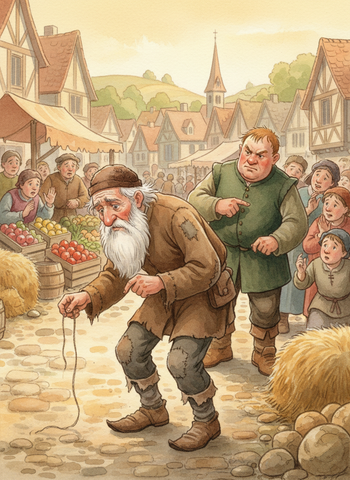
When a frugal old peasant is seen stooping to pick up a scrap of string, a rival's cruel guess brands him a thief — and no matter how loudly he protests, no one will believe the truth.
It was market-day, and from all the country round Goderville the peasants and their wives were coming toward the town. The men walked slowly, throwing the whole body forward at every step of their long, crooked legs. They were deformed from pushing the plough which makes the left-shoulder higher, and bends their figures side-ways; from reaping the grain, when they have to spread their legs so as to keep on their feet. Their starched blue blouses, glossy as though varnished, ornamented at collar and cuffs with a little embroidered design and blown out around their bony bodies, looked very much like balloons about to soar, whence issued two arms and two feet.
Era día de mercado, y desde todo el campo alrededor de Goderville los campesinos y sus esposas venían hacia el pueblo. Los hombres caminaban despacio, arrojando todo el cuerpo hacia adelante a cada paso de sus piernas largas y torcidas. Estaban deformados de tanto empujar el arado, lo que les levanta el hombro izquierdo y les tuerce la figura de costado; de tanto segar el grano, cuando tienen que separar las piernas para mantenerse en pie. Sus blusas azules almidonadas, brillantes como si estuvieran barnizadas, adornadas en cuello y puños con un pequeño diseño bordado e hinchadas alrededor de sus cuerpos huesudos, se parecían mucho a globos a punto de elevarse, de los cuales salían dos brazos y dos pies.
Some of these fellows dragged a cow or a calf at the end of a rope. And just behind the animal followed their wives beating it over the back with a leaf-covered branch to hasten its pace, and carrying large baskets out of which protruded the heads of chickens or ducks. These women walked more quickly and energetically than the men, with their erect, dried-up figures, adorned with scanty little shawls pinned over their flat bosoms, and their heads wrapped round with a white cloth, enclosing the hair and surmounted by a cap.
Algunos de estos hombres arrastraban una vaca o un ternero al final de una cuerda. Y justo detrás del animal seguían sus esposas, golpeándolo en el lomo con una rama cubierta de hojas para apurar su paso, y cargando grandes cestas de las que asomaban las cabezas de gallinas o patos. Estas mujeres caminaban más rápido y con más energía que los hombres, con sus figuras erguidas y resecas, adornadas con escasos chalecitos prendidos sobre sus pechos planos, y la cabeza envuelta en un paño blanco, que les cubría el cabello y estaba coronado por una cofia.
Now a char-a-banc passed by, jogging along behind a nag and shaking up strangely the two men on the seat, and the woman at the bottom of the cart who held fast to its sides to lessen the hard jolting.
Ahora pasaba un char-a-banc, traqueteando tras un jamelgo y sacudiendo extrañamente a los dos hombres del asiento, y a la mujer en el fondo del carro que se aferraba a los costados para amortiguar los duros tumbos.
In the market-place at Goderville was a great crowd, a mingled multitude of men and beasts. The horns of cattle, the high, long-napped hats of wealthy peasants, the head-dresses of the women came to the surface of that sea. And the sharp, shrill, barking voices made a continuous, wild din, while above it occasionally rose a huge burst of laughter from the sturdy lungs of a merry peasant or a prolonged bellow from a cow tied fast to the wall of a house.
En la plaza del mercado de Goderville había una gran multitud, una muchedumbre mezclada de hombres y bestias. Los cuernos del ganado, los altos sombreros de pelo largo de los campesinos acomodados, los tocados de las mujeres asomaban a la superficie de aquel mar. Y las voces agudas, chillonas, ladradoras, formaban un estruendo continuo y salvaje, mientras por encima se alzaba de vez en cuando una gran carcajada de los pulmones robustos de algún campesino alegre, o el mugido prolongado de una vaca atada firmemente a la pared de una casa.
It all smelled of the stable, of milk, of hay and of perspiration, giving off that half-human, half-animal odor which is peculiar to country folks.
Todo olía a establo, a leche, a heno y a sudor, desprendiendo ese olor medio humano, medio animal, propio de la gente del campo.
Maitre Hauchecorne, of Breaute, had just arrived at Goderville and was making his way toward the square when he perceived on the ground a little piece of string. Maitre Hauchecorne, economical as are all true Normans, reflected that everything was worth picking up which could be of any use, and he stooped down, but painfully, because he suffered from rheumatism. He took the bit of thin string from the ground and was carefully preparing to roll it up when he saw Maitre Malandain, the harness maker, on his doorstep staring at him. They had once had a quarrel about a halter, and they had borne each other malice ever since.
Maese Hauchecorne, de Bréauté, acababa de llegar a Goderville y se dirigía hacia la plaza cuando divisó en el suelo un pequeño trozo de cuerda. Maese Hauchecorne, económico como son todos los verdaderos normandos, reflexionó que todo lo que pudiera servir para algo valía la pena recogerlo, y se agachó, aunque con dolor, pues sufría de reumatismo. Tomó del suelo el pedacito de cuerda delgada y se preparaba con cuidado a enrollarlo cuando vio a maese Malandain, el guarnicionero, en la puerta de su casa, mirándolo fijamente. Habían tenido en su día una disputa por un ronzal, y desde entonces se guardaban rencor mutuo.
Maitre Hauchecorne was overcome with a sort of shame at being seen by his enemy picking up a bit of string in the road. He quickly hid it beneath his blouse and then slipped it into his breeches, pocket, then pretended to be still looking for something on the ground which he did not discover and finally went off toward the market-place, his head bent forward and his body almost doubled in two by rheumatic pains.
A maese Hauchecorne lo invadió una especie de vergüenza al ser visto por su enemigo recogiendo un trozo de cuerda del camino. Rápidamente lo escondió bajo la blusa y luego lo deslizó en el bolsillo de sus pantalones, y después fingió seguir buscando algo en el suelo que no lograba encontrar, y por fin se dirigió hacia la plaza del mercado, con la cabeza inclinada hacia adelante y el cuerpo casi doblado en dos por los dolores reumáticos.
He was at once lost in the crowd, which kept moving about slowly and noisily as it chaffered and bargained. The peasants examined the cows, went off, came back, always in doubt for fear of being cheated, never quite daring to decide, looking the seller square in the eye in the effort to discover the tricks of the man and the defect in the beast.
De inmediato se perdió entre la multitud, que seguía moviéndose despacio y ruidosamente mientras regateaba y negociaba. Los campesinos examinaban las vacas, se alejaban, volvían, siempre dudando por miedo a que los engañaran, sin atreverse nunca del todo a decidirse, mirando al vendedor directo a los ojos en un esfuerzo por descubrir las trampas del hombre y los defectos de la bestia.
The women, having placed their great baskets at their feet, had taken out the poultry, which lay upon the ground, their legs tied together, with terrified eyes and scarlet combs.
Las mujeres, tras haber puesto sus grandes cestas a sus pies, habían sacado las aves de corral, que yacían sobre el suelo, con las patas atadas, los ojos aterrados y las crestas escarlatas.
They listened to propositions, maintaining their prices in a decided manner with an impassive face or perhaps deciding to accept the smaller price offered, suddenly calling out to the customer who was starting to go away:
Escuchaban las propuestas, manteniendo sus precios con firmeza y rostro impasible, o quizás decidiendo aceptar la oferta más baja, y de pronto llamaban al comprador que empezaba a alejarse:
“All right, I'll let you have them, Mait' Anthime.”
—Está bien, se las dejo, maese Anthime.
Then, little by little, the square became empty, and when the Angelus struck midday those who lived at a distance poured into the inns.
Luego, poco a poco, la plaza se fue vaciando, y cuando el Ángelus tocó al mediodía, los que vivían lejos se agolparon en las posadas.
At Jourdain's the great room was filled with eaters, just as the vast court was filled with vehicles of every sort—wagons, gigs, chars-a- bancs, tilburies, innumerable vehicles which have no name, yellow with mud, misshapen, pieced together, raising their shafts to heaven like two arms, or it may be with their nose on the ground and their rear in the air.
En lo de Jourdain, la gran sala estaba llena de comensales, tal como el vasto patio estaba lleno de vehículos de toda clase: carretas, calesas, char-a-bancs, tílburis, innumerables vehículos que no tienen nombre, amarillos de barro, deformes, remendados, alzando sus varales al cielo como dos brazos, o quizás con el morro en el suelo y la trasera al aire.
Just opposite to where the diners were at table the huge fireplace, with its bright flame, gave out a burning heat on the backs of those who sat at the right. Three spits were turning, loaded with chickens, with pigeons and with joints of mutton, and a delectable odor of roast meat and of gravy flowing over crisp brown skin arose from the hearth, kindled merriment, caused mouths to water.
Justo frente a donde comían los comensales, la enorme chimenea, con su llama brillante, despedía un calor abrasador sobre las espaldas de los que se sentaban a la derecha. Tres asadores giraban, cargados de pollos, palomas y trozos de carnero, y un delicioso olor a carne asada y a jugo que corría sobre piel crujiente y dorada se elevaba desde el hogar, encendía la alegría, hacía que a todos se les hiciera agua la boca.
All the aristocracy of the plough were eating there at Mait' Jourdain's, the innkeeper's, a dealer in horses also and a sharp fellow who had made a great deal of money in his day.
Toda la aristocracia del arado comía allí, en lo de maese Jourdain, el posadero, tratante de caballos también, y hombre astuto que había ganado mucho dinero en su vida.
The dishes were passed round, were emptied, as were the jugs of yellow cider. Every one told of his affairs, of his purchases and his sales. They exchanged news about the crops. The weather was good for greens, but too wet for grain.
Los platos circulaban, se vaciaban, igual que las jarras de sidra amarilla. Cada cual contaba sus asuntos, sus compras y sus ventas. Intercambiaban noticias sobre las cosechas. El tiempo era bueno para las verduras, pero demasiado húmedo para el grano.
Suddenly the drum began to beat in the courtyard before the house. Every one, except some of the most indifferent, was on their feet at once and ran to the door, to the windows, their mouths full and napkins in their hand.
De pronto empezó a redoblar el tambor en el patio frente a la casa. Todos, salvo algunos de los más indiferentes, se levantaron de un salto y corrieron hacia la puerta, hacia las ventanas, con la boca llena y las servilletas en la mano.
When the public crier had finished his tattoo he called forth in a jerky voice, pausing in the wrong places:
Cuando el pregonero público terminó su redoble, gritó con voz entrecortada, haciendo pausas en los lugares equivocados:
“Be it known to the inhabitants of Goderville and in general to all persons present at the market that there has been lost this morning on the Beuzeville road, between nine and ten o'clock, a black leather pocketbook containing five hundred francs and business papers. You are requested to return it to the mayor's office at once or to Maitre Fortune Houlbreque, of Manneville. There will be twenty francs reward.”
—Sépase por los habitantes de Goderville y, en general, por todas las personas presentes en el mercado, que se ha perdido esta mañana, en el camino de Beuzeville, entre las nueve y las diez, una cartera de cuero negro que contenía quinientos francos y documentos de negocios. Se ruega devolverla de inmediato a la alcaldía o a maese Fortuné Houlbrèque, de Manneville. Habrá una recompensa de veinte francos.
Then the man went away. They heard once more at a distance the dull beating of the drum and the faint voice of the crier. Then they all began to talk of this incident, reckoning up the chances which Maitre Houlbreque had of finding or of not finding his pocketbook again.
Entonces el hombre se marchó. Volvieron a oír a lo lejos el redoble sordo del tambor y la voz débil del pregonero. Entonces todos empezaron a hablar de este incidente, calculando las posibilidades que tenía maese Houlbrèque de encontrar, o de no encontrar, su cartera de nuevo.
The meal went on. They were finishing their coffee when the corporal of gendarmes appeared on the threshold.
La comida continuó. Terminaban su café cuando el cabo de gendarmes apareció en el umbral.
He asked:
Preguntó:
“Is Maitre Hauchecorne, of Breaute, here?”
—¿Está aquí maese Hauchecorne, de Bréauté?
Maitre Hauchecorne, seated at the other end of the table answered:
Maese Hauchecorne, sentado al otro extremo de la mesa, respondió:
“Here I am, here I am.”
—Aquí estoy, aquí estoy.
And he followed the corporal.
Y siguió al cabo.
The mayor was waiting for him, seated in an armchair. He was the notary of the place, a tall, grave man of pompous speech.
El alcalde lo esperaba, sentado en un sillón. Era el notario del lugar, un hombre alto y grave, de discurso pomposo.
“Maitre Hauchecorne,” said he, “this morning on the Beuzeville road, you were seen to pick up the pocketbook lost by Maitre Houlbreque, of Manneville.”
—Maese Hauchecorne —dijo—, esta mañana, en el camino de Beuzeville, lo vieron recoger la cartera perdida por maese Houlbrèque, de Manneville.
The countryman looked at the mayor in amazement frightened already at this suspicion which rested on him, he knew not why.
El campesino miró al alcalde con asombro, ya asustado por esta sospecha que recaía sobre él, sin saber por qué.
“I—I picked up that pocketbook?”
—¿Yo… yo recogí esa cartera?
“Yes, YOU.”
—Sí, USTED.
“I swear I don't even know anything about it.”
—Juro que ni siquiera sé nada de eso.
“You were seen.”
—Lo vieron.
“I was seen—I? Who saw me?”
—¿Me vieron a mí? ¿Quién me vio?
“M. Malandain, the harness-maker.”
—El señor Malandain, el guarnicionero.
Then the old man remembered, understood, and, reddening with anger, said:
Entonces el anciano recordó, comprendió, y, enrojeciendo de ira, dijo:
“Ah! he saw me, did he, the rascal? He saw me picking up this string here, M'sieu le Maire.”
—¡Ah! ¿Así que me vio, el muy bribón? Me vio recoger esta cuerda de aquí, señor alcalde.
And fumbling at the bottom of his pocket, he pulled out of it the little end of string.
Y hurgando en el fondo de su bolsillo, sacó de él el pequeño cabo de cuerda.
But the mayor incredulously shook his head:
Pero el alcalde negó incrédulo con la cabeza:
“You will not make me believe, Maitre Hauchecorne, that M. Malandain, who is a man whose word can be relied on, has mistaken this string for a pocketbook.”
—No me hará usted creer, maese Hauchecorne, que el señor Malandain, hombre cuya palabra es de fiar, haya confundido esta cuerda con una cartera.
The peasant, furious, raised his hand and spat on the ground beside him as if to attest his good faith, repeating:
El campesino, furioso, alzó la mano y escupió al suelo a su lado, como para dar fe de su buena fe, repitiendo:
“For all that, it is God's truth, M'sieu le Maire. There! On my soul's salvation, I repeat it.”
—Aun así, es la pura verdad de Dios, señor alcalde. ¡Ahí lo tiene! Por la salvación de mi alma, se lo repito.
The mayor continued:
El alcalde continuó:
“After you picked up the object in question, you even looked about for some time in the mud to see if a piece of money had not dropped out of it.”
—Después de recoger el objeto en cuestión, hasta anduvo un rato buscando en el barro, a ver si no se le había caído alguna moneda.
The good man was choking with indignation and fear.
El buen hombre se ahogaba de indignación y de miedo.
“How can they tell—how can they tell such lies as that to slander an honest man! How can they?”
—¿Cómo pueden… cómo pueden decir semejantes mentiras para calumniar a un hombre honesto? ¿Cómo pueden?
His protestations were in vain; he was not believed.
Sus protestas fueron en vano; no le creyeron.
He was confronted with M. Malandain, who repeated and sustained his testimony. They railed at one another for an hour. At his own request Maitre Hauchecorne was searched. Nothing was found on him.
Lo confrontaron con el señor Malandain, quien repitió y sostuvo su testimonio. Se insultaron mutuamente durante una hora. A petición propia, registraron a maese Hauchecorne. No encontraron nada en él.
At last the mayor, much perplexed, sent him away, warning him that he would inform the public prosecutor and ask for orders.
Al fin el alcalde, muy perplejo, lo despidió, advirtiéndole que informaría al fiscal y pediría instrucciones.
The news had spread. When he left the mayor's office the old man was surrounded, interrogated with a curiosity which was serious or mocking, as the case might be, but into which no indignation entered. And he began to tell the story of the string. They did not believe him. They laughed.
La noticia se había difundido. Al salir de la alcaldía, el anciano se vio rodeado, interrogado con una curiosidad que era seria o burlona, según el caso, pero en la que no entraba indignación alguna. Y él se puso a contar la historia de la cuerda. No le creyeron. Se rieron.
He passed on, buttonholed by every one, himself buttonholing his acquaintances, beginning over and over again his tale and his protestations, showing his pockets turned inside out to prove that he had nothing in them.
Siguió su camino, abordado por todos, él mismo abordando a sus conocidos, empezando una y otra vez su relato y sus protestas, mostrando sus bolsillos vueltos del revés para probar que no tenía nada en ellos.
They said to him:
Le decían:
“You old rogue!”
—¡Viejo pícaro!
He grew more and more angry, feverish, in despair at not being believed, and kept on telling his story.
Se enojaba cada vez más, febril, desesperado por no ser creído, y seguía contando su historia.
The night came. It was time to go home. He left with three of his neighbors, to whom he pointed out the place where he had picked up the string, and all the way he talked of his adventure.
Llegó la noche. Era hora de volver a casa. Se fue con tres de sus vecinos, a quienes les señaló el lugar donde había recogido la cuerda, y todo el camino habló de su aventura.
That evening he made the round of the village of Breaute for the purpose of telling every one. He met only unbelievers.
Esa noche recorrió el pueblo de Bréauté con el propósito de contárselo a todos. Solo encontró incrédulos.
He brooded over it all night long.
Se lo pasó rumiando toda la noche.
The next day, about one in the afternoon, Marius Paumelle, a farm hand of Maitre Breton, the market gardener at Ymauville, returned the pocketbook and its contents to Maitre Holbreque, of Manneville.
Al día siguiente, alrededor de la una de la tarde, Marius Paumelle, un peón de la granja de maese Breton, el hortelano de Ymauville, devolvió la cartera y su contenido a maese Houlbrèque, de Manneville.
This man said, indeed, that he had found it on the road, but not knowing how to read, he had carried it home and given it to his master.
Este hombre dijo, en efecto, que la había encontrado en el camino, pero que, al no saber leer, la había llevado a su casa y se la había entregado a su patrón.
The news spread to the environs. Maitre Hauchecorne was informed. He started off at once and began to relate his story with the denoument. He was triumphant.
La noticia se difundió por los alrededores. Informaron a maese Hauchecorne. Salió de inmediato y comenzó a relatar su historia con el desenlace incluido. Estaba triunfante.
“What grieved me,” said he, “was not the thing itself, do you understand, but it was being accused of lying. Nothing does you so much harm as being in disgrace for lying.”
—Lo que me apenaba —dijo— no era la cosa en sí, ¿entiende usted?, sino que me acusaran de mentir. Nada le hace tanto daño a uno como quedar en desgracia por mentiroso.
All day he talked of his adventure. He told it on the roads to the people who passed, at the cabaret to the people who drank and next Sunday when they came out of church. He even stopped strangers to tell them about it. He was easy now, and yet something worried him without his knowing exactly what it was. People had a joking manner while they listened. They did not seem convinced. He seemed to feel their remarks behind his back.
Todo el día habló de su aventura. La contó en los caminos a la gente que pasaba, en la taberna a la gente que bebía, y el domingo siguiente cuando salían de la iglesia. Hasta detenía a los desconocidos para contárselo. Estaba tranquilo ahora, y sin embargo algo lo preocupaba sin que supiera exactamente qué era. La gente tenía un aire burlón mientras lo escuchaba. No parecían convencidos. Le parecía sentir sus comentarios a sus espaldas.
On Tuesday of the following week he went to market at Goderville, prompted solely by the need of telling his story.
El martes de la semana siguiente fue al mercado de Goderville, movido únicamente por la necesidad de contar su historia.
Malandain, standing on his doorstep, began to laugh as he saw him pass. Why?
Malandain, de pie en la puerta de su casa, se echó a reír al verlo pasar. ¿Por qué?
He accosted a farmer of Criquetot, who did not let him finish, and giving him a punch in the pit of the stomach cried in his face: “Oh, you great rogue!” Then he turned his heel upon him.
Abordó a un granjero de Criquetot, quien no lo dejó terminar, y dándole un puñetazo en la boca del estómago le gritó en la cara: "¡Ah, gran pícaro!". Luego le dio la espalda.
Maitre Hauchecorne remained speechless and grew more and more uneasy. Why had they called him “great rogue”?
Maese Hauchecorne se quedó mudo y cada vez más inquieto. ¿Por qué lo habían llamado "gran pícaro"?
When seated at table in Jourdain's tavern he began again to explain the whole affair.
Cuando se sentó a la mesa en la taberna de Jourdain, comenzó de nuevo a explicar todo el asunto.
A horse dealer of Montivilliers shouted at him:
Un tratante de caballos de Montivilliers le gritó:
“Get out, get out, you old scamp! I know all about your old string.”
—¡Fuera, fuera, viejo bribón! Ya sé todo sobre su famosa cuerda.
Hauchecorne stammered:
Hauchecorne balbuceó:
“But since they found it again, the pocketbook!”
—¡Pero si la encontraron de nuevo, la cartera!
But the other continued:
Pero el otro continuó:
“Hold your tongue, daddy; there's one who finds it and there's another who returns it. And no one the wiser.”
—Cállese, abuelo; uno la encuentra y otro la devuelve. Y nadie se entera de nada.
The farmer was speechless. He understood at last. They accused him of having had the pocketbook brought back by an accomplice, by a confederate.
El campesino se quedó sin habla. Por fin comprendió. Lo acusaban de haber hecho devolver la cartera por un cómplice, por un confederado.
He tried to protest. The whole table began to laugh.
Trató de protestar. Toda la mesa se echó a reír.
He could not finish his dinner, and went away amid a chorus of jeers.
No pudo terminar su cena, y se fue en medio de un coro de burlas.
He went home indignant, choking with rage, with confusion, the more cast down since with his Norman craftiness he was, perhaps, capable of having done what they accused him of and even of boasting of it as a good trick. He was dimly conscious that it was impossible to prove his innocence, his craftiness being so well known. He felt himself struck to the heart by the injustice of the suspicion.
Volvió a casa indignado, ahogándose de rabia, de confusión, aún más abatido pues, con su astucia normanda, quizás habría sido capaz de hacer lo que le acusaban e incluso de jactarse de ello como de una buena treta. Vagamente era consciente de que le resultaba imposible probar su inocencia, tan conocida era su astucia. Se sintió herido en el corazón por la injusticia de la sospecha.
He began anew to tell his tale, lengthening his recital every day, each day adding new proofs, more energetic declarations and more sacred oaths, which he thought of, which he prepared in his hours of solitude, for his mind was entirely occupied with the story of the string. The more he denied it, the more artful his arguments, the less he was believed.
Empezó de nuevo a contar su relato, alargándolo cada día, añadiendo cada día nuevas pruebas, declaraciones más enérgicas y juramentos más sagrados, que pensaba, que preparaba en sus horas de soledad, pues su mente estaba enteramente ocupada con la historia de la cuerda. Cuanto más lo negaba, más ingeniosos sus argumentos, menos le creían.
“Those are liars proofs,” they said behind his back.
—Esas son pruebas de embustero —decían a sus espaldas.
He felt this. It preyed upon him and he exhausted himself in useless efforts.
Él lo sentía. Lo consumía, y se agotaba en esfuerzos inútiles.
He was visibly wasting away.
Se iba consumiendo visiblemente.
Jokers would make him tell the story of “the piece of string” to amuse them, just as you make a soldier who has been on a campaign tell his story of the battle. His mind kept growing weaker and about the end of December he took to his bed.
Los bromistas lo hacían contar la historia de "el pedazo de cuerda" para divertirse, tal como se hace contar a un soldado que estuvo en campaña la historia de la batalla. Su mente se iba debilitando cada vez más, y hacia fines de diciembre se metió en cama.
He passed away early in January, and, in the ravings of death agony, he protested his innocence, repeating:
Falleció a principios de enero, y, en el delirio de la agonía, protestaba su inocencia, repitiendo:
“A little bit of string—a little bit of string. See, here it is, M'sieu le Maire.”
—Un pedacito de cuerda… un pedacito de cuerda. Mire, aquí está, señor alcalde.
