The Piece of String
A free B2-level English story for language learners, readable online in 7 languages, with an option to listen via the free Storyteller app.
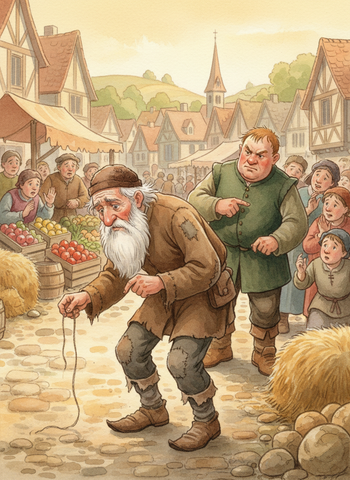
When a frugal old peasant is seen stooping to pick up a scrap of string, a rival's cruel guess brands him a thief — and no matter how loudly he protests, no one will believe the truth.
It was market-day, and from all the country round Goderville the peasants and their wives were coming toward the town. The men walked slowly, throwing the whole body forward at every step of their long, crooked legs. They were deformed from pushing the plough which makes the left-shoulder higher, and bends their figures side-ways; from reaping the grain, when they have to spread their legs so as to keep on their feet. Their starched blue blouses, glossy as though varnished, ornamented at collar and cuffs with a little embroidered design and blown out around their bony bodies, looked very much like balloons about to soar, whence issued two arms and two feet.
Hari itu adalah hari pasar, dan dari seluruh pelosok negeri di sekitar Goderville para petani dan istri-istri mereka berdatangan menuju kota. Para lelaki berjalan perlahan, mendorong seluruh tubuh mereka ke depan di setiap langkah kaki mereka yang panjang dan bengkok. Mereka menjadi bungkuk karena mendorong bajak yang membuat bahu kiri lebih tinggi, dan membengkokkan tubuh mereka ke samping; karena menuai gandum, ketika mereka harus merenggangkan kaki agar tetap berdiri. Blus biru mereka yang berkanji, mengilap seolah dipernis, dihiasi di kerah dan manset dengan sedikit sulaman dan menggelembung di sekeliling tubuh mereka yang bertulang, tampak sangat mirip balon-balon yang hendak melayang, dari mana muncul dua lengan dan dua kaki.
Some of these fellows dragged a cow or a calf at the end of a rope. And just behind the animal followed their wives beating it over the back with a leaf-covered branch to hasten its pace, and carrying large baskets out of which protruded the heads of chickens or ducks. These women walked more quickly and energetically than the men, with their erect, dried-up figures, adorned with scanty little shawls pinned over their flat bosoms, and their heads wrapped round with a white cloth, enclosing the hair and surmounted by a cap.
Beberapa dari orang-orang ini menyeret seekor sapi atau anak sapi di ujung seutas tali. Dan tepat di belakang binatang itu mengikuti istri-istri mereka yang memukuli punggungnya dengan sebatang ranting berdaun untuk mempercepat langkahnya, dan membawa keranjang-keranjang besar yang di dalamnya menonjol kepala ayam atau bebek. Para perempuan ini berjalan lebih cepat dan bertenaga daripada para lelaki, dengan tubuh mereka yang tegak dan kurus, dihiasi selendang-selendang kecil yang tipis disematkan di atas dada mereka yang rata, dan kepala mereka dibalut kain putih, membungkus rambut dan ditutupi topi kecil.
Now a char-a-banc passed by, jogging along behind a nag and shaking up strangely the two men on the seat, and the woman at the bottom of the cart who held fast to its sides to lessen the hard jolting.
Kini sebuah kereta char-a-banc lewat, berguncang-guncang di belakang seekor kuda dan mengguncang dengan aneh kedua lelaki di kursinya, serta perempuan di dasar kereta yang berpegangan erat pada sisinya untuk mengurangi guncangan keras itu.
In the market-place at Goderville was a great crowd, a mingled multitude of men and beasts. The horns of cattle, the high, long-napped hats of wealthy peasants, the head-dresses of the women came to the surface of that sea. And the sharp, shrill, barking voices made a continuous, wild din, while above it occasionally rose a huge burst of laughter from the sturdy lungs of a merry peasant or a prolonged bellow from a cow tied fast to the wall of a house.
Di lapangan pasar Goderville ada kerumunan besar, sebuah keramaian bercampur antara manusia dan hewan. Tanduk-tanduk sapi, topi-topi tinggi berbulu panjang milik para petani kaya, hiasan kepala para perempuan muncul di permukaan lautan itu. Dan suara-suara tajam, melengking, menggonggong itu menimbulkan keributan yang liar dan terus-menerus, sementara di atasnya sesekali muncul gelak tawa keras dari paru-paru kuat seorang petani yang riang atau lenguhan panjang dari seekor sapi yang terikat pada dinding sebuah rumah.
It all smelled of the stable, of milk, of hay and of perspiration, giving off that half-human, half-animal odor which is peculiar to country folks.
Semuanya berbau kandang, susu, jerami dan keringat, memancarkan bau setengah manusia setengah hewan yang khas bagi orang-orang desa.
Maitre Hauchecorne, of Breaute, had just arrived at Goderville and was making his way toward the square when he perceived on the ground a little piece of string. Maitre Hauchecorne, economical as are all true Normans, reflected that everything was worth picking up which could be of any use, and he stooped down, but painfully, because he suffered from rheumatism. He took the bit of thin string from the ground and was carefully preparing to roll it up when he saw Maitre Malandain, the harness maker, on his doorstep staring at him. They had once had a quarrel about a halter, and they had borne each other malice ever since.
Maitre Hauchecorne, dari Breaute, baru saja tiba di Goderville dan sedang menuju ke arah lapangan ketika ia melihat di tanah sepotong kecil tali. Maitre Hauchecorne, hemat sebagaimana semua orang Normandia sejati, berpikir bahwa segala sesuatu layak dipungut jika bisa berguna, dan ia membungkuk, tetapi dengan menahan sakit, sebab ia menderita rematik. Ia mengambil potongan tali tipis itu dari tanah dan dengan hati-hati bersiap menggulungnya ketika ia melihat Maitre Malandain, si tukang pelana, di ambang pintunya menatapnya. Mereka pernah bertengkar dulu soal sebuah tali kekang, dan sejak itu mereka saling menyimpan dendam.
Maitre Hauchecorne was overcome with a sort of shame at being seen by his enemy picking up a bit of string in the road. He quickly hid it beneath his blouse and then slipped it into his breeches, pocket, then pretended to be still looking for something on the ground which he did not discover and finally went off toward the market-place, his head bent forward and his body almost doubled in two by rheumatic pains.
Maitre Hauchecorne diliputi semacam rasa malu karena terlihat oleh musuhnya sedang memungut sepotong tali di jalan. Ia buru-buru menyembunyikannya di balik blusnya lalu menyelipkannya ke dalam saku celananya, kemudian berpura-pura masih mencari sesuatu di tanah yang tidak ia temukan dan akhirnya berjalan menuju lapangan pasar, kepalanya menunduk ke depan dan tubuhnya hampir terlipat dua karena nyeri rematik.
He was at once lost in the crowd, which kept moving about slowly and noisily as it chaffered and bargained. The peasants examined the cows, went off, came back, always in doubt for fear of being cheated, never quite daring to decide, looking the seller square in the eye in the effort to discover the tricks of the man and the defect in the beast.
Ia segera menghilang dalam kerumunan, yang terus bergerak perlahan dan riuh sambil tawar-menawar dan berdagang. Para petani memeriksa sapi-sapi itu, pergi, kembali lagi, selalu ragu karena takut ditipu, tak pernah cukup berani memutuskan, menatap tepat ke mata penjual dalam upaya menemukan tipu daya orang itu dan cacat pada binatangnya.
The women, having placed their great baskets at their feet, had taken out the poultry, which lay upon the ground, their legs tied together, with terrified eyes and scarlet combs.
Para perempuan, setelah meletakkan keranjang-keranjang besar mereka di kaki mereka, telah mengeluarkan unggas-unggas itu, yang terbaring di tanah, kaki-kakinya diikat bersama, dengan mata ketakutan dan jengger merah menyala.
They listened to propositions, maintaining their prices in a decided manner with an impassive face or perhaps deciding to accept the smaller price offered, suddenly calling out to the customer who was starting to go away:
Mereka mendengarkan tawaran-tawaran, mempertahankan harga mereka dengan tegas dengan wajah tak berubah atau barangkali memutuskan untuk menerima harga yang lebih rendah, tiba-tiba berseru kepada pembeli yang mulai beranjak pergi:
“All right, I'll let you have them, Mait' Anthime.”
"Baiklah, akan kubiarkan kau mengambilnya, Mait' Anthime."
Then, little by little, the square became empty, and when the Angelus struck midday those who lived at a distance poured into the inns.
Kemudian, sedikit demi sedikit, lapangan itu mulai sepi, dan ketika lonceng Angelus berbunyi tengah hari, mereka yang tinggal jauh berbondong-bondong masuk ke penginapan-penginapan.
At Jourdain's the great room was filled with eaters, just as the vast court was filled with vehicles of every sort—wagons, gigs, chars-a- bancs, tilburies, innumerable vehicles which have no name, yellow with mud, misshapen, pieced together, raising their shafts to heaven like two arms, or it may be with their nose on the ground and their rear in the air.
Di tempat Jourdain, ruangan besar itu dipenuhi orang-orang yang makan, sama seperti halaman luas yang dipenuhi kendaraan dari segala jenis—gerobak, kereta ringan, char-a-bancs, tilburi, kendaraan-kendaraan tak terhitung yang tak punya nama, menguning oleh lumpur, cacat bentuknya, tersambung asal-asalan, mengangkat pancangnya ke langit seperti dua lengan, atau mungkin dengan moncongnya menyentuh tanah dan bagian belakangnya menghadap ke udara.
Just opposite to where the diners were at table the huge fireplace, with its bright flame, gave out a burning heat on the backs of those who sat at the right. Three spits were turning, loaded with chickens, with pigeons and with joints of mutton, and a delectable odor of roast meat and of gravy flowing over crisp brown skin arose from the hearth, kindled merriment, caused mouths to water.
Tepat di seberang tempat para tamu makan duduk, perapian besar dengan nyala terangnya, memancarkan panas yang membakar ke punggung mereka yang duduk di sebelah kanan. Tiga tusukan sate berputar, penuh dengan ayam, merpati dan potongan daging kambing, dan aroma lezat daging panggang serta kuahnya yang mengalir di atas kulit renyah kecokelatan naik dari perapian itu, membangkitkan keceriaan, membuat mulut berair.
All the aristocracy of the plough were eating there at Mait' Jourdain's, the innkeeper's, a dealer in horses also and a sharp fellow who had made a great deal of money in his day.
Seluruh kaum bangsawan bajak sedang makan di sana di tempat Mait' Jourdain, sang pemilik penginapan, juga seorang pedagang kuda dan orang yang cerdik yang telah menghasilkan banyak uang pada masanya.
The dishes were passed round, were emptied, as were the jugs of yellow cider. Every one told of his affairs, of his purchases and his sales. They exchanged news about the crops. The weather was good for greens, but too wet for grain.
Piring-piring diedarkan, dikosongkan, begitu pula kendi-kendi sari apel kuning. Setiap orang menceritakan urusannya sendiri, pembelian dan penjualannya. Mereka bertukar kabar tentang panen. Cuaca bagus untuk sayuran hijau, tetapi terlalu basah untuk gandum.
Suddenly the drum began to beat in the courtyard before the house. Every one, except some of the most indifferent, was on their feet at once and ran to the door, to the windows, their mouths full and napkins in their hand.
Tiba-tiba tabuhan genderang mulai terdengar di halaman depan rumah itu. Setiap orang, kecuali beberapa yang paling tak acuh, segera berdiri dan berlari ke pintu, ke jendela, mulut mereka masih penuh dan serbet di tangan.
When the public crier had finished his tattoo he called forth in a jerky voice, pausing in the wrong places:
Ketika penabuh genderang publik selesai menabuh, ia berseru dengan suara tersendat-sendat, berhenti di tempat-tempat yang salah:
“Be it known to the inhabitants of Goderville and in general to all persons present at the market that there has been lost this morning on the Beuzeville road, between nine and ten o'clock, a black leather pocketbook containing five hundred francs and business papers. You are requested to return it to the mayor's office at once or to Maitre Fortune Houlbreque, of Manneville. There will be twenty francs reward.”
"Ketahuilah oleh penduduk Goderville dan pada umumnya oleh semua orang yang hadir di pasar bahwa pagi ini telah hilang di jalan Beuzeville, antara pukul sembilan dan sepuluh, sebuah dompet kulit hitam berisi lima ratus franc dan surat-surat bisnis. Anda diminta mengembalikannya ke kantor wali kota segera atau kepada Maitre Fortune Houlbreque, dari Manneville. Akan ada hadiah dua puluh franc."
Then the man went away. They heard once more at a distance the dull beating of the drum and the faint voice of the crier. Then they all began to talk of this incident, reckoning up the chances which Maitre Houlbreque had of finding or of not finding his pocketbook again.
Kemudian lelaki itu pergi. Mereka mendengar sekali lagi dari kejauhan tabuhan genderang yang berat dan suara samar si penabuh. Kemudian mereka semua mulai membicarakan kejadian ini, menghitung-hitung peluang yang dimiliki Maitre Houlbreque untuk menemukan atau tidak menemukan kembali dompetnya.
The meal went on. They were finishing their coffee when the corporal of gendarmes appeared on the threshold.
Makan siang terus berlanjut. Mereka sedang menghabiskan kopi ketika kopral gendarme muncul di ambang pintu.
He asked:
Ia bertanya:
“Is Maitre Hauchecorne, of Breaute, here?”
"Apakah Maitre Hauchecorne, dari Breaute, ada di sini?"
Maitre Hauchecorne, seated at the other end of the table answered:
Maitre Hauchecorne, yang duduk di ujung meja yang lain menjawab:
“Here I am, here I am.”
"Ini aku, ini aku."
And he followed the corporal.
Dan ia mengikuti sang kopral.
The mayor was waiting for him, seated in an armchair. He was the notary of the place, a tall, grave man of pompous speech.
Sang wali kota telah menunggunya, duduk di kursi berlengan. Ia adalah notaris setempat, seorang lelaki tinggi dan serius dengan cara bicara yang berlagak.
“Maitre Hauchecorne,” said he, “this morning on the Beuzeville road, you were seen to pick up the pocketbook lost by Maitre Houlbreque, of Manneville.”
"Maitre Hauchecorne," katanya, "pagi ini di jalan Beuzeville, kau terlihat memungut dompet yang hilang milik Maitre Houlbreque, dari Manneville."
The countryman looked at the mayor in amazement frightened already at this suspicion which rested on him, he knew not why.
Sang petani menatap wali kota itu dengan takjub, sudah ketakutan oleh kecurigaan yang tertuju padanya, yang ia sendiri tak tahu sebabnya.
“I—I picked up that pocketbook?”
"Aku—aku memungut dompet itu?"
“Yes, YOU.”
"Ya, KAU."
“I swear I don't even know anything about it.”
"Aku bersumpah aku bahkan tak tahu apa pun tentang itu."
“You were seen.”
"Kau terlihat."
“I was seen—I? Who saw me?”
"Aku terlihat—aku? Siapa yang melihatku?"
“M. Malandain, the harness-maker.”
"Tuan Malandain, si tukang pelana."
Then the old man remembered, understood, and, reddening with anger, said:
Maka lelaki tua itu teringat, mengerti, dan, memerah karena marah, berkata:
“Ah! he saw me, did he, the rascal? He saw me picking up this string here, M'sieu le Maire.”
"Ah! ia melihatku, ya? bajingan itu? Ia melihatku memungut tali ini di sini, M'sieu le Maire."
And fumbling at the bottom of his pocket, he pulled out of it the little end of string.
Dan merogoh ke dasar sakunya, ia mengeluarkan potongan kecil tali itu.
But the mayor incredulously shook his head:
Tetapi wali kota menggelengkan kepalanya dengan tak percaya:
“You will not make me believe, Maitre Hauchecorne, that M. Malandain, who is a man whose word can be relied on, has mistaken this string for a pocketbook.”
"Kau tak akan membuatku percaya, Maitre Hauchecorne, bahwa Tuan Malandain, seorang lelaki yang perkataannya bisa dipercaya, telah salah mengira tali ini sebagai dompet."
The peasant, furious, raised his hand and spat on the ground beside him as if to attest his good faith, repeating:
Sang petani, marah, mengangkat tangannya dan meludah ke tanah di sampingnya seolah untuk membuktikan niat baiknya, mengulangi:
“For all that, it is God's truth, M'sieu le Maire. There! On my soul's salvation, I repeat it.”
"Bagaimanapun juga, ini kebenaran demi Tuhan, M'sieu le Maire. Nah! Demi keselamatan jiwaku, kuulangi lagi."
The mayor continued:
Sang wali kota melanjutkan:
“After you picked up the object in question, you even looked about for some time in the mud to see if a piece of money had not dropped out of it.”
"Setelah kau memungut benda yang dimaksud, kau bahkan tampak mencari-cari sesaat di lumpur untuk melihat apakah sekeping uang tidak terjatuh darinya."
The good man was choking with indignation and fear.
Lelaki baik itu tercekik oleh amarah dan ketakutan.
“How can they tell—how can they tell such lies as that to slander an honest man! How can they?”
"Bagaimana mereka bisa—bagaimana mereka bisa berbohong seperti itu untuk memfitnah orang yang jujur! Bagaimana mereka bisa?"
His protestations were in vain; he was not believed.
Protesnya sia-sia; ia tak dipercaya.
He was confronted with M. Malandain, who repeated and sustained his testimony. They railed at one another for an hour. At his own request Maitre Hauchecorne was searched. Nothing was found on him.
Ia dihadapkan dengan Tuan Malandain, yang mengulangi dan mempertahankan kesaksiannya. Mereka saling memaki selama satu jam. Atas permintaannya sendiri Maitre Hauchecorne digeledah. Tak ditemukan apa pun padanya.
At last the mayor, much perplexed, sent him away, warning him that he would inform the public prosecutor and ask for orders.
Akhirnya sang wali kota, yang sangat bingung, menyuruhnya pergi, memperingatkannya bahwa ia akan memberitahu jaksa penuntut umum dan meminta perintah.
The news had spread. When he left the mayor's office the old man was surrounded, interrogated with a curiosity which was serious or mocking, as the case might be, but into which no indignation entered. And he began to tell the story of the string. They did not believe him. They laughed.
Kabar itu telah tersebar. Ketika ia keluar dari kantor wali kota, lelaki tua itu dikelilingi, diinterogasi dengan rasa penasaran yang serius atau mengejek, tergantung situasinya, tetapi tak ada kemarahan yang muncul di dalamnya. Dan ia mulai menceritakan kisah tali itu. Mereka tak mempercayainya. Mereka tertawa.
He passed on, buttonholed by every one, himself buttonholing his acquaintances, beginning over and over again his tale and his protestations, showing his pockets turned inside out to prove that he had nothing in them.
Ia berjalan terus, dicegat oleh setiap orang, ia sendiri mencegat kenalan-kenalannya, mengulang lagi dan lagi kisahnya dan protesnya, menunjukkan sakunya yang terbalik untuk membuktikan bahwa ia tak memiliki apa pun di dalamnya.
They said to him:
Mereka berkata kepadanya:
“You old rogue!”
"Dasar bajingan tua!"
He grew more and more angry, feverish, in despair at not being believed, and kept on telling his story.
Ia menjadi semakin marah, gelisah, putus asa karena tak dipercaya, dan terus menceritakan kisahnya.
The night came. It was time to go home. He left with three of his neighbors, to whom he pointed out the place where he had picked up the string, and all the way he talked of his adventure.
Malam pun tiba. Sudah waktunya pulang. Ia pergi bersama tiga tetangganya, kepada siapa ia menunjukkan tempat ia memungut tali itu, dan sepanjang jalan ia membicarakan petualangannya.
That evening he made the round of the village of Breaute for the purpose of telling every one. He met only unbelievers.
Malam itu ia berkeliling desa Breaute untuk menceritakannya kepada semua orang. Ia hanya bertemu orang-orang yang tak percaya.
He brooded over it all night long.
Ia merenungkannya sepanjang malam.
The next day, about one in the afternoon, Marius Paumelle, a farm hand of Maitre Breton, the market gardener at Ymauville, returned the pocketbook and its contents to Maitre Holbreque, of Manneville.
Keesokan harinya, sekitar pukul satu siang, Marius Paumelle, seorang buruh tani milik Maitre Breton, penjual sayur di Ymauville, mengembalikan dompet itu beserta isinya kepada Maitre Holbreque, dari Manneville.
This man said, indeed, that he had found it on the road, but not knowing how to read, he had carried it home and given it to his master.
Lelaki ini memang berkata bahwa ia menemukannya di jalan, tetapi karena tak bisa membaca, ia membawanya pulang dan memberikannya kepada majikannya.
The news spread to the environs. Maitre Hauchecorne was informed. He started off at once and began to relate his story with the denoument. He was triumphant.
Kabar itu tersebar ke sekeliling. Maitre Hauchecorne diberitahu. Ia segera berangkat dan mulai menceritakan kisahnya dengan akhir ceritanya itu. Ia merasa menang.
“What grieved me,” said he, “was not the thing itself, do you understand, but it was being accused of lying. Nothing does you so much harm as being in disgrace for lying.”
"Yang membuatku sedih," katanya, "bukanlah hal itu sendiri, mengertikah kau, tetapi tuduhan berbohong itu. Tak ada yang lebih merugikanmu daripada dipermalukan karena dianggap berbohong."
All day he talked of his adventure. He told it on the roads to the people who passed, at the cabaret to the people who drank and next Sunday when they came out of church. He even stopped strangers to tell them about it. He was easy now, and yet something worried him without his knowing exactly what it was. People had a joking manner while they listened. They did not seem convinced. He seemed to feel their remarks behind his back.
Sepanjang hari ia membicarakan petualangannya. Ia menceritakannya di jalan-jalan kepada orang-orang yang lewat, di kedai kepada orang-orang yang minum dan Minggu berikutnya ketika mereka keluar dari gereja. Ia bahkan menghentikan orang-orang asing untuk menceritakannya. Ia merasa tenang sekarang, namun sesuatu mengganggunya tanpa ia tahu persis apa itu. Orang-orang bersikap seolah bercanda ketika mendengarkan. Mereka tampak tak yakin. Ia merasakan komentar-komentar mereka di belakang punggungnya.
On Tuesday of the following week he went to market at Goderville, prompted solely by the need of telling his story.
Pada hari Selasa minggu berikutnya ia pergi ke pasar di Goderville, semata-mata didorong oleh kebutuhan untuk menceritakan kisahnya.
Malandain, standing on his doorstep, began to laugh as he saw him pass. Why?
Malandain, berdiri di ambang pintunya, mulai tertawa ketika melihatnya lewat. Mengapa?
He accosted a farmer of Criquetot, who did not let him finish, and giving him a punch in the pit of the stomach cried in his face: “Oh, you great rogue!” Then he turned his heel upon him.
Ia menghampiri seorang petani dari Criquetot, yang tak membiarkannya menyelesaikan ceritanya, dan sambil memukul perutnya berseru tepat di wajahnya: "Oh, dasar bajingan besar!" Kemudian ia membalikkan tumitnya dan pergi.
Maitre Hauchecorne remained speechless and grew more and more uneasy. Why had they called him “great rogue”?
Maitre Hauchecorne terdiam dan semakin gelisah. Mengapa mereka memanggilnya "bajingan besar"?
When seated at table in Jourdain's tavern he began again to explain the whole affair.
Ketika duduk di meja di kedai Jourdain ia mulai lagi menjelaskan seluruh peristiwa itu.
A horse dealer of Montivilliers shouted at him:
Seorang pedagang kuda dari Montivilliers berteriak kepadanya:
“Get out, get out, you old scamp! I know all about your old string.”
"Pergi, pergi, dasar penipu tua! Aku tahu semua tentang tali tuamu itu."
Hauchecorne stammered:
Hauchecorne tergagap:
“But since they found it again, the pocketbook!”
"Tapi sejak mereka menemukannya kembali, dompet itu!"
But the other continued:
Tetapi yang lain melanjutkan:
“Hold your tongue, daddy; there's one who finds it and there's another who returns it. And no one the wiser.”
"Diamlah, pak tua; ada yang menemukannya dan ada yang mengembalikannya. Dan tak ada yang tahu apa-apa."
The farmer was speechless. He understood at last. They accused him of having had the pocketbook brought back by an accomplice, by a confederate.
Sang petani terdiam. Ia akhirnya mengerti. Mereka menuduhnya telah menyuruh dompet itu dikembalikan oleh seorang kaki tangan, oleh seorang sekutu.
He tried to protest. The whole table began to laugh.
Ia mencoba membantah. Seluruh meja mulai tertawa.
He could not finish his dinner, and went away amid a chorus of jeers.
Ia tak bisa menghabiskan makan malamnya, dan pergi di tengah paduan suara ejekan.
He went home indignant, choking with rage, with confusion, the more cast down since with his Norman craftiness he was, perhaps, capable of having done what they accused him of and even of boasting of it as a good trick. He was dimly conscious that it was impossible to prove his innocence, his craftiness being so well known. He felt himself struck to the heart by the injustice of the suspicion.
Ia pulang dengan marah, tercekik oleh amarah, oleh kebingungan, semakin terpuruk karena dengan kelicikan Normandianya ia mungkin saja mampu melakukan apa yang mereka tuduhkan padanya dan bahkan membanggakannya sebagai tipu daya yang bagus. Ia sadar samar-samar bahwa mustahil membuktikan ketidakbersalahannya, sebab kelicikannya begitu dikenal orang. Ia merasa hatinya tertikam oleh ketidakadilan kecurigaan itu.
He began anew to tell his tale, lengthening his recital every day, each day adding new proofs, more energetic declarations and more sacred oaths, which he thought of, which he prepared in his hours of solitude, for his mind was entirely occupied with the story of the string. The more he denied it, the more artful his arguments, the less he was believed.
Ia mulai lagi menceritakan kisahnya, memperpanjang ceritanya setiap hari, setiap hari menambahkan bukti-bukti baru, pernyataan-pernyataan yang lebih bersemangat dan sumpah-sumpah yang lebih suci, yang ia pikirkan, yang ia siapkan dalam jam-jam kesendiriannya, sebab pikirannya sepenuhnya dipenuhi oleh kisah tali itu. Semakin ia menyangkalnya, semakin cerdik argumennya, semakin sedikit ia dipercaya.
“Those are liars proofs,” they said behind his back.
"Itu bukti-bukti pembohong," kata mereka di belakang punggungnya.
He felt this. It preyed upon him and he exhausted himself in useless efforts.
Ia merasakan ini. Hal itu menghantuinya dan ia melelahkan dirinya sendiri dalam upaya-upaya yang sia-sia.
He was visibly wasting away.
Ia tampak jelas semakin kurus.
Jokers would make him tell the story of “the piece of string” to amuse them, just as you make a soldier who has been on a campaign tell his story of the battle. His mind kept growing weaker and about the end of December he took to his bed.
Para pengejek akan menyuruhnya menceritakan kisah "sepotong tali" itu untuk menghibur mereka, sama seperti kau membuat seorang prajurit yang pernah bertempur menceritakan kisah pertempurannya. Pikirannya terus melemah dan menjelang akhir Desember ia jatuh sakit dan berbaring di tempat tidur.
He passed away early in January, and, in the ravings of death agony, he protested his innocence, repeating:
Ia meninggal dunia pada awal Januari, dan, dalam igauan sakratulmautnya, ia terus membela ketidakbersalahannya, mengulangi:
“A little bit of string—a little bit of string. See, here it is, M'sieu le Maire.”
"Sepotong kecil tali—sepotong kecil tali. Lihat, ini dia, M'sieu le Maire."
