The Last Leaf
A free B2-level English story for language learners, readable online in 7 languages, with an option to listen via the free Storyteller app.
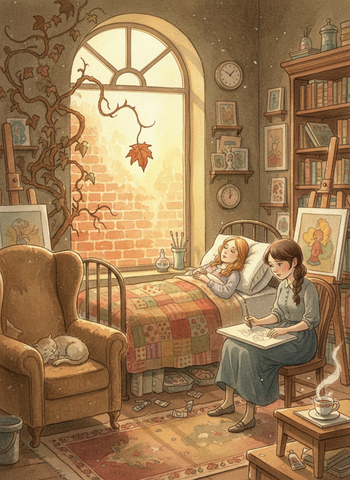
In a shabby Greenwich Village studio, two young painters share a life devoted to art — until one falls gravely ill and ties her hope to the last leaf clinging to a vine outside her window.
In a little district west of Washington Square the streets have run crazy and broken themselves into small strips called “places.” These “places” make strange angles and curves. One street crosses itself a time or two. An artist once discovered a valuable possibility in this street. Suppose a collector with a bill for paints, paper and canvas should, in traversing this route, suddenly meet himself coming back, without a cent having been paid on account!
En un pequeño barrio al oeste de Washington Square, las calles se han vuelto locas y se han quebrado en pequeñas franjas llamadas “plazoletas”. Estas “plazoletas” forman ángulos y curvas extrañas. Una calle se cruza a sí misma una o dos veces. Un artista descubrió una vez una posibilidad muy valiosa en esta calle. ¡Supongamos que un cobrador con una factura de pinturas, papel y lienzo, al recorrer esta ruta, se encontrara de pronto consigo mismo de regreso, sin haber cobrado ni un centavo!
So, to quaint old Greenwich Village the art people soon came prowling, hunting for north windows and eighteenth-century gables and Dutch attics and low rents. Then they imported some pewter mugs and a chafing dish or two from Sixth avenue, and became a “colony.”
Así que a la pintoresca y vieja Greenwich Village pronto llegaron los artistas, husmeando en busca de ventanas orientadas al norte, gabletes del siglo dieciocho, buhardillas holandesas y alquileres bajos. Luego importaron algunas jarras de peltre y uno o dos hornillos desde la Sexta Avenida, y se convirtieron en una “colonia”.
At the top of a squatty, three-story brick Sue and Johnsy had their studio. “Johnsy” was familiar for Joanna. One was from Maine; the other from California. They had met at the table d’hôte of an Eighth street “Delmonico’s,” and found their tastes in art, chicory salad and bishop sleeves so congenial that the joint studio resulted.
En lo alto de un rechoncho edificio de ladrillo de tres pisos, Sue y Johnsy tenían su estudio. “Johnsy” era el diminutivo de Joanna. Una era de Maine; la otra, de California. Se habían conocido en la mesa redonda de un “Delmonico’s” de la calle Ocho, y encontraron sus gustos en arte, en ensalada de achicoria y en mangas de obispo tan afines que resultó de ello el estudio compartido.
That was in May. In November a cold, unseen stranger, whom the doctors called Pneumonia, stalked about the colony, touching one here and there with his icy fingers. Over on the east side this ravager strode boldly, smiting his victims by scores, but his feet trod slowly through the maze of the narrow and moss-grown “places.”
Eso fue en mayo. En noviembre, un frío e invisible extraño, al que los médicos llamaban Neumonía, merodeaba por la colonia, tocando aquí y allá con sus dedos helados. Al otro lado, en el este, este devastador avanzaba con audacia, derribando a sus víctimas por decenas, pero sus pies caminaban despacio por el laberinto de las estrechas y cubiertas de musgo “plazoletas”.
Mr. Pneumonia was not what you would call a chivalric old gentleman. A mite of a little woman with blood thinned by California zephyrs was hardly fair game for the red-fisted, short-breathed old duffer. But Johnsy he smote; and she lay, scarcely moving, on her painted iron bedstead, looking through the small Dutch window-panes at the blank side of the next brick house.
El señor Neumonía no era lo que se llamaría un anciano caballeroso. Una menuda mujercita con la sangre aligerada por las brisas de California difícilmente era presa digna para aquel viejo rufián de puños rojos y aliento corto. Pero a Johnsy la golpeó; y ella yacía, apenas moviéndose, en su cama de hierro pintado, mirando por los pequeños cristales de la ventana holandesa el muro ciego de la casa de ladrillo vecina.
One morning the busy doctor invited Sue into the hallway with a shaggy, gray eyebrow.
Una mañana el atareado médico invitó a Sue al pasillo con una peluda ceja gris.
“She has one chance in—let us say, ten,” he said, as he shook down the mercury in his clinical thermometer. “And that chance is for her to want to live. This way people have of lining-up on the side of the undertaker makes the entire pharmacopeia look silly. Your little lady has made up her mind that she’s not going to get well. Has she anything on her mind?”
“Tiene una oportunidad entre, digamos, diez”, dijo, mientras sacudía el mercurio de su termómetro clínico. “Y esa oportunidad depende de que ella quiera vivir. Esta manera que tiene la gente de ponerse del lado del sepulturero hace que toda la farmacopea parezca ridícula. Su pequeña amiga ha decidido que no va a recuperarse. ¿Tiene algo en la cabeza?”
“She—she wanted to paint the Bay of Naples some day,” said Sue.
“Ella… ella quería pintar la bahía de Nápoles algún día”, dijo Sue.
“Paint?—bosh! Has she anything on her mind worth thinking about twice—a man, for instance?”
“¿Pintar? ¡Tonterías! ¿Tiene algo en la cabeza que valga la pena pensar dos veces… un hombre, por ejemplo?”
“A man?” said Sue, with a jew’s-harp twang in her voice. “Is a man worth—but, no, doctor; there is nothing of the kind.”
“¿Un hombre?” dijo Sue, con un tono metálico en la voz. “¿Vale la pena un hombre… pero no, doctor; no hay nada de eso.”
“Well, it is the weakness, then,” said the doctor. “I will do all that science, so far as it may filter through my efforts, can accomplish. But whenever my patient begins to count the carriages in her funeral procession I subtract 50 per cent. from the curative power of medicines. If you will get her to ask one question about the new winter styles in cloak sleeves I will promise you a one-in-five chance for her, instead of one in ten.”
“Bueno, entonces es debilidad”, dijo el médico. “Haré todo lo que la ciencia, en la medida en que pueda filtrarse a través de mis esfuerzos, pueda lograr. Pero cuando mi paciente empieza a contar los carruajes de su propio cortejo fúnebre, resto un cincuenta por ciento del poder curativo de las medicinas. Si logra que le haga alguna pregunta sobre las nuevas modas invernales en mangas de abrigo, le prometo una oportunidad de una entre cinco, en lugar de una entre diez.”
After the doctor had gone Sue went into the workroom and cried a Japanese napkin to a pulp. Then she swaggered into Johnsy’s room with her drawing board, whistling ragtime.
Después de que el médico se marchó, Sue fue al cuarto de trabajo y lloró hasta hacer pulpa una servilleta japonesa. Luego entró contoneándose en la habitación de Johnsy con su tablero de dibujo, silbando ragtime.
Johnsy lay, scarcely making a ripple under the bedclothes, with her face toward the window. Sue stopped whistling, thinking she was asleep.
Johnsy yacía, apenas formando una ondulación bajo las sábanas, con el rostro vuelto hacia la ventana. Sue dejó de silbar, pensando que estaba dormida.
She arranged her board and began a pen-and-ink drawing to illustrate a magazine story. Young artists must pave their way to Art by drawing pictures for magazine stories that young authors write to pave their way to Literature.
Acomodó su tablero y comenzó un dibujo a pluma y tinta para ilustrar un cuento de revista. Los jóvenes artistas deben pavimentar su camino hacia el Arte dibujando ilustraciones para los cuentos de revista que escriben los jóvenes autores para pavimentar su camino hacia la Literatura.
As Sue was sketching a pair of elegant horseshow riding trousers and a monocle on the figure of the hero, an Idaho cowboy, she heard a low sound, several times repeated. She went quickly to the bedside.
Mientras Sue bosquejaba un elegante par de pantalones de montar de concurso y un monóculo en la figura del héroe, un vaquero de Idaho, oyó un sonido bajo, repetido varias veces. Fue rápidamente hasta la cama.
Johnsy’s eyes were open wide. She was looking out the window and counting—counting backward.
Los ojos de Johnsy estaban muy abiertos. Miraba por la ventana y contaba… contaba hacia atrás.
“Twelve,” she said, and a little later “eleven;” and then “ten,” and “nine;” and then “eight” and “seven,” almost together.
“Doce”, dijo, y un poco después “once”; y luego “diez”, y “nueve”; y después “ocho” y “siete”, casi juntos.
Sue looked solicitously out the window. What was there to count? There was only a bare, dreary yard to be seen, and the blank side of the brick house twenty feet away. An old, old ivy vine, gnarled and decayed at the roots, climbed half way up the brick wall. The cold breath of autumn had stricken its leaves from the vine until its skeleton branches clung, almost bare, to the crumbling bricks.
Sue miró por la ventana con inquietud. ¿Qué había allí para contar? Solo se veía un patio desnudo y desolado, y el muro ciego de la casa de ladrillo a seis metros de distancia. Una vieja, viejísima enredadera de hiedra, nudosa y podrida en las raíces, trepaba hasta la mitad del muro de ladrillo. El aliento frío del otoño había arrancado sus hojas de la enredadera hasta que sus ramas esqueléticas se aferraban, casi desnudas, a los ladrillos desmoronados.
“What is it, dear?” asked Sue.
“¿Qué es, querida?” preguntó Sue.
“Six,” said Johnsy, in almost a whisper. “They’re falling faster now. Three days ago there were almost a hundred. It made my head ache to count them. But now it’s easy. There goes another one. There are only five left now.”
“Seis”, dijo Johnsy, casi en un susurro. “Ahora caen más rápido. Hace tres días había casi cien. Me dolía la cabeza de contarlas. Pero ahora es fácil. Ahí va otra. Ya solo quedan cinco.”
“Five what, dear. Tell your Sudie.”
“Cinco qué, querida. Cuéntale a tu Sudie.”
“Leaves. On the ivy vine. When the last one falls I must go, too. I’ve known that for three days. Didn’t the doctor tell you?”
“Hojas. En la enredadera de hiedra. Cuando caiga la última, yo también tendré que irme. Lo sé desde hace tres días. ¿No te lo dijo el doctor?”
“Oh, I never heard of such nonsense,” complained Sue, with magnificent scorn. “What have old ivy leaves to do with your getting well? And you used to love that vine so, you naughty girl. Don’t be a goosey. Why, the doctor told me this morning that your chances for getting well real soon were—let’s see exactly what he said—he said the chances were ten to one!
“Ay, nunca oí semejante tontería”, se quejó Sue, con magnífico desdén. “¿Qué tienen que ver unas viejas hojas de hiedra con que te recuperes? Y antes te encantaba esa enredadera, niña traviesa. No seas boba. Pues el doctor me dijo esta mañana que tus probabilidades de recuperarte pronto eran… déjame ver exactamente lo que dijo… dijo que las probabilidades eran de diez a uno.
“Why, that’s almost as good a chance as we have in New York when we ride on the street cars or walk past a new building. Try to take some broth now, and let Sudie go back to her drawing, so she can sell the editor man with it, and buy port wine for her sick child, and pork chops for her greedy self.”
“Vaya, es casi tan buena oportunidad como la que tenemos en Nueva York cuando vamos en el tranvía o pasamos junto a un edificio en construcción. Trata de tomar algo de caldo ahora, y deja que Sudie vuelva a su dibujo, para poder vendérselo al señor editor, y comprar vino de Oporto para su niña enferma, y chuletas de cerdo para su glotona persona.”
“You needn’t get any more wine,” said Johnsy, keeping her eyes fixed out the window. “There goes another. No, I don’t want any broth. That leaves just four. I want to see the last one fall before it gets dark. Then I’ll go, too.”
“No necesitas comprar más vino”, dijo Johnsy, con los ojos fijos en la ventana. “Ahí va otra. No, no quiero caldo. Eso deja solo cuatro. Quiero ver caer la última antes de que oscurezca. Entonces yo también me iré.”
“Johnsy, dear,” said Sue, bending over her, “will you promise me to keep your eyes closed, and not look out the window until I am done working? I must hand those drawings in by to-morrow. I need the light, or I would draw the shade down.”
“Johnsy, querida”, dijo Sue, inclinándose sobre ella, “¿me prometes mantener los ojos cerrados y no mirar por la ventana hasta que termine de trabajar? Debo entregar estos dibujos mañana. Necesito la luz, o bajaría la persiana.”
“Couldn’t you draw in the other room?” asked Johnsy, coldly.
“¿No podrías dibujar en la otra habitación?” preguntó Johnsy, con frialdad.
“I’d rather be here by you,” said Sue. “Besides I don’t want you to keep looking at those silly ivy leaves.”
“Prefiero estar aquí contigo”, dijo Sue. “Además, no quiero que sigas mirando esas tontas hojas de hiedra.”
“Tell me as soon as you have finished,” said Johnsy, closing her eyes, and lying white and still as a fallen statue, “because I want to see the last one fall. I’m tired of waiting. I’m tired of thinking. I want to turn loose my hold on everything, and go sailing down, down, just like one of those poor, tired leaves.”
“Avísame en cuanto termines”, dijo Johnsy, cerrando los ojos, y quedando blanca e inmóvil como una estatua caída, “porque quiero ver caer la última. Estoy cansada de esperar. Estoy cansada de pensar. Quiero soltar mi agarre de todo, e irme flotando hacia abajo, abajo, como una de esas pobres hojas cansadas.”
“Try to sleep,” said Sue. “I must call Behrman up to be my model for the old hermit miner. I’ll not be gone a minute. Don’t try to move ’till I come back.”
“Trata de dormir”, dijo Sue. “Debo llamar a Behrman para que sea mi modelo del viejo minero ermitaño. No tardaré ni un minuto. No intentes moverte hasta que vuelva.”
Old Behrman was a painter who lived on the ground floor beneath them. He was past sixty and had a Michael Angelo’s Moses beard curling down from the head of a satyr along the body of an imp. Behrman was a failure in art. Forty years he had wielded the brush without getting near enough to touch the hem of his Mistress’s robe. He had been always about to paint a masterpiece, but had never yet begun it. For several years he had painted nothing except now and then a daub in the line of commerce or advertising.
El viejo Behrman era un pintor que vivía en la planta baja, debajo de ellas. Tenía más de sesenta años y una barba a lo Moisés de Miguel Ángel que le caía desde la cabeza de un sátiro por el cuerpo de un duende. Behrman era un fracaso en el arte. Durante cuarenta años había manejado el pincel sin lograr rozar siquiera el borde del manto de su Musa. Siempre había estado a punto de pintar una obra maestra, pero nunca la había empezado. Durante varios años no había pintado nada salvo, de vez en cuando, algún garabato de índole comercial o publicitaria.
He earned a little by serving as a model to those young artists in the colony who could not pay the price of a professional. He drank gin to excess, and still talked of his coming masterpiece. For the rest he was a fierce little old man, who scoffed terribly at softness in any one, and who regarded himself as especial mastiff-in-waiting to protect the two young artists in the studio above.
Ganaba algo sirviendo de modelo a aquellos jóvenes artistas de la colonia que no podían pagar el precio de un profesional. Bebía ginebra en exceso, y aun así seguía hablando de su próxima obra maestra. Por lo demás, era un fiero viejecillo, que se burlaba terriblemente de la blandura en cualquiera, y que se consideraba a sí mismo una especie de mastín guardián especial para proteger a las dos jóvenes artistas del estudio de arriba.
Sue found Behrman smelling strongly of juniper berries in his dimly lighted den below. In one corner was a blank canvas on an easel that had been waiting there for twenty-five years to receive the first line of the masterpiece. She told him of Johnsy’s fancy, and how she feared she would, indeed, light and fragile as a leaf herself, float away when her slight hold upon the world grew weaker.
Sue encontró a Behrman oliendo fuertemente a bayas de enebro en su guarida, tenuemente iluminada, allá abajo. En un rincón había un lienzo en blanco sobre un caballete que llevaba veinticinco años esperando recibir la primera línea de la obra maestra. Ella le contó de la fantasía de Johnsy, y de cómo temía que, ligera y frágil como una hoja ella misma, se marchara flotando cuando su débil asidero al mundo se debilitara aún más.
Old Behrman, with his red eyes plainly streaming, shouted his contempt and derision for such idiotic imaginings.
El viejo Behrman, con los ojos rojos claramente llorosos, gritó su desprecio y su burla ante semejantes imaginaciones idiotas.
“Vass!” he cried. “Is dere people in de world mit der foolishness to die because leafs dey drop off from a confounded vine? I haf not heard of such a thing. No, I will not bose as a model for your fool hermit-dunderhead. Vy do you allow dot silly pusiness to come in der prain of her? Ach, dot poor lettle Miss Johnsy.”
“¡Vass!” exclamó. “¿Hay gente en el mundo con la tontería de morirse porque se caen las hojas de una maldita enredadera? No he oído nunca semejante cosa. No, no voy a posar como modelo para su necio ermitaño-cabeza de chorlito. ¿Por qué permite que semejante tontería entre en la mente de ella? Ay, esa pobre pequeña señorita Johnsy.”
“She is very ill and weak,” said Sue, “and the fever has left her mind morbid and full of strange fancies. Very well, Mr. Behrman, if you do not care to pose for me, you needn’t. But I think you are a horrid old—old flibbertigibbet.”
“Está muy enferma y débil”, dijo Sue, “y la fiebre le ha dejado la mente mórbida y llena de extrañas fantasías. Muy bien, señor Behrman, si no le importa posar para mí, no tiene que hacerlo. Pero creo que es usted un horrible… viejo tarambana.”
“You are just like a woman!” yelled Behrman. “Who said I will not bose? Go on. I come mit you. For half an hour I haf peen trying to say dot I am ready to bose. Gott! dis is not any blace in which one so goot as Miss Yohnsy shall lie sick. Some day I vill baint a masterpiece, and ve shall all go away. Gott! yes.”
“¡Es usted igual que una mujer!” gritó Behrman. “¿Quién dijo que no voy a posar? Vamos. Voy con usted. Durante media hora he estado tratando de decir que estoy listo para posar. ¡Dios! Este no es lugar para que alguien tan buena como la señorita Yohnsy esté enferma. Algún día pintaré una obra maestra, y nos iremos todos de aquí. ¡Dios, sí!”
Johnsy was sleeping when they went upstairs. Sue pulled the shade down to the window-sill, and motioned Behrman into the other room. In there they peered out the window fearfully at the ivy vine. Then they looked at each other for a moment without speaking. A persistent, cold rain was falling, mingled with snow. Behrman, in his old blue shirt, took his seat as the hermit-miner on an upturned kettle for a rock.
Johnsy dormía cuando subieron. Sue bajó la persiana hasta el alféizar de la ventana, e hizo señas a Behrman para que pasara a la otra habitación. Allí espiaron con temor por la ventana la enredadera de hiedra. Luego se miraron el uno al otro un momento sin hablar. Caía una lluvia fría y persistente, mezclada con nieve. Behrman, con su vieja camisa azul, tomó asiento como el minero ermitaño sobre una tetera volteada que hacía de roca.
When Sue awoke from an hour’s sleep the next morning she found Johnsy with dull, wide-open eyes staring at the drawn green shade.
Cuando Sue despertó de una hora de sueño a la mañana siguiente, encontró a Johnsy con los ojos apagados y muy abiertos, mirando fijo hacia la persiana verde bajada.
“Pull it up; I want to see,” she ordered, in a whisper.
“Súbela; quiero ver”, ordenó, en un susurro.
Wearily Sue obeyed.
Con desgana, Sue obedeció.
But, lo! after the beating rain and fierce gusts of wind that had endured through the livelong night, there yet stood out against the brick wall one ivy leaf. It was the last on the vine. Still dark green near its stem, but with its serrated edges tinted with the yellow of dissolution and decay, it hung bravely from a branch some twenty feet above the ground.
Pero, ¡he aquí! después de la lluvia azotadora y las feroces ráfagas de viento que habían durado toda la larga noche, aún se destacaba contra el muro de ladrillo una hoja de hiedra. Era la última de la enredadera. Todavía verde oscuro cerca de su tallo, pero con sus bordes aserrados teñidos del amarillo de la disolución y la decadencia, colgaba con valentía de una rama a unos seis metros sobre el suelo.
“It is the last one,” said Johnsy. “I thought it would surely fall during the night. I heard the wind. It will fall to-day, and I shall die at the same time.”
“Es la última”, dijo Johnsy. “Pensé que seguramente caería durante la noche. Oí el viento. Caerá hoy, y yo moriré al mismo tiempo.”
“Dear, dear!” said Sue, leaning her worn face down to the pillow, “think of me, if you won’t think of yourself. What would I do?”
“¡Querida, querida!” dijo Sue, inclinando su rostro cansado hacia la almohada, “piensa en mí, si no quieres pensar en ti misma. ¿Qué haría yo?”
But Johnsy did not answer. The lonesomest thing in all the world is a soul when it is making ready to go on its mysterious, far journey. The fancy seemed to possess her more strongly as one by one the ties that bound her to friendship and to earth were loosed.
Pero Johnsy no respondió. Lo más solitario en todo el mundo es un alma cuando se prepara para emprender su misterioso y lejano viaje. La fantasía parecía apoderarse de ella con más fuerza a medida que, uno a uno, se soltaban los lazos que la ataban a la amistad y a la tierra.
The day wore away, and even through the twilight they could see the lone ivy leaf clinging to its stem against the wall. And then, with the coming of the night the north wind was again loosed, while the rain still beat against the windows and pattered down from the low Dutch eaves.
El día se fue consumiendo, y aun a través del crepúsculo podían ver la solitaria hoja de hiedra aferrada a su tallo contra el muro. Y luego, con la llegada de la noche, el viento del norte se soltó de nuevo, mientras la lluvia seguía golpeando contra las ventanas y goteando desde los bajos aleros holandeses.
When it was light enough Johnsy, the merciless, commanded that the shade be raised.
Cuando hubo suficiente luz, Johnsy, la despiadada, ordenó que subieran la persiana.
The ivy leaf was still there.
La hoja de hiedra seguía allí.
Johnsy lay for a long time looking at it. And then she called to Sue, who was stirring her chicken broth over the gas stove.
Johnsy la contempló durante largo rato. Y entonces llamó a Sue, que revolvía su caldo de pollo sobre la cocina de gas.
“I’ve been a bad girl, Sudie,” said Johnsy. “Something has made that last leaf stay there to show me how wicked I was. It is a sin to want to die. You may bring me a little broth now, and some milk with a little port in it, and—no; bring me a hand-mirror first, and then pack some pillows about me, and I will sit up and watch you cook.”
“He sido una chica mala, Sudie”, dijo Johnsy. “Algo ha hecho que esa última hoja se quedara ahí para mostrarme lo malvada que era. Es un pecado querer morir. Puedes traerme ahora un poco de caldo, y algo de leche con un poco de oporto, y… no; tráeme primero un espejo de mano, y luego acomódame algunas almohadas alrededor, y me sentaré a verte cocinar.”
An hour later she said.
Una hora después dijo.
“Sudie, some day I hope to paint the Bay of Naples.”
“Sudie, algún día espero pintar la bahía de Nápoles.”
The doctor came in the afternoon, and Sue had an excuse to go into the hallway as he left.
El médico vino por la tarde, y Sue tuvo un pretexto para salir al pasillo cuando él se marchaba.
“Even chances,” said the doctor, taking Sue’s thin, shaking hand in his. “With good nursing you’ll win. And now I must see another case I have downstairs. Behrman, his name is—some kind of an artist, I believe. Pneumonia, too. He is an old, weak man, and the attack is acute. There is no hope for him; but he goes to the hospital to-day to be made more comfortable.”
“Probabilidades iguales”, dijo el médico, tomando entre las suyas la mano delgada y temblorosa de Sue. “Con buenos cuidados, ganará usted. Y ahora debo ver a otro caso que tengo abajo. Behrman, se llama… alguna clase de artista, creo. Neumonía, también. Es un hombre viejo y débil, y el ataque es agudo. No hay esperanza para él; pero hoy va al hospital para estar más cómodo.”
The next day the doctor said to Sue: “She’s out of danger. You’ve won. Nutrition and care now—that’s all.”
Al día siguiente el médico le dijo a Sue: “Está fuera de peligro. Ha ganado usted. Nutrición y cuidados ahora… eso es todo.”
And that afternoon Sue came to the bed where Johnsy lay, contentedly knitting a very blue and very useless woolen shoulder scarf, and put one arm around her, pillows and all.
Y esa tarde Sue se acercó a la cama donde yacía Johnsy, tejiendo plácidamente una muy azul y muy inútil bufanda de lana para los hombros, y le pasó un brazo alrededor, almohadas y todo.
“I have something to tell you, white mouse,” she said. “Mr. Behrman died of pneumonia to-day in the hospital. He was ill only two days. The janitor found him on the morning of the first day in his room downstairs helpless with pain. His shoes and clothing were wet through and icy cold. They couldn’t imagine where he had been on such a dreadful night.
“Tengo algo que decirte, ratoncito blanco”, dijo. “El señor Behrman murió de neumonía hoy en el hospital. Estuvo enfermo solo dos días. El portero lo encontró la mañana del primer día en su habitación de abajo, indefenso por el dolor. Sus zapatos y su ropa estaban empapados y helados. No podían imaginar dónde había estado en una noche tan terrible.
“And then they found a lantern, still lighted, and a ladder that had been dragged from its place, and some scattered brushes, and a palette with green and yellow colors mixed on it, and—look out the window, dear, at the last ivy leaf on the wall. Didn’t you wonder why it never fluttered or moved when the wind blew? Ah, darling, it’s Behrman’s masterpiece—he painted it there the night that the last leaf fell.”
“Y luego encontraron un farol, todavía encendido, y una escalera que habían arrastrado de su sitio, y algunos pinceles dispersos, y una paleta con colores verde y amarillo mezclados en ella, y… mira por la ventana, querida, la última hoja de hiedra en el muro. ¿Nunca te preguntaste por qué nunca se agitaba ni se movía cuando soplaba el viento? Ah, querida, es la obra maestra de Behrman… la pintó ahí la noche en que cayó la última hoja.”
