The Elephant's Child
A free B2-level English story for language learners, readable online in 7 languages, with an option to listen via the free Storyteller app.
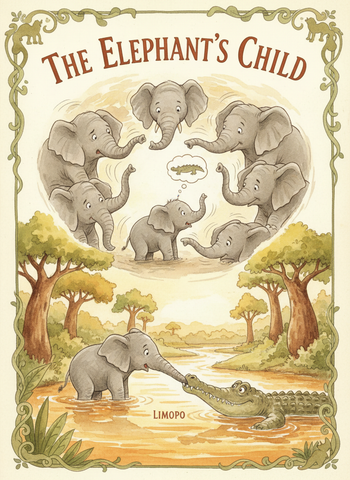
An impossibly curious young elephant refuses to stop asking questions, no matter how many relatives swat him for it — until one especially nosy question by the Limpopo River changes his shape forever.
In the High and Far-Off Times the Elephant, O Best Beloved, had no trunk. He had only a blackish, bulgy nose, as big as a boot, that he could wriggle about from side to side; but he couldn’t pick up things with it. But there was one Elephant—a new Elephant—an Elephant’s Child—who was full of ‘satiable curtiosity, and that means he asked ever so many questions. And he lived in Africa, and he filled all Africa with his ‘satiable curtiosities.
En los Tiempos Remotos y Lejanos, el Elefante, oh mi Bien Amado, no tenía trompa. Tenía solo una nariz negruzca y abultada, del tamaño de una bota, que podía mover de un lado a otro; pero no podía recoger cosas con ella. Pero había un Elefante —un Elefante nuevo— un Elefantito— que estaba lleno de 'saciable curiosidad, y eso quiere decir que hacía muchísimas preguntas. Y vivía en África, y llenaba toda África con sus 'saciables curiosidades.
He asked his tall aunt, the Ostrich, why her tail-feathers grew just so, and his tall aunt the Ostrich spanked him with her hard, hard claw. He asked his tall uncle, the Giraffe, what made his skin spotty, and his tall uncle, the Giraffe, spanked him with his hard, hard hoof. And still he was full of ‘satiable curtiosity!
Le preguntó a su alta tía, el Avestruz, por qué le crecían así las plumas de la cola, y su alta tía el Avestruz le dio un azote con su dura, durísima garra. Le preguntó a su alto tío, la Jirafa, qué le hacía manchada la piel, y su alto tío, la Jirafa, le dio un azote con su duro, durísimo casco. ¡Y aun así seguía lleno de 'saciable curiosidad!
He asked his broad aunt, the Hippopotamus, why her eyes were red, and his broad aunt, the Hippopotamus, spanked him with her broad, broad hoof; and he asked his hairy uncle, the Baboon, why melons tasted just so, and his hairy uncle, the Baboon, spanked him with his hairy, hairy paw. And still he was full of ‘satiable curtiosity!
Le preguntó a su ancha tía, el Hipopótamo, por qué tenía los ojos rojos, y su ancha tía, el Hipopótamo, le dio un azote con su ancha, anchísima pata; y le preguntó a su peludo tío, el Babuino, por qué los melones sabían así, y su peludo tío, el Babuino, le dio un azote con su peluda, peludísima zarpa. ¡Y aun así seguía lleno de 'saciable curiosidad!
He asked questions about everything that he saw, or heard, or felt, or smelt, or touched, and all his uncles and his aunts spanked him. And still he was full of ‘satiable curtiosity!
Preguntaba cosas sobre todo lo que veía, oía, sentía, olía o tocaba, y todos sus tíos y tías lo azotaban. ¡Y aun así seguía lleno de 'saciable curiosidad!
One fine morning in the middle of the Precession of the Equinoxes this ‘satiable Elephant’s Child asked a new fine question that he had never asked before. He asked, ‘What does the Crocodile have for dinner?’ Then everybody said, ‘Hush!’ in a loud and dretful tone, and they spanked him immediately and directly, without stopping, for a long time.
Una hermosa mañana, en mitad de la Precesión de los Equinoccios, este 'saciable Elefantito hizo una nueva y hermosa pregunta que jamás había hecho antes. Preguntó: «¿Qué cena el Cocodrilo?». Entonces todos dijeron «¡Chitón!» en tono fuerte y espantoso, y lo azotaron inmediata y directamente, sin parar, durante mucho rato.
By and by, when that was finished, he came upon Kolokolo Bird sitting in the middle of a wait-a-bit thorn-bush, and he said, ‘My father has spanked me, and my mother has spanked me; all my aunts and uncles have spanked me for my ‘satiable curtiosity; and still I want to know what the Crocodile has for dinner!’
Al poco, cuando aquello terminó, se topó con el Pájaro Kolokolo, sentado en medio de un espinoso arbusto de espera-un-poco, y le dijo: «Mi padre me ha azotado, y mi madre me ha azotado; todos mis tíos y tías me han azotado por mi 'saciable curiosidad; ¡y aun así quiero saber qué cena el Cocodrilo!».
Then Kolokolo Bird said, with a mournful cry, ‘Go to the banks of the great grey-green, greasy Limpopo River, all set about with fever-trees, and find out.’
Entonces el Pájaro Kolokolo dijo, con un grito lastimero: «Ve a las orillas del gran río Limpopo, gris verdoso, grasiento y todo rodeado de árboles de la fiebre, y averígualo».
That very next morning, when there was nothing left of the Equinoxes, because the Precession had preceded according to precedent, this ‘satiable Elephant’s Child took a hundred pounds of bananas (the little short red kind), and a hundred pounds of sugar-cane (the long purple kind), and seventeen melons (the greeny-crackly kind), and said to all his dear families, ‘Goodbye. I am going to the great grey-green, greasy Limpopo River, all set about with fever-trees, to find out what the Crocodile has for dinner.’ And they all spanked him once more for luck, though he asked them most politely to stop.
A la mañana siguiente, cuando ya no quedaba nada de los Equinoccios, porque la Precesión había precedido según lo previsto, este 'saciable Elefantito tomó cien libras de plátanos (de esos pequeños y rojos), y cien libras de caña de azúcar (de la larga y morada), y diecisiete melones (de los verdes y crujientes), y les dijo a todas sus queridas familias: «Adiós. Voy a las orillas del gran río Limpopo, gris verdoso y grasiento, todo rodeado de árboles de la fiebre, a averiguar qué cena el Cocodrilo». Y todos lo azotaron una vez más para la suerte, aunque él les pidió muy educadamente que pararan.
Then he went away, a little warm, but not at all astonished, eating melons, and throwing the rind about, because he could not pick it up.
Entonces se marchó, un poco acalorado, pero nada asombrado, comiendo melones y tirando las cáscaras por ahí, porque no podía recogerlas.
He went from Graham’s Town to Kimberley, and from Kimberley to Khama’s Country, and from Khama’s Country he went east by north, eating melons all the time, till at last he came to the banks of the great grey-green, greasy Limpopo River, all set about with fever-trees, precisely as Kolokolo Bird had said.
Fue de la Ciudad de Graham a Kimberley, y de Kimberley al País de Khama, y desde el País de Khama fue hacia el este y un poco al norte, comiendo melones todo el camino, hasta que por fin llegó a las orillas del gran río Limpopo, gris verdoso y grasiento, todo rodeado de árboles de la fiebre, exactamente como había dicho el Pájaro Kolokolo.
Now you must know and understand, O Best Beloved, that till that very week, and day, and hour, and minute, this ‘satiable Elephant’s Child had never seen a Crocodile, and did not know what one was like. It was all his ‘satiable curtiosity.
Ahora debes saber y entender, oh mi Bien Amado, que hasta esa misma semana, y día, y hora, y minuto, este 'saciable Elefantito jamás había visto a un Cocodrilo, y no sabía cómo era uno. Todo era por su 'saciable curiosidad.
The first thing that he found was a Bi-Coloured-Python-Rock-Snake curled round a rock.
Lo primero que encontró fue una Serpiente-Pitón-de-Roca-Bicolor enroscada en torno a una roca.
‘’Scuse me,’ said the Elephant’s Child most politely, ‘but have you seen such a thing as a Crocodile in these promiscuous parts?’
«Discúlpame», dijo el Elefantito muy educadamente, «pero ¿has visto algo parecido a un Cocodrilo por estos promiscuos parajes?».
‘Have I seen a Crocodile?’ said the Bi-Coloured-Python-Rock-Snake, in a voice of dretful scorn. ‘What will you ask me next?’
«¿Que si he visto a un Cocodrilo?», dijo la Serpiente-Pitón-de-Roca-Bicolor, con voz de espantoso desdén. «¿Y qué me preguntarás después?».
‘’Scuse me,’ said the Elephant’s Child, ‘but could you kindly tell me what he has for dinner?’
«Discúlpame», dijo el Elefantito, «pero ¿podrías decirme amablemente qué cena?».
Then the Bi-Coloured-Python-Rock-Snake uncoiled himself very quickly from the rock, and spanked the Elephant’s Child with his scalesome, flailsome tail.
Entonces la Serpiente-Pitón-de-Roca-Bicolor se desenroscó muy rápido de la roca, y azotó al Elefantito con su cola escamosa y azotadora.
‘That is odd,’ said the Elephant’s Child, ‘because my father and my mother, and my uncle and my aunt, not to mention my other aunt, the Hippopotamus, and my other uncle, the Baboon, have all spanked me for my ‘satiable curtiosity—and I suppose this is the same thing.
«Qué raro», dijo el Elefantito, «porque mi padre y mi madre, y mi tío y mi tía, sin contar a mi otra tía, el Hipopótamo, y a mi otro tío, el Babuino, todos me han azotado por mi 'saciable curiosidad —y supongo que esto es lo mismo.
So he said good-bye very politely to the Bi-Coloured-Python-Rock-Snake, and helped to coil him up on the rock again, and went on, a little warm, but not at all astonished, eating melons, and throwing the rind about, because he could not pick it up, till he trod on what he thought was a log of wood at the very edge of the great grey-green, greasy Limpopo River, all set about with fever-trees.
Así que se despidió muy educadamente de la Serpiente-Pitón-de-Roca-Bicolor, y ayudó a enroscarla de nuevo sobre la roca, y siguió su camino, un poco acalorado, pero nada asombrado, comiendo melones y tirando las cáscaras por ahí, porque no podía recogerlas, hasta que pisó lo que creyó que era un tronco de madera justo en la orilla del gran río Limpopo, gris verdoso y grasiento, todo rodeado de árboles de la fiebre.
But it was really the Crocodile, O Best Beloved, and the Crocodile winked one eye—like this!
Pero en realidad era el Cocodrilo, oh mi Bien Amado, y el Cocodrilo guiñó un ojo —¡así!
‘’Scuse me,’ said the Elephant’s Child most politely, ‘but do you happen to have seen a Crocodile in these promiscuous parts?’
«Discúlpame», dijo el Elefantito muy educadamente, «pero ¿por casualidad has visto a un Cocodrilo por estos promiscuos parajes?».
Then the Crocodile winked the other eye, and lifted half his tail out of the mud; and the Elephant’s Child stepped back most politely, because he did not wish to be spanked again.
Entonces el Cocodrilo guiñó el otro ojo, y levantó media cola fuera del barro; y el Elefantito retrocedió muy educadamente, porque no quería que lo azotaran otra vez.
‘Come hither, Little One,’ said the Crocodile. ‘Why do you ask such things?’
«Ven aquí, Pequeñín», dijo el Cocodrilo. «¿Por qué preguntas esas cosas?».
‘’Scuse me,’ said the Elephant’s Child most politely, ‘but my father has spanked me, my mother has spanked me, not to mention my tall aunt, the Ostrich, and my tall uncle, the Giraffe, who can kick ever so hard, as well as my broad aunt, the Hippopotamus, and my hairy uncle, the Baboon, and including the Bi-Coloured-Python-Rock-Snake, with the scalesome, flailsome tail, just up the bank, who spanks harder than any of them; and so, if it’s quite all the same to you, I don’t want to be spanked any more.’
«Discúlpame», dijo el Elefantito muy educadamente, «pero mi padre me ha azotado, mi madre me ha azotado, sin contar a mi alta tía, el Avestruz, y a mi alto tío, la Jirafa, que da unas coces durísimas, así como mi ancha tía, el Hipopótamo, y mi peludo tío, el Babuino, y sin olvidar a la Serpiente-Pitón-de-Roca-Bicolor, de la cola escamosa y azotadora, allí arriba en la orilla, que azota más fuerte que ninguno; así que, si a ti te da igual, no quiero que me azoten más».
‘Come hither, Little One,’ said the Crocodile, ‘for I am the Crocodile,’ and he wept crocodile-tears to show it was quite true.
«Ven aquí, Pequeñín», dijo el Cocodrilo, «porque yo soy el Cocodrilo», y lloró lágrimas de cocodrilo para demostrar que era verdad.
Then the Elephant’s Child grew all breathless, and panted, and kneeled down on the bank and said, ‘You are the very person I have been looking for all these long days. Will you please tell me what you have for dinner?’
Entonces el Elefantito se quedó sin aliento, y jadeó, y se arrodilló en la orilla y dijo: «Tú eres justo la persona que he estado buscando todos estos largos días. ¿Podrías decirme qué cenas?».
‘Come hither, Little One,’ said the Crocodile, ‘and I’ll whisper.’
«Ven aquí, Pequeñín», dijo el Cocodrilo, «y te lo susurraré».
Then the Elephant’s Child put his head down close to the Crocodile’s musky, tusky mouth, and the Crocodile caught him by his little nose, which up to that very week, day, hour, and minute, had been no bigger than a boot, though much more useful.
Entonces el Elefantito acercó la cabeza a la boca almizclada y colmilluda del Cocodrilo, y el Cocodrilo lo agarró por su naricita, que hasta esa misma semana, día, hora y minuto, no había sido más grande que una bota, aunque sí mucho más útil.
‘I think, said the Crocodile—and he said it between his teeth, like this—‘I think to-day I will begin with Elephant’s Child!’
«Creo», dijo el Cocodrilo —y lo dijo entre dientes, así— «creo que hoy empezaré por el Elefantito».
At this, O Best Beloved, the Elephant’s Child was much annoyed, and he said, speaking through his nose, like this, ‘Led go! You are hurtig be!’
Ante esto, oh mi Bien Amado, el Elefantito se sintió muy molesto, y dijo, hablando por la nariz, así: «¡Suédtabe! ¡Be estás hacieddo daño!».
Then the Bi-Coloured-Python-Rock-Snake scuffled down from the bank and said, ‘My young friend, if you do not now, immediately and instantly, pull as hard as ever you can, it is my opinion that your acquaintance in the large-pattern leather ulster’ (and by this he meant the Crocodile) ‘will jerk you into yonder limpid stream before you can say Jack Robinson.’
Entonces la Serpiente-Pitón-de-Roca-Bicolor bajó reptando de la orilla y dijo: «Mi joven amigo, si no tiras ahora mismo, inmediata e instantáneamente, con toda la fuerza que puedas, es mi opinión que tu conocido de la gabardina de cuero de dibujo grande» (y con esto quería decir el Cocodrilo) «te arrastrará a esa límpida corriente de allí antes de que puedas decir Jack Robinson».
This is the way Bi-Coloured-Python-Rock-Snakes always talk.
Así es como hablan siempre las Serpientes-Pitón-de-Roca-Bicolor.
Then the Elephant’s Child sat back on his little haunches, and pulled, and pulled, and pulled, and his nose began to stretch. And the Crocodile floundered into the water, making it all creamy with great sweeps of his tail, and he pulled, and pulled, and pulled.
Entonces el Elefantito se sentó sobre sus pequeñas ancas, y tiró, y tiró, y tiró, y su nariz empezó a estirarse. Y el Cocodrilo se revolvió en el agua, volviéndola toda cremosa con grandes coletazos, y tiró, y tiró, y tiró.
And the Elephant’s Child’s nose kept on stretching; and the Elephant’s Child spread all his little four legs and pulled, and pulled, and pulled, and his nose kept on stretching; and the Crocodile threshed his tail like an oar, and he pulled, and pulled, and pulled, and at each pull the Elephant’s Child’s nose grew longer and longer—and it hurt him hijjus!
Y la nariz del Elefantito seguía estirándose; y el Elefantito extendió sus cuatro patitas y tiró, y tiró, y tiró, y su nariz seguía estirándose; y el Cocodrilo azotaba con la cola como un remo, y tiró, y tiró, y tiró, y con cada tirón la nariz del Elefantito se hacía más y más larga —¡y le dolía horrores!
Then the Elephant’s Child felt his legs slipping, and he said through his nose, which was now nearly five feet long, ‘This is too butch for be!’
Entonces el Elefantito sintió que sus patas resbalaban, y dijo por su nariz, que ya medía casi cinco pies, «¡Esto es debasiado para bí!».
Then the Bi-Coloured-Python-Rock-Snake came down from the bank, and knotted himself in a double-clove-hitch round the Elephant’s Child’s hind legs, and said, ‘Rash and inexperienced traveller, we will now seriously devote ourselves to a little high tension, because if we do not, it is my impression that yonder self-propelling man-of-war with the armour-plated upper deck’ (and by this, O Best Beloved, he meant the Crocodile), ‘will permanently vitiate your future career.
Entonces la Serpiente-Pitón-de-Roca-Bicolor bajó de la orilla, y se anudó con un doble as de guía alrededor de las patas traseras del Elefantito, y dijo: «Viajero temerario e inexperto, ahora nos dedicaremos seriamente a un poco de alta tensión, porque si no lo hacemos, es mi impresión que ese buque de guerra autopropulsado de cubierta acorazada» (y con esto, oh mi Bien Amado, quería decir el Cocodrilo) «viciará permanentemente tu futura carrera».
That is the way all Bi-Coloured-Python-Rock-Snakes always talk.
Así es como hablan siempre todas las Serpientes-Pitón-de-Roca-Bicolor.
So he pulled, and the Elephant’s Child pulled, and the Crocodile pulled; but the Elephant’s Child and the Bi-Coloured-Python-Rock-Snake pulled hardest; and at last the Crocodile let go of the Elephant’s Child’s nose with a plop that you could hear all up and down the Limpopo.
Así que tiró él, y tiró el Elefantito, y tiró el Cocodrilo; pero el Elefantito y la Serpiente-Pitón-de-Roca-Bicolor tiraron más fuerte; y al fin el Cocodrilo soltó la nariz del Elefantito con un chapoteo que se oyó por todo el Limpopo, arriba y abajo.
Then the Elephant’s Child sat down most hard and sudden; but first he was careful to say ‘Thank you’ to the Bi-Coloured-Python-Rock-Snake; and next he was kind to his poor pulled nose, and wrapped it all up in cool banana leaves, and hung it in the great grey-green, greasy Limpopo to cool.
Entonces el Elefantito se sentó de golpe y muy duro; pero primero tuvo el cuidado de decir «Gracias» a la Serpiente-Pitón-de-Roca-Bicolor; y luego fue amable con su pobre nariz estirada, y la envolvió toda en frescas hojas de plátano, y la colgó en el gran río Limpopo, gris verdoso y grasiento, para que se enfriara.
‘What are you doing that for?’ said the Bi-Coloured-Python-Rock-Snake.
«¿Para qué haces eso?», dijo la Serpiente-Pitón-de-Roca-Bicolor.
‘’Scuse me,’ said the Elephant’s Child, ‘but my nose is badly out of shape, and I am waiting for it to shrink.
«Discúlpame», dijo el Elefantito, «pero mi nariz está muy fuera de forma, y estoy esperando a que encoja».
‘Then you will have to wait a long time, said the Bi-Coloured-Python-Rock-Snake. ‘Some people do not know what is good for them.’
«Entonces tendrás que esperar mucho tiempo», dijo la Serpiente-Pitón-de-Roca-Bicolor. «Algunas personas no saben lo que les conviene».
The Elephant’s Child sat there for three days waiting for his nose to shrink. But it never grew any shorter, and, besides, it made him squint. For, O Best Beloved, you will see and understand that the Crocodile had pulled it out into a really truly trunk same as all Elephants have to-day.
El Elefantito se quedó allí sentado tres días esperando a que su nariz encogiera. Pero nunca se hizo más corta, y además, le hacía bizquear. Porque, oh mi Bien Amado, ya verás y entenderás que el Cocodrilo la había estirado hasta convertirla en una trompa de verdad, igual que todos los Elefantes tienen hoy.
At the end of the third day a fly came and stung him on the shoulder, and before he knew what he was doing he lifted up his trunk and hit that fly dead with the end of it.
Al final del tercer día, una mosca vino y le picó en el hombro, y antes de darse cuenta de lo que hacía, levantó la trompa y mató a esa mosca de un golpe con la punta.
‘’Vantage number one!’ said the Bi-Coloured-Python-Rock-Snake. ‘You couldn’t have done that with a mere-smear nose. Try and eat a little now.’
«¡Ventaja número uno!», dijo la Serpiente-Pitón-de-Roca-Bicolor. «Eso no lo habrías podido hacer con una simple naricilla. Intenta comer un poco ahora».
Before he thought what he was doing the Elephant’s Child put out his trunk and plucked a large bundle of grass, dusted it clean against his fore-legs, and stuffed it into his own mouth.
Antes de pensar lo que hacía, el Elefantito sacó su trompa y arrancó un buen manojo de hierba, lo sacudió limpio contra sus patas delanteras, y se lo metió en la propia boca.
‘Vantage number two!’ said the Bi-Coloured-Python-Rock-Snake. ‘You couldn’t have done that with a mere-smear nose. Don’t you think the sun is very hot here?’
«¡Ventaja número dos!», dijo la Serpiente-Pitón-de-Roca-Bicolor. «Eso no lo habrías podido hacer con una simple naricilla. ¿No te parece que el sol pega muy fuerte aquí?».
‘It is,’ said the Elephant’s Child, and before he thought what he was doing he schlooped up a schloop of mud from the banks of the great grey-green, greasy Limpopo, and slapped it on his head, where it made a cool schloopy-sloshy mud-cap all trickly behind his ears.
«Sí», dijo el Elefantito, y antes de pensar lo que hacía, sorbió con la trompa un buen chapoteo de barro de las orillas del gran río Limpopo, gris verdoso y grasiento, y se lo puso en la cabeza, donde le formó un fresco y chapoteante gorro de barro que le chorreaba tras las orejas.
‘Vantage number three!’ said the Bi-Coloured-Python-Rock-Snake. ‘You couldn’t have done that with a mere-smear nose. Now how do you feel about being spanked again?’
«¡Ventaja número tres!», dijo la Serpiente-Pitón-de-Roca-Bicolor. «Eso no lo habrías podido hacer con una simple naricilla. Ahora, ¿qué te parecería que te azotaran otra vez?».
‘’Scuse me,’ said the Elephant’s Child, ‘but I should not like it at all.’
«Discúlpame», dijo el Elefantito, «pero no me gustaría nada».
‘How would you like to spank somebody?’ said the Bi-Coloured-Python-Rock-Snake.
«¿Y qué te parecería azotar tú a alguien?», dijo la Serpiente-Pitón-de-Roca-Bicolor.
‘I should like it very much indeed,’ said the Elephant’s Child.
«Eso sí que me gustaría muchísimo», dijo el Elefantito.
‘Well,’ said the Bi-Coloured-Python-Rock-Snake, ‘you will find that new nose of yours very useful to spank people with.’
«Bueno», dijo la Serpiente-Pitón-de-Roca-Bicolor, «ya verás que esa nueva nariz tuya te será muy útil para azotar a la gente».
‘Thank you,’ said the Elephant’s Child, ‘I’ll remember that; and now I think I’ll go home to all my dear families and try.’
«Gracias», dijo el Elefantito, «lo recordaré; y ahora creo que iré a casa con todas mis queridas familias a probarlo».
So the Elephant’s Child went home across Africa frisking and whisking his trunk. When he wanted fruit to eat he pulled fruit down from a tree, instead of waiting for it to fall as he used to do. When he wanted grass he plucked grass up from the ground, instead of going on his knees as he used to do. When the flies bit him he broke off the branch of a tree and used it as fly-whisk; and he made himself a new, cool, slushy-squshy mud-cap whenever the sun was hot. When he felt lonely walking through Africa he sang to himself down his trunk, and the noise was louder than several brass bands.
Así que el Elefantito volvió a casa cruzando África, retozando y agitando su trompa. Cuando quería comer fruta, tiraba de la fruta desde un árbol, en lugar de esperar a que cayera como solía hacer. Cuando quería hierba, la arrancaba del suelo, en lugar de ponerse de rodillas como solía hacer. Cuando las moscas lo picaban, rompía la rama de un árbol y la usaba como espantamoscas; y se hacía un nuevo, fresco y chapoteante gorro de barro cada vez que hacía calor. Cuando se sentía solo caminando por África, se cantaba a sí mismo con la trompa, y el ruido era más fuerte que varias bandas de música.
He went especially out of his way to find a broad Hippopotamus (she was no relation of his), and he spanked her very hard, to make sure that the Bi-Coloured-Python-Rock-Snake had spoken the truth about his new trunk. The rest of the time he picked up the melon rinds that he had dropped on his way to the Limpopo—for he was a Tidy Pachyderm.
Se desvió especialmente de su camino para encontrar a un ancho Hipopótamo (que no era pariente suyo), y la azotó muy fuerte, para asegurarse de que la Serpiente-Pitón-de-Roca-Bicolor había dicho la verdad sobre su nueva trompa. El resto del tiempo lo pasó recogiendo las cáscaras de melón que había dejado caer camino del Limpopo —pues era un Paquidermo Ordenado.
One dark evening he came back to all his dear families, and he coiled up his trunk and said, ‘How do you do?’ They were very glad to see him, and immediately said, ‘Come here and be spanked for your ‘satiable curtiosity.’
Una tarde oscura volvió con todas sus queridas familias, y enrolló su trompa y dijo: «¿Cómo están?». Se alegraron mucho de verlo, y de inmediato dijeron: «Ven aquí a que te azotemos por tu 'saciable curiosidad».
‘Pooh,’ said the Elephant’s Child. ‘I don’t think you peoples know anything about spanking; but I do, and I’ll show you.’ Then he uncurled his trunk and knocked two of his dear brothers head over heels.
«Bah», dijo el Elefantito. «No creo que ustedes sepan nada de azotar; pero yo sí, y se los voy a enseñar». Entonces desenrolló su trompa y tumbó a dos de sus queridos hermanos patas arriba.
‘O Bananas!’ said they, ‘where did you learn that trick, and what have you done to your nose?’
«¡Vaya plátanos!», dijeron ellos, «¿dónde aprendiste ese truco, y qué te has hecho en la nariz?».
‘I got a new one from the Crocodile on the banks of the great grey-green, greasy Limpopo River,’ said the Elephant’s Child. ‘I asked him what he had for dinner, and he gave me this to keep.’
«Conseguí una nueva del Cocodrilo, en las orillas del gran río Limpopo, gris verdoso y grasiento», dijo el Elefantito. «Le pregunté qué cenaba, y me dio esto para quedármelo».
‘It looks very ugly,’ said his hairy uncle, the Baboon.
«Es muy fea», dijo su peludo tío, el Babuino.
‘It does,’ said the Elephant’s Child. ‘But it’s very useful,’ and he picked up his hairy uncle, the Baboon, by one hairy leg, and hove him into a hornet’s nest.
«Lo es», dijo el Elefantito. «Pero es muy útil», y agarró a su peludo tío, el Babuino, por una pata peluda, y lo lanzó a un nido de avispas.
Then that bad Elephant’s Child spanked all his dear families for a long time, till they were very warm and greatly astonished. He pulled out his tall Ostrich aunt’s tail-feathers; and he caught his tall uncle, the Giraffe, by the hind-leg, and dragged him through a thorn-bush; and he shouted at his broad aunt, the Hippopotamus, and blew bubbles into her ear when she was sleeping in the water after meals; but he never let any one touch Kolokolo Bird.
Entonces aquel Elefantito travieso azotó a todas sus queridas familias durante mucho rato, hasta que quedaron muy acaloradas y muy asombradas. Le arrancó las plumas de la cola a su alta tía Avestruz; y agarró a su alto tío, la Jirafa, por la pata trasera, y lo arrastró por un espinal; y le gritó a su ancha tía, el Hipopótamo, y le sopló burbujas en la oreja mientras dormía en el agua después de comer; pero nunca dejó que nadie tocara al Pájaro Kolokolo.
At last things grew so exciting that his dear families went off one by one in a hurry to the banks of the great grey-green, greasy Limpopo River, all set about with fever-trees, to borrow new noses from the Crocodile. When they came back nobody spanked anybody any more; and ever since that day, O Best Beloved, all the Elephants you will ever see, besides all those that you won’t, have trunks precisely like the trunk of the ‘satiable Elephant’s Child.
Al fin las cosas se pusieron tan emocionantes que sus queridas familias se fueron una por una, deprisa, hacia las orillas del gran río Limpopo, gris verdoso y grasiento, todo rodeado de árboles de la fiebre, a pedir prestadas narices nuevas al Cocodrilo. Cuando regresaron, ya nadie azotaba a nadie más; y desde aquel día, oh mi Bien Amado, todos los Elefantes que verás alguna vez, además de todos los que no verás, tienen trompas exactamente iguales a la del 'saciable Elefantito.
I Keep six honest serving-men: (They taught me all I knew) Their names are What and Where and When And How and Why and Who. I send them over land and sea, I send them east and west; But after they have worked for me, I give them all a rest.
Tengo seis honrados sirvientes: (Ellos me enseñaron todo lo que sé) Sus nombres son Qué y Dónde y Cuándo Y Cómo y Por qué y Quién. Los mando por tierra y por mar, Los mando al este y al oeste; Pero después de que han trabajado para mí, Les doy a todos un descanso.
I let them rest from nine till five. For I am busy then, As well as breakfast, lunch, and tea, For they are hungry men: But different folk have different views: I know a person small— She keeps ten million serving-men, Who get no rest at all! She sends ‘em abroad on her own affairs, From the second she opens her eyes— One million Hows, two million Wheres, And seven million Whys!
Los dejo descansar de nueve a cinco. Porque entonces estoy ocupado, Además del desayuno, el almuerzo y la merienda, Pues son hombres hambrientos: Pero cada cual tiene sus opiniones: Conozco a una persona pequeña— Ella tiene diez millones de sirvientes, ¡Que no descansan nunca! Los manda al extranjero a sus propios asuntos, Desde el segundo en que abre los ojos— ¡Un millón de Cómos, dos millones de Dóndes, Y siete millones de Porqués!
