The Story of the Old Man Who Made Withered Trees to Flower
A free B1-level English story for language learners, readable online in 7 languages, with an option to listen via the free Storyteller app.
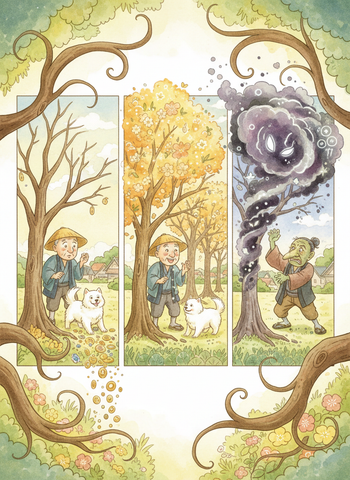
A loyal dog's devotion uncovers a hidden treasure, but his master's jealous neighbor wants the same luck for himself — with consequences that turn ashes into a strange kind of magic.
Long, long ago there lived an old man and his wife who supported themselves by cultivating a small plot of land. Their life had been a very happy and peaceful one save for one great sorrow, and this was they had no child. Their only pet was a dog named Shiro, and on him they lavished all the affection of their old age. Indeed, they loved him so much that whenever they had anything nice to eat they denied themselves to give it to Shiro. Now Shiro means “white,” and he was so called because of his color. He was a real Japanese dog, and very like a small wolf in appearance.
Há muito, muito tempo, viviam um velho e sua esposa que se sustentavam cultivando um pequeno pedaço de terra. Sua vida tinha sido muito feliz e tranquila, exceto por uma grande tristeza: não tinham filhos. Seu único bichinho de estimação era um cão chamado Shiro, sobre quem derramavam todo o afeto de sua velhice. De fato, o amavam tanto que sempre que tinham algo gostoso para comer, privavam-se disso para dar a Shiro. Ora, Shiro significa "branco", e ele se chamava assim por causa de sua cor. Era um verdadeiro cão japonês, e muito parecido, na aparência, com um pequeno lobo.
The happiest hour of the day both for the old man and his dog was when the man returned from his work in the field, and having finished his frugal supper of rice and vegetables, would take what he had saved from the meal out to the little veranda that ran round the cottage. Sure enough, Shiro was waiting for his master and the evening tit-bit. Then the old man said “Chin, chin!” and Shiro sat up and begged, and his master gave him the food.
A hora mais feliz do dia, tanto para o velho quanto para seu cão, era quando o homem voltava do trabalho no campo, e, depois de terminar sua frugal ceia de arroz e legumes, levava o que tinha guardado da refeição até a pequena varanda que contornava a casinha. E, sem falta, Shiro estava esperando por seu dono e pela guloseima da noite. Então o velho dizia "Chin, chin!" e Shiro se sentava e implorava, e seu dono lhe dava a comida.
Next door to this good old couple there lived another old man and his wife who were both wicked and cruel, and who hated their good neighbors and the dog Shiro with all their might. Whenever Shiro happened to look into their kitchen they at once kicked him or threw something at him, sometimes even wounding him.
Na casa vizinha a esse bom velho casal, vivia outro velho e sua esposa, ambos maus e cruéis, que odiavam seus bons vizinhos e o cão Shiro com todas as suas forças. Sempre que Shiro por acaso olhava para dentro da cozinha deles, eles logo lhe davam um chute ou atiravam alguma coisa nele, às vezes até o ferindo.
One day Shiro was heard barking for a long time in the field at the back of his master’s house. The old man, thinking that perhaps some birds were attacking the corn, hurried out to see what was the matter. As soon as Shiro saw his master he ran to meet him, wagging his tail, and, seizing the end of his kimono, dragged him under a large yenoki tree. Here he began to dig very industriously with his paws, yelping with joy all the time. The old man, unable to understand what it all meant, stood looking on in bewilderment. But Shiro went on barking and digging with all his might.
Certo dia, ouviu-se Shiro latindo por um bom tempo no campo atrás da casa de seu dono. O velho, pensando que talvez alguns pássaros estivessem atacando o milho, saiu correndo para ver o que estava acontecendo. Assim que Shiro viu seu dono, correu ao seu encontro, abanando o rabo, e, agarrando a barra de seu quimono, arrastou-o até debaixo de uma grande árvore yenoki. Ali começou a cavar muito diligentemente com as patas, ganindo de alegria o tempo todo. O velho, incapaz de entender o que aquilo tudo significava, ficou olhando, desconcertado. Mas Shiro continuou latindo e cavando com todas as suas forças.
The thought that something might be hidden beneath the tree, and that the dog had scented it, at last struck the old man. He ran back to the house, fetched his spade and began to dig the ground at that spot. What was his astonishment when, after digging for some time, he came upon a heap of old and valuable coins, and the deeper he dug the more gold coins did he find. So intent was the old man on his work that he never saw the cross face of his neighbor peering at him through the bamboo hedge.
A ideia de que algo poderia estar escondido debaixo da árvore, e que o cão o tinha farejado, finalmente ocorreu ao velho. Ele correu de volta para casa, pegou sua pá e começou a cavar a terra naquele lugar. Qual não foi seu espanto quando, depois de cavar por um tempo, deu com um monte de moedas antigas e valiosas, e quanto mais fundo cavava, mais moedas de ouro encontrava. Tão concentrado estava o velho em seu trabalho que nunca viu o rosto zangado de seu vizinho espiando por trás da cerca de bambu.
At last all the gold coins lay shining on the ground. Shiro sat by erect with pride and looking fondly at his master as if to say, “You see, though only a dog, I can make some return for all the kindness you show me.”
Por fim, todas as moedas de ouro jaziam brilhando no chão. Shiro se sentou ereto, cheio de orgulho, olhando com carinho para seu dono, como se dissesse: "Está vendo, ainda que eu seja apenas um cão, posso retribuir um pouco de toda a bondade que você me mostra."
The old man ran in to call his wife, and together they carried home the treasure. Thus in one day the poor old man became rich. His gratitude to the faithful dog knew no bounds, and he loved and petted him more than ever, if that were possible.
O velho entrou correndo para chamar sua esposa, e juntos carregaram o tesouro para casa. Assim, num só dia, o pobre velho se tornou rico. Sua gratidão ao fiel cão não tinha limites, e ele o amava e o mimava mais do que nunca, se é que isso era possível.
The cross old neighbor, attracted by Shiro’s barking, had been an unseen and envious witness of the finding of the treasure. He began to think that he, too, would like to find a fortune. So a few days later he called at the old man’s house and very ceremoniously asked permission to borrow Shiro for a short time.
O rabugento vizinho, atraído pelos latidos de Shiro, tinha sido uma testemunha invisível e invejosa da descoberta do tesouro. Começou a pensar que ele também gostaria de encontrar uma fortuna. Então, alguns dias depois, foi até a casa do velho e, com muita cerimônia, pediu permissão para pegar Shiro emprestado por um curto período.
Shiro’s master thought this a strange request, because he knew quite well that not only did his neighbor not love his pet dog, but that he never lost an opportunity of striking and tormenting him whenever the dog crossed his path. But the good old man was too kind-hearted to refuse his neighbor, so he consented to lend the dog on condition that he should be taken great care of.
O dono de Shiro achou aquele um pedido estranho, pois sabia muito bem que seu vizinho não só não amava seu cãozinho, como também nunca perdia a oportunidade de bater nele e atormentá-lo sempre que o cão cruzava seu caminho. Mas o bom velho tinha o coração bom demais para recusar o vizinho, então consentiu em emprestar o cão, com a condição de que fosse muito bem cuidado.
The wicked old man returned to his home with an evil smile on his face, and told his wife how he had succeeded in his crafty intentions. He then took his spade and hastened to his own field, forcing the unwilling Shiro to follow him. As soon as he reached a yenoki tree, he said to the dog, threateningly:
O velho perverso voltou para casa com um sorriso maligno no rosto, e contou à esposa como tinha conseguido concretizar suas intenções astutas. Então pegou sua pá e correu para seu próprio campo, forçando o relutante Shiro a segui-lo. Assim que chegou a uma árvore yenoki, disse ao cão, ameaçadoramente:
“If there were gold coins under your master’s tree, there must also be gold coins under my tree. You must find them for me! Where are they? Where? Where?”
"Se havia moedas de ouro debaixo da árvore do seu dono, também deve haver moedas de ouro debaixo da minha árvore. Você precisa encontrá-las para mim! Onde estão? Onde? Onde?"
And catching hold of Shiro’s neck he held the dog’s head to the ground, so that Shiro began to scratch and dig in order to free himself from the horrid old man’s grasp.
E agarrando o pescoço de Shiro, ele pressionou a cabeça do cão contra o chão, de modo que Shiro começou a arranhar e a cavar para se libertar das garras daquele velho horrível.
The old man was very pleased when he saw the dog begin to scratch and dig, for he at once supposed that some gold coins lay buried under his tree as well as under his neighbor’s, and that the dog had scented them as before; so pushing Shiro away he began to dig himself, but there was nothing to be found. As he went on digging a foul smell was noticeable, and he at last came upon a refuse heap.
O velho ficou muito satisfeito ao ver o cão começar a arranhar e a cavar, pois logo supôs que havia moedas de ouro enterradas debaixo de sua árvore, assim como debaixo da árvore de seu vizinho, e que o cão as tinha farejado como antes; então, empurrando Shiro para longe, começou a cavar ele mesmo, mas não havia nada a encontrar. Enquanto continuava cavando, um cheiro fétido se tornou perceptível, e ele por fim deu com um monte de lixo.
The old man’s disgust can be imagined. This soon gave way to anger. He had seen his neighbor’s good fortune, and hoping for the same luck himself, he had borrowed the dog Shiro; and now, just as he seemed on the point of finding what he sought, only a horrid smelling refuse heap had rewarded him for a morning’s digging. Instead of blaming his own greed for his disappointment, he blamed the poor dog.
O nojo do velho pode-se imaginar. Isso logo deu lugar à raiva. Ele tinha visto a boa sorte de seu vizinho, e esperando a mesma sorte para si mesmo, tinha pego o cão Shiro emprestado; e agora, bem quando parecia estar prestes a encontrar o que procurava, apenas um monte de lixo malcheiroso o havia recompensado por uma manhã de escavação. Em vez de culpar sua própria ganância pela decepção, culpou o pobre cão.
He seized his spade, and with all his strength struck Shiro and killed him on the spot. He then threw the dog’s body into the hole which he had dug in the hope of finding a treasure of gold coins, and covered it over with the earth. Then he returned to the house, telling no one, not even his wife, what he had done.
Pegou sua pá, e com toda a força golpeou Shiro e o matou na hora. Depois jogou o corpo do cão no buraco que tinha cavado na esperança de encontrar um tesouro de moedas de ouro, e o cobriu com terra. Então voltou para casa, sem contar a ninguém, nem mesmo à esposa, o que tinha feito.
After waiting several days, as the dog Shiro did not return, his master began to grow anxious. Day after day went by and the good old man waited in vain. Then he went to his neighbor and asked him to give him back his dog. Without any shame or hesitation, the wicked neighbor answered that he had killed Shiro because of his bad behavior.
Depois de esperar vários dias, como o cão Shiro não voltava, seu dono começou a ficar ansioso. Dia após dia se passou, e o bom velho esperou em vão. Então foi até seu vizinho e pediu que lhe devolvesse o cão. Sem nenhuma vergonha ou hesitação, o vizinho perverso respondeu que tinha matado Shiro por causa de seu mau comportamento.
At this dreadful news Shiro’s master wept many sad and bitter tears. Great indeed, was his woful surprise, but he was too good and gentle to reproach his bad neighbor. Learning that Shiro was buried under the yenoki tree in the field, he asked the old man to give him the tree, in remembrance of his poor dog Shiro.
Diante dessa notícia terrível, o dono de Shiro chorou muitas lágrimas tristes e amargas. Grande, de fato, foi sua triste surpresa, mas ele era bom e gentil demais para repreender seu vizinho ruim. Ao saber que Shiro estava enterrado debaixo da árvore yenoki no campo, pediu ao velho que lhe desse a árvore, em memória de seu pobre cão Shiro.
Even the cross old neighbor could not refuse such a simple request, so he consented to give the old man the tree under which Shiro lay buried. Shiro’s master then cut the tree down and carried it home. Out of the trunk he made a mortar. In this his wife put some rice, and he began to pound it with the intention of making a festival to the memory of his dog Shiro.
Até mesmo o rabugento vizinho não pôde recusar um pedido tão simples, então consentiu em dar ao velho a árvore sob a qual Shiro jazia enterrado. O dono de Shiro então cortou a árvore e a levou para casa. Do tronco, fez um pilão. Nele sua esposa colocou um pouco de arroz, e ele começou a socá-lo com a intenção de fazer um festival em memória de seu cão Shiro.
A strange thing happened! His wife put the rice into the mortar, and no sooner had he begun to pound it to make the cakes, than it began to increase in quantity gradually till it was about five times the original amount, and the cakes were turned out of the mortar as if an invisible hand were at work.
Aconteceu uma coisa estranha! Sua esposa colocou o arroz no pilão, e assim que ele começou a socá-lo para fazer os bolinhos, este começou a aumentar de quantidade gradualmente, até chegar a cerca de cinco vezes a quantidade original, e os bolinhos saíam do pilão como se uma mão invisível estivesse trabalhando.
When the old man and his wife saw this, they understood that it was a reward to them from Shiro for their faithful love to him. They tasted the cakes and found them nicer than any other food. So from this time they never troubled about food, for they lived upon the cakes with which the mortar never ceased to supply them.
Quando o velho e sua esposa viram isso, entenderam que era uma recompensa de Shiro por seu amor fiel a ele. Provaram os bolinhos e os acharam mais gostosos que qualquer outra comida. Então, a partir daquele momento, nunca mais se preocuparam com comida, pois viveram dos bolinhos com que o pilão nunca deixou de supri-los.
The greedy neighbor, hearing of this new piece of good luck, was filled with envy as before, and called on the old man and asked leave to borrow the wonderful mortar for a short time, pretending that he, too, sorrowed for the death of Shiro, and wished to make cakes for a festival to the dog’s memory.
O vizinho ganancioso, ao ouvir falar dessa nova sorte, encheu-se de inveja como antes, e foi visitar o velho e pediu licença para pegar emprestado o maravilhoso pilão por um curto período, fingindo que também lamentava a morte de Shiro, e desejava fazer bolinhos para um festival em memória do cão.
The old man did not in the least wish to lend it to his cruel neighbor, but he was too kind to refuse. So the envious man carried home the mortar, but he never brought it back.
O velho não queria de forma alguma emprestá-lo a seu vizinho cruel, mas era gentil demais para recusar. Então o homem invejoso levou o pilão para casa, mas nunca o devolveu.
Several days passed, and Shiro’s master waited in vain for the mortar, so he went to call on the borrower, and asked him to be good enough to return the mortar if he had finished with it. He found him sitting by a big fire made of pieces of wood. On the ground lay what looked very much like pieces of a broken mortar. In answer to the old man’s inquiry, the wicked neighbor answered haughtily:
Vários dias se passaram, e o dono de Shiro esperou em vão pelo pilão, então foi visitar o homem que o havia emprestado, e pediu-lhe a gentileza de devolver o pilão, se já tivesse terminado de usá-lo. Encontrou-o sentado junto a uma grande fogueira feita de pedaços de madeira. No chão jaziam pedaços que se pareciam muito com fragmentos de um pilão quebrado. Em resposta à pergunta do velho, o vizinho perverso respondeu com arrogância:
“Have you come to ask me for your mortar? I broke it to pieces, and now I am making a fire of the wood, for when I tried to pound cakes in it only some horrid smelling stuff came out.”
"Veio me pedir seu pilão? Eu o quebrei em pedaços, e agora estou fazendo uma fogueira com a madeira, pois quando tentei socar bolinhos nele, só saiu de dentro alguma coisa de cheiro horrível."
The good old man said:
O bom velho disse:
“I am very sorry for that. It is a great pity you did not ask me for the cakes if you wanted them. I would have given you as many as ever you wanted. Now please give me the ashes of the mortar, as I wish to keep them in remembrance of my dog.”
"Sinto muito por isso. É uma grande pena que você não tenha me pedido os bolinhos, se os desejava. Eu lhe teria dado tantos quantos você quisesse. Agora, por favor, dê-me as cinzas do pilão, pois desejo guardá-las em memória de meu cão."
The neighbor consented at once, and the old man carried home a basket full of ashes.
O vizinho consentiu na hora, e o velho levou para casa uma cesta cheia de cinzas.
Not long after this the old man accidentally scattered some of the ashes made by the burning of the mortar on the trees of his garden. A wonderful thing happened!
Não muito depois disso, o velho, por acidente, espalhou algumas das cinzas produzidas pela queima do pilão sobre as árvores de seu jardim. Aconteceu uma coisa maravilhosa!
It was late in autumn and all the trees had shed their leaves, but no sooner did the ashes touch their branches than the cherry trees, the plum trees, and all other blossoming shrubs burst into bloom, so that the old man’s garden was suddenly transformed into a beautiful picture of spring. The old man’s delight knew no bounds, and he carefully preserved the remaining ashes.
Era já bem tarde no outono, e todas as árvores tinham perdido suas folhas, mas assim que as cinzas tocaram seus galhos, as cerejeiras, as ameixeiras e todos os outros arbustos floridos irromperam em flor, de modo que o jardim do velho se transformou de repente num belo quadro de primavera. A alegria do velho não tinha limites, e ele preservou com cuidado as cinzas restantes.
The story of the old man’s garden spread far and wide, and people from far and near came to see the wonderful sight.
A história do jardim do velho se espalhou por toda parte, e vinha gente de longe e de perto para ver aquela visão maravilhosa.
One day, soon after this, the old man heard some one knocking at his door, and going to the porch to see who it was he was surprised to see a Knight standing there. This Knight told him that he was a retainer of a great Daimio (Earl); that one of the favorite cherry trees in this nobleman’s garden had withered, and that though every one in his service had tried all manner of means to revive it, none took effect.
Um dia, pouco depois disso, o velho ouviu alguém batendo à sua porta, e, indo até o alpendre ver quem era, surpreendeu-se ao ver um Cavaleiro parado ali. Esse Cavaleiro lhe disse que era vassalo de um grande Daimio (Conde); que uma das cerejeiras favoritas no jardim daquele nobre havia murchado, e que, embora todos a seu serviço tivessem tentado toda sorte de meios para reanimá-la, nenhum tinha surtido efeito.
The Knight was sore perplexed when he saw what great displeasure the loss of his favorite cherry tree caused the Daimio. At this point, fortunately, they had heard that there was a wonderful old man who could make withered trees to blossom, and that his Lord had sent him to ask the old man to come to him.
O Cavaleiro estava muito perturbado ao ver o grande desagrado que a perda da cerejeira favorita causava ao Daimio. Nesse momento, felizmente, tinham ouvido dizer que havia um velho maravilhoso capaz de fazer árvores murchas florescerem, e que seu Senhor o tinha enviado para pedir ao velho que fosse até ele.
“And,” added the Knight, “I shall be very much obliged if you will come at once.”
"E", acrescentou o Cavaleiro, "ficarei muito grato se o senhor vier imediatamente."
The good old man was greatly surprised at what he heard, but respectfully followed the Knight to the nobleman’s Palace.
O bom velho ficou muito surpreso com o que ouviu, mas seguiu respeitosamente o Cavaleiro até o Palácio do nobre.
The Daimio, who had been impatiently awaiting the old man’s coming, as soon as he saw him asked him at once:
O Daimio, que esperava impacientemente pela chegada do velho, assim que o viu, perguntou-lhe imediatamente:
“Are you the old man who can make withered trees flower even out of season?”
"É o senhor o velho que consegue fazer árvores murchas florescerem, mesmo fora de estação?"
The old man made an obeisance, and replied:
O velho fez uma reverência, e respondeu:
“I am that old man!”
"Sou eu mesmo esse velho!"
Then the Daimio said:
Então o Daimio disse:
“You must make that dead cherry tree in my garden blossom again by means of your famous ashes. I shall look on.”
"O senhor deve fazer aquela cerejeira morta em meu jardim florescer novamente, por meio de suas famosas cinzas. Vou observar."
Then they all went into the garden—the Daimio and his retainers and the ladies-in waiting, who carried the Daimio’s sword.
Então todos foram para o jardim — o Daimio e seus vassalos e as damas de companhia, que carregavam a espada do Daimio.
The old man now tucked up his kimono and made ready to climb the tree. Saying “Excuse me,” he took the pot of ashes which he had brought with him, and began to climb the tree, every one watching his movements with great interest.
O velho então arregaçou seu quimono e se preparou para subir na árvore. Dizendo "com licença", pegou o pote de cinzas que trouxera consigo, e começou a subir na árvore, com todos observando seus movimentos com grande interesse.
At last he climbed to the spot where the tree divided into two great branches, and taking up his position here, the old man sat down and scattered the ashes right and left all over the branches and twigs.
Por fim, subiu até o ponto onde a árvore se dividia em dois grandes galhos, e, posicionando-se ali, o velho se sentou e espalhou as cinzas para a direita e para a esquerda, por todos os galhos e ramos.
Wonderful, indeed, was the result! The withered tree at once burst into full bloom! The Daimio was so transported with joy that he looked as if he would go mad. He rose to his feet and spread out his fan, calling the old man down from the tree. He himself gave the old man a wine cup filled with the best SAKE, and rewarded him with much silver and gold and many other precious things. The Daimio ordered that henceforth the old man should call himself by the name of Hana-Saka-Jijii, or “The Old Man who makes the Trees to Blossom,” and that henceforth all were to recognize him by this name, and he sent him home with great honor.
Maravilhoso, de fato, foi o resultado! A árvore murcha irrompeu de imediato em plena floração! O Daimio ficou tão transportado de alegria que parecia que ia enlouquecer. Levantou-se e abriu seu leque, chamando o velho para descer da árvore. Ele mesmo deu ao velho uma taça de vinho cheia do melhor SAQUÊ, e o recompensou com muita prata e ouro e muitas outras coisas preciosas. O Daimio ordenou que, dali em diante, o velho se chamasse Hana-Saka-Jijii, ou "O Velho que Faz as Árvores Florescerem", e que, dali em diante, todos o reconhecessem por esse nome, e o mandou de volta para casa com grande honra.
The wicked neighbor, as before, heard of the good old man’s fortune, and of all that had so auspiciously befallen him, and he could not suppress all the envy and jealousy that filled his heart. He called to mind how he had failed in his attempt to find the gold coins, and then in making the magic cakes; this time surely he must succeed if he imitated the old man, who made withered trees to flower simply by sprinkling ashes on them. This would be the simplest task of all.
O vizinho perverso, como antes, ouviu falar da boa sorte do bom velho, e de tudo o que lhe tinha ocorrido tão auspiciosamente, e não conseguiu suprimir toda a inveja e o ciúme que lhe enchiam o coração. Lembrou-se de como tinha fracassado em sua tentativa de encontrar as moedas de ouro, e depois em fazer os bolinhos mágicos; desta vez, com certeza, teria de ter sucesso, se imitasse o velho, que fazia árvores murchas florescerem simplesmente espalhando cinzas sobre elas. Essa seria a tarefa mais simples de todas.
So he set to work and gathered together all the ashes which remained in the fire-place from the burning of the wonderful mortar. Then he set out in the hope of finding some great man to employ him, calling out loudly as he went along:
Então ele se pôs a trabalhar e reuniu todas as cinzas que restavam na lareira, da queima do maravilhoso pilão. Depois partiu na esperança de encontrar algum grande homem para empregá-lo, gritando bem alto enquanto caminhava:
“Here comes the wonderful man who can make withered trees blossom! Here comes the old man who can make dead trees blossom!”
"Aí vem o homem maravilhoso que consegue fazer árvores murchas florescerem! Aí vem o velho que consegue fazer árvores mortas florescerem!"
The Daimio in his Palace heard this cry, and said:
O Daimio, em seu Palácio, ouviu esse chamado, e disse:
“That must be the Hana-Saka-Jijii passing. I have nothing to do to-day. Let him try his art again; it will amuse me to look on.”
"Deve ser o Hana-Saka-Jijii passando. Não tenho nada para fazer hoje. Deixem que ele tente sua arte de novo; será divertido observar."
So the retainers went out and brought in the impostor before their Lord. The satisfaction of false old man can now be imagined.
Então os vassalos saíram e trouxeram o impostor diante de seu Senhor. A satisfação do velho falsário pode-se agora imaginar.
But the Daimio looking at him, thought it strange that he was not at all like the old man he had seen before, so he asked him:
Mas o Daimio, olhando para ele, achou estranho que não se parecesse em nada com o velho que tinha visto antes, então lhe perguntou:
“Are you the man whom I named Hana-Saka-Jijii?”
"É o senhor o homem a quem chamei de Hana-Saka-Jijii?"
And the envious neighbor answered with a lie:
E o vizinho invejoso respondeu com uma mentira:
“Yes, my Lord!”
"Sim, meu Senhor!"
“That is strange!” said the Daimio. “I thought there was only one Hana-Saka-Jijii in the world! Has he now some disciples?”
"Que estranho!" disse o Daimio. "Pensei que houvesse apenas um Hana-Saka-Jijii no mundo! Ele agora tem discípulos?"
“I am the true Hana-Saka-Jijii. The one who came to you before was only my disciple!” replied the old man again.
"Eu sou o verdadeiro Hana-Saka-Jijii. Aquele que veio ao senhor antes era apenas meu discípulo!" respondeu de novo o velho.
“Then you must be more skillful than the other. Try what you can do and let me see!”
"Então o senhor deve ser mais habilidoso que o outro. Tente o que sabe fazer e deixe-me ver!"
The envious neighbor, with the Daimio and his Court following, then went into the garden, and approaching a dead tree, took out a handful of the ashes which he carried with him, and scattered them over the tree.
O vizinho invejoso, seguido pelo Daimio e sua Corte, foi então até o jardim, e, aproximando-se de uma árvore morta, tirou um punhado das cinzas que trazia consigo, e as espalhou sobre a árvore.
But not only did the tree not burst into flower, but not even a bud came forth. Thinking that he had not used enough ashes, the old man took handfuls and again sprinkled them over the withered tree. But all to no effect. After trying several times, the ashes were blown into the Daimio’s eyes. This made him very angry, and he ordered his retainers to arrest the false Hana-Saka-Jijii at once and put him in prison for an impostor. From this imprisonment the wicked old man was never freed. Thus did he meet with punishment at last for all his evil doings.
Mas não só a árvore não irrompeu em flor, como nem sequer surgiu um único broto. Pensando que não tinha usado cinzas suficientes, o velho pegou mais punhados e de novo os espalhou sobre a árvore murcha. Mas tudo sem efeito algum. Depois de tentar várias vezes, as cinzas foram sopradas para os olhos do Daimio. Isso o deixou muito irritado, e ele ordenou a seus vassalos que prendessem imediatamente o falso Hana-Saka-Jijii e o colocassem na prisão, por impostor. Dessa prisão, o velho perverso nunca foi libertado. Assim, por fim, ele encontrou o castigo por todos os seus atos maldosos.
The good old man, however, with the treasure of gold coins which Shiro had found for him, and with all the gold and the silver which the Daimio had showered on him, became a rich and prosperous man in his old age, and lived a long and happy life, beloved and respected by all.
O bom velho, porém, com o tesouro de moedas de ouro que Shiro tinha encontrado para ele, e com todo o ouro e a prata que o Daimio lhe tinha concedido em abundância, tornou-se um homem rico e próspero em sua velhice, e viveu uma vida longa e feliz, amado e respeitado por todos.
