The Sheep and the Pig who Set Up House
A free B1-level English story for language learners, readable online in 7 languages, with an option to listen via the free Storyteller app.
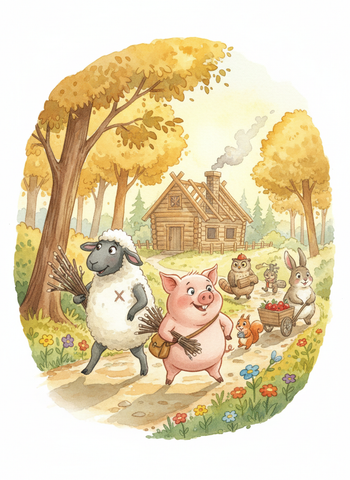
A sheep marked for slaughter talks a pig into running away with him to build a house in the woods — and recruits an odd crew of animal helpers along the way.
"Once on a time there was a sheep who stood in the pen to be fattened; so he lived well, and was stuffed and crammed with everything that was good. So it went on, till, one day, the dairymaid came and gave him still more food, and then she said,
— Era uma vez uma ovelha que ficava no curral para engordar; então ela vivia bem, e era recheada e empanturrada com tudo que era bom. E assim foi, até que, um dia, a leiteira veio e lhe deu ainda mais comida, e então disse:
"'Eat away, sheep; you won't be much longer here; we are going to kill you to-morrow.'
— "Coma bem, ovelha; você não vai ficar muito mais tempo aqui; vamos te matar amanhã."
"It is an old saying, that women's counsel is always worth having, and that there is a cure and physic for everything but death. 'But, after all,' said the sheep to himself, 'there may be a cure even for death this time.'
— É um velho ditado que o conselho das mulheres sempre vale a pena ouvir, e que há remédio e cura para tudo menos para a morte. "Mas, afinal", disse a ovelha para si mesma, "talvez desta vez haja uma cura até mesmo para a morte."
"So he ate till he was ready to burst; and when he was crammed full, he butted out the door of the pen, and took his way to the neighbouring farm. There he went to the pigsty to a pig whom he had known out on the common, and ever since had been the best friends with.
— Então ela comeu até quase estourar; e quando estava toda recheada, deu uma cabeçada na porta do curral, e seguiu caminho até a fazenda vizinha. Ali foi até o chiqueiro, até um porco que conhecia dos pastos comuns, e com quem desde então era o melhor amigo.
"'Good day!' said the sheep, 'and thanks for our last merry meeting.'
— "Bom dia!" disse a ovelha, "e obrigada pelo nosso último encontro alegre."
"'Good day!' answered the pig, 'and the same to you.'
— "Bom dia!" respondeu o porco, "o mesmo para você."
"'Do you know,' said the sheep, 'why it is you are so well off, and why it is they fatten you and take such pains with you?'
— "Você sabe", disse a ovelha, "por que você vive tão bem, e por que te engordam e têm tanto cuidado com você?"
"'No, I don't,' said the pig.
— "Não, não sei", disse o porco.
"'Many a flask empties the cask; I suppose you know that,' said the sheep. 'They are going to kill and eat you.'
— "Muitos frascos esvaziam o barril; suponho que você saiba disso", disse a ovelha. "Eles vão te matar e te comer."
"'Are they?' said the pig; 'well, I hope they'll say grace after meat.'
— "Vão?" disse o porco; "bem, espero que rezem antes da refeição."
"'If you will do as I do,' said the sheep, 'we'll go off to the wood, build us a house, and set up for ourselves. A home is a home be it ever so homely.'
— "Se você fizer como eu", disse a ovelha, "vamos embora para o bosque, construir uma casa para nós, e nos estabelecer por conta própria. Um lar é um lar, por mais simples que seja."
"Yes! the pig was willing enough. 'Good company is such a comfort,' he said, and so the two set off.
— Sim! O porco estava bem disposto. "Boa companhia é um grande conforto", disse ele, e então os dois partiram.
"So, when they had gone a bit they met a goose.
— Então, quando já tinham andado um pouco, encontraram um ganso.
"'Good day, good sirs, and thanks for our last merry meeting,' said the goose; 'whither away so fast to-day?'
— "Bom dia, bons senhores, e obrigado pelo nosso último encontro alegre", disse o ganso; "para onde vão com tanta pressa hoje?"
"'Good day, and the same to you,' said the sheep; 'you must know we were too well off at home, and so we are going to set up for ourselves in the wood, for you know every man's house is his castle.'
— "Bom dia, o mesmo para você", disse a ovelha; "saiba que estávamos vivendo bem demais em casa, e por isso vamos nos estabelecer por conta própria no bosque, pois, como se sabe, a casa de cada um é o seu castelo."
"'Well!' said the goose, 'it's much the same with me where I am. Can't I go with you too, for it's child's play when three share the day.'
— "Bem!" disse o ganso, "é praticamente a mesma coisa comigo onde estou. Não posso ir com vocês também? Pois é brincadeira de criança quando três dividem o dia."
"'With gossip and gabble is built neither house nor stable,' said the pig, 'let us know what you can do.'
— "Com fofoca e tagarelice não se constrói nem casa nem estábulo", disse o porco, "deixe-nos saber o que você sabe fazer."
"'By cunning and skill a cripple can do what he will,' said the goose. 'I can pluck moss and stuff it into the seams of the planks, and your house will be tight and warm.'
— "Com astúcia e habilidade, até um aleijado faz o que quer", disse o ganso. "Eu posso arrancar musgo e enfiá-lo nas frestas das tábuas, e sua casa vai ficar bem vedada e quentinha."
"Yes! they would give him leave, for, above all things piggy wished to be warm and comfortable.
— Sim! Deram-lhe licença, pois, acima de tudo, o porquinho queria ficar quentinho e confortável.
"So, when they had gone a bit farther—the goose had hard work to walk so fast—they met a hare, who came frisking out of the wood.
— Então, quando já tinham ido um pouco mais longe — o ganso tinha muito trabalho para andar tão depressa — encontraram uma lebre, que saiu saltitando do bosque.
"'Good day, good sirs, and thanks for our last merry meeting,' she said, 'how far are you trotting to-day?'
— "Bom dia, bons senhores, e obrigada pelo nosso último encontro alegre", disse ela, "até onde vão trotando hoje?"
"'Good day, and the same to you,' said the sheep; 'we were far too well off at home, and so we're going to the wood, to build us a house, and set up for ourselves, for you know, try all the world round, there's nothing like home.'
— "Bom dia, o mesmo para você", disse a ovelha; "estávamos vivendo bem demais em casa, e por isso vamos para o bosque, construir uma casa para nós, e nos estabelecer por conta própria, pois, como se sabe, procurando o mundo todo, não há nada como o lar."
"'As for that,' said the hare, 'I have a house in every bush—yes, a house in every bush; but, yet, I have often said, in winter, 'if I only live till summer, I'll build me a house;' and so I have half a mind to go with you and build one up, after all.'
— "Quanto a isso", disse a lebre, "eu tenho uma casa em cada moita — sim, uma casa em cada moita; mas, ainda assim, sempre digo, no inverno, 'se eu apenas viver até o verão, construirei uma casa para mim'; e por isso estou meio inclinada a ir com vocês e construir uma, afinal de contas."
"'Yes!' said the pig, 'if we ever get into a scrape, we might use you to scare away the dogs, for you don't fancy you could help us in house building.'
— "Sim!" disse o porco, "se algum dia entrarmos numa encrenca, podemos usar você para afugentar os cachorros, pois não imagino que você possa nos ajudar a construir casa."
"'He who lives long enough always finds work enough to do,' said the hare. 'I have teeth to gnaw pegs, and paws to drive them into the wall, so I can very well set up to be a carpenter, for "good tools make good work," as the man said, when he flayed the mare with a gimlet.'
— "Quem vive o bastante sempre encontra trabalho suficiente para fazer", disse a lebre. "Tenho dentes para roer pregos, e patas para cravá-los na parede, então posso muito bem me estabelecer como carpinteira, pois 'boas ferramentas fazem bom trabalho', como disse o homem, quando esfolou a égua com uma verruma."
"Yes! he too got leave to go with them and build their house, there was nothing more to be said about it.
— Sim! Ela também recebeu licença para ir com eles e construir a casa, não havia mais nada a dizer sobre isso.
"When they had gone a bit farther they met a cock.
— Quando já tinham ido um pouco mais longe, encontraram um galo.
"'Good day, good sirs,' said the cock, 'and thanks for our last merry meeting; whither are ye going to-day, gentlemen?'
— "Bom dia, bons senhores", disse o galo, "e obrigado pelo nosso último encontro alegre; para onde vão hoje, cavalheiros?"
"'Good day, and the same to you,' said the sheep. 'At home we were too well off, and so we are going off to the wood to build us a house, and set up for ourselves; for he who out of doors shall bake, loses at last both coal and cake.'
— "Bom dia, o mesmo para você", disse a ovelha. "Em casa vivíamos bem demais, e por isso vamos para o bosque construir uma casa para nós, e nos estabelecer por conta própria; pois quem assa pão ao ar livre acaba perdendo tanto o carvão quanto o bolo."
"'Well!' said the cock, 'that's just my case; but it's better to sit on one's own perch, for then one can never be left in the lurch, and, besides, all cocks crow loudest at home. Now, if I might have leave to join such a gallant company, I also would like to go to the wood and build a house.'
— "Bem!" disse o galo, "esse é exatamente o meu caso; mas é melhor sentar no próprio poleiro, pois assim nunca se fica na mão, e, além disso, todo galo canta mais alto em casa. Ora, se eu pudesse ter licença para me juntar a tão galante companhia, também gostaria de ir ao bosque e construir uma casa."
"'Ay! ay!' said the pig, 'flapping and crowing sets tongues a-going; but a jaw on a stick never yet laid a brick. How can you ever help us to build a house?'
— "Ei, ei!" disse o porco, "bater as asas e cantar faz as línguas se soltarem; mas um papo furado nunca assentou um tijolo. Como é que você vai nos ajudar a construir uma casa?"
"'Oh!' said the cock, 'that house will never have a clock, where there is neither dog nor cock. I am up early, and I wake every one.'
— "Ah!" disse o galo, "aquela casa nunca terá um relógio, onde não há nem cachorro nem galo. Eu acordo cedo, e acordo todo mundo."
"'Very true,' said the pig, 'the morning hour has a golden dower; let him come with us;' for, you must know, piggy was always the soundest sleeper. 'Sleep is the biggest thief,' he said; 'he thinks nothing of stealing half one's life.'
— "Muito verdade", disse o porco, "a hora da manhã tem dote de ouro; deixem-no vir conosco;" pois, saibam vocês, o porquinho sempre foi o que dormia mais pesado. "O sono é o maior ladrão", disse ele; "não pensa duas vezes antes de roubar metade da vida da gente."
"So they all set off to the wood, as a band and brotherhood, and built the house. The pig hewed the timber, and the sheep drew it home; the hare was carpenter, and gnawed pegs and bolts, and hammered them into the walls and roof; the goose plucked moss and stuffed it into the seams; the cock crew, and looked out that they did not oversleep themselves in the morning; and when the house was ready, and the roof lined with birch bark, and thatched with turf; there they lived by themselves, and were merry and well. ''Tis good to travel east and west,' said the sheep, 'but after all a home is best.'
— Então todos partiram para o bosque, como uma banda e irmandade, e construíram a casa. O porco cortava a madeira, e a ovelha a carregava para casa; a lebre era a carpinteira, e roía pinos e cavilhas, e os martelava nas paredes e no telhado; o ganso arrancava musgo e o enfiava nas frestas; o galo cantava, e cuidava para que não dormissem demais pela manhã; e quando a casa estava pronta, e o telhado forrado com casca de bétula, e coberto com torrão de grama; ali viveram por conta própria, e foram felizes e prósperos. "É bom viajar para leste e para oeste", disse a ovelha, "mas no fim das contas, um lar é o melhor de tudo."
"But you must know that a bit farther on in the wood was a wolf's den, and there lived two graylegs. So when they saw that a new house had risen up hard by, they wanted to know what sort of folk their neighbours were, for they thought to themselves that a good neighbour was better than a brother in a foreign land, and that it was better to live in a good neighbourhood than to know many people miles and miles off.
— Mas saibam que um pouco mais adiante no bosque havia uma toca de lobo, e ali viviam dois lobos-cinzentos. Então, quando viram que uma casa nova tinha surgido bem perto, quiseram saber que tipo de gente eram seus vizinhos, pois pensaram consigo mesmos que um bom vizinho era melhor que um irmão em terra estrangeira, e que era melhor viver numa boa vizinhança do que conhecer muita gente a quilômetros e quilômetros de distância.
"So one of them made up an errand, and went into the new house and asked for a light for his pipe. But as soon as ever he got inside the door, the sheep gave him such a butt that he fell head foremost into the stove. Then the pig began to gore and bite him, the goose to nip and peck him, the cock upon the roost to crow and chatter; and as for the hare he was so frightened out of his wits, that he ran about aloft and on the floor, and scratched and scrambled in every corner of the house.
— Então um deles inventou um pretexto, e entrou na casa nova pedindo fogo para o cachimbo. Mas assim que pôs os pés dentro da porta, a ovelha lhe deu uma cabeçada tão forte que ele caiu de cabeça dentro do fogão. Então o porco começou a chifrá-lo e mordê-lo, o ganso a beliscá-lo e bicá-lo, o galo no poleiro a cantar e tagarelar; e quanto à lebre, ela ficou tão apavorada que saiu correndo por cima e pelo chão, arranhando e se espremendo em cada canto da casa.
"So after a long time the wolf came out.
— Então, depois de muito tempo, o lobo saiu.
"'Well!' said the one who waited for him outside, 'neighbourhood makes brotherhood. You must have come into a perfect paradise on bare earth, since you stayed so long. But what became of the light, for you have neither pipe nor smoke.'
— "Bem!" disse aquele que o esperava do lado de fora, "vizinhança faz irmandade. Você deve ter entrado num verdadeiro paraíso na terra, já que ficou tanto tempo. Mas o que aconteceu com o fogo, pois você não tem nem cachimbo nem fumaça."
"'Yes, yes!' said the other; 'it was just a nice light and a pleasant company. Such manners I never saw in all my life. But then you know we can't pick and choose in this wicked world, and an unbidden guest gets bad treatment. As soon as I got inside the door, the shoe-maker let fly at me with his last, so that I fell head foremost into the stithy fire; and there sat two smiths who blew the bellows and made the sparks fly, and beat and punched me with red hot tongs and pincers, so that they tore whole pieces out of my body.
— "Sim, sim!" disse o outro; "foi um fogo agradável e uma companhia muito boa. Nunca vi maneiras assim em toda a minha vida. Mas você sabe que não podemos escolher a dedo neste mundo perverso, e um convidado não chamado recebe mau tratamento. Assim que entrei pela porta, o sapateiro me atirou sua forma, de modo que caí de cabeça no fogo da forja; e ali estavam sentados dois ferreiros que sopravam o fole e faziam as faíscas voarem, e me bateram e me espetaram com tenazes e pinças em brasa, de tal forma que arrancaram pedaços inteiros do meu corpo.
"As for the hunter he went scrambling about looking for his gun, and it was good luck he did not find it. And all the while there was another who sat up under the roof, and slapped his arms and sang out,
— Quanto ao caçador, ele ficou remexendo por ali procurando sua arma, e foi sorte não tê-la encontrado. E o tempo todo havia um outro que ficava lá em cima, sob o telhado, batendo os braços e cantando:
"'Put a hook into him, and drag him hither, drag him hither.' That was what he screamed, and if he had only got hold of me, I should never have come out alive."
— "Enfiem um gancho nele, e arrastem-no para cá, arrastem-no para cá." Foi isso que ele gritou, e se tivesse conseguido me agarrar, eu nunca teria saído vivo de lá.
