Cap O' Rushes
A free B1-level English story for language learners, readable online in 7 languages, with an option to listen via the free Storyteller app.
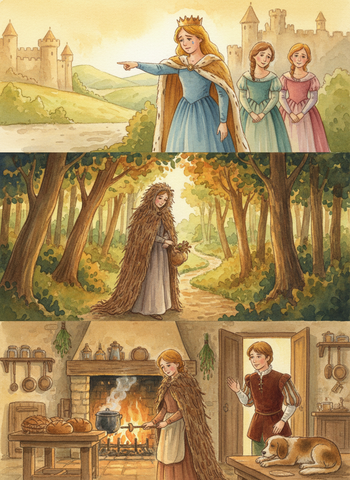
A father disowns his youngest daughter for an odd answer about her love for him, so she disguises herself in a cloak of rushes and finds work far from home.
Well, there was once a very rich gentleman, and he'd three daughters, and he thought he'd see how fond they were of him. So he says to the first, “How much do you love me, my dear?”
Pois bem, havia uma vez um cavalheiro muito rico, e ele tinha três filhas, e pensou em ver o quanto elas gostavam dele. Então disse à primeira: — Quanto você me ama, minha querida?
“Why,” says she, “as I love my life.”
— Ora — disse ela — como amo a minha própria vida.
“That's good,” says he.
— Isso é bom — disse ele.
So he says to the second, “How much do you love me, my dear?”
Então disse à segunda: — Quanto você me ama, minha querida?
“Why,” says she, “better nor all the world.”
— Ora — disse ela — mais do que a tudo no mundo.
“That's good,” says he.
— Isso é bom — disse ele.
So he says to the third, “How much do you love me, my dear?”
Então disse à terceira: — Quanto você me ama, minha querida?
“Why, I love you as fresh meat loves salt,” says she.
— Eu amo o senhor como a carne fresca ama o sal — disse ela.
Well, he was that angry. “You don't love me at all,” says he, “and in my house you stay no more.” So he drove her out there and then, and shut the door in her face.
Bem, ele ficou tão zangado. — Você não me ama nada — disse ele — e na minha casa você não fica mais. — E a expulsou ali mesmo, e bateu a porta na cara dela.
Well, she went away on and on till she came to a fen, and there she gathered a lot of rushes and made them into a kind of a sort of a cloak with a hood, to cover her from head to foot, and to hide her fine clothes. And then she went on and on till she came to a great house.
Bem, ela foi caminhando e caminhando até chegar a um pântano, e ali colheu um monte de juncos e fez deles uma espécie de manto com capuz, para se cobrir da cabeça aos pés e esconder suas roupas finas. E então seguiu caminhando e caminhando até chegar a uma grande casa.
“Do you want a maid?” says she.
— A senhora precisa de uma criada? — disse ela.
“No, we don't,” said they.
— Não, não precisamos — disseram eles.
“I haven't nowhere to go,” says she; “and I ask no wages, and do any sort of work,” says she.
— Não tenho para onde ir — disse ela — e não peço salário nenhum, e faço qualquer tipo de trabalho — disse ela.
“Well,” says they, “if you like to wash the pots and scrape the saucepans you may stay,” said they.
— Bem — disseram eles — se você quiser lavar as panelas e esfregar as caçarolas, pode ficar — disseram eles.
So she stayed there and washed the pots and scraped the saucepans and did all the dirty work. And because she gave no name they called her “Cap o' Rushes.”
Então ela ficou ali e lavou as panelas e esfregou as caçarolas e fez todo o trabalho sujo. E como ela não deu nome nenhum, chamaram-na de "Touca de Juncos".
Well, one day there was to be a great dance a little way off, and the servants were allowed to go and look on at the grand people. Cap o' Rushes said she was too tired to go, so she stayed at home.
Bem, um dia haveria um grande baile não muito longe dali, e os criados tinham permissão para ir olhar a gente fina. Touca de Juncos disse que estava cansada demais para ir, então ficou em casa.
But when they were gone she offed with her cap o' rushes, and cleaned herself, and went to the dance. And no one there was so finely dressed as her.
Mas quando todos foram embora, ela tirou sua touca de juncos, se arrumou, e foi ao baile. E ninguém ali estava tão bem vestida quanto ela.
Well, who should be there but her master's son, and what should he do but fall in love with her the minute he set eyes on her. He wouldn't dance with any one else.
Bem, quem estava lá senão o filho do patrão, e o que ele fez senão se apaixonar por ela no minuto em que pôs os olhos nela. Ele não quis dançar com mais ninguém.
But before the dance was done Cap o' Rushes slipt off, and away she went home. And when the other maids came back she was pretending to be asleep with her cap o' rushes on.
Mas antes que o baile terminasse, Touca de Juncos escapuliu, e foi para casa. E quando as outras criadas voltaram, ela fingia estar dormindo com sua touca de juncos posta.
Well, next morning they said to her, “You did miss a sight, Cap o' Rushes!”
Bem, na manhã seguinte disseram a ela: — Você perdeu uma visão e tanto, Touca de Juncos!
“What was that?” says she.
— O que foi? — disse ela.
“Why, the beautifullest lady you ever see, dressed right gay and ga'. The young master, he never took his eyes off her.”
— Ora, a moça mais bonita que você já viu, vestida tão elegante e vistosa. O jovem patrão não tirou os olhos dela nem um instante.
“Well, I should have liked to have seen her,” says Cap o' Rushes.
— Bem, eu gostaria de ter visto — disse Touca de Juncos.
“Well, there's to be another dance this evening, and perhaps she'll be there.”
— Bem, haverá outro baile esta noite, e talvez ela esteja lá.
But, come the evening, Cap o' Rushes said she was too tired to go with them. Howsoever, when they were gone, she offed with her cap o' rushes and cleaned herself, and away she went to the dance.
Mas, quando chegou a noite, Touca de Juncos disse que estava cansada demais para ir com eles. Contudo, quando eles foram embora, ela tirou sua touca de juncos e se arrumou, e foi para o baile.
The master's son had been reckoning on seeing her, and he danced with no one else, and never took his eyes off her. But, before the dance was over, she slipt off, and home she went, and when the maids came back she, pretended to be asleep with her cap o' rushes on.
O filho do patrão vinha esperando vê-la, e não dançou com mais ninguém, e não tirou os olhos dela. Mas, antes que o baile terminasse, ela escapuliu, e foi para casa, e quando as criadas voltaram ela fingia estar dormindo com sua touca de juncos posta.
Next day they said to her again, “Well, Cap o' Rushes, you should ha' been there to see the lady. There she was again, gay and ga', and the young master he never took his eyes off her.”
No dia seguinte disseram a ela outra vez: — Bem, Touca de Juncos, você devia ter ido ver a moça. Lá estava ela outra vez, elegante e vistosa, e o jovem patrão não tirou os olhos dela.
“Well, there,” says she, “I should ha' liked to ha' seen her.”
— Bem — disse ela — eu gostaria de tê-la visto.
“Well,” says they, “there's a dance again this evening, and you must go with us, for she's sure to be there.”
— Bem — disseram eles — há outro baile esta noite, e você precisa ir conosco, pois ela certamente estará lá.
Well, come this evening, Cap o' Rushes said she was too tired to go, and do what they would she stayed at home. But when they were gone she offed with her cap o' rushes and cleaned herself, and away she went to the dance.
Bem, chegada esta noite, Touca de Juncos disse que estava cansada demais para ir, e por mais que insistissem, ela ficou em casa. Mas quando eles foram embora, ela tirou sua touca de juncos e se arrumou, e foi para o baile.
The master's son was rarely glad when he saw her. He danced with none but her and never took his eyes off her. When she wouldn't tell him her name, nor where she came from, he gave her a ring and told her if he didn't see her again he should die.
O filho do patrão ficou muito contente quando a viu. Não dançou com mais ninguém além dela e não tirou os olhos dela. Quando ela não quis dizer seu nome, nem de onde vinha, ele lhe deu um anel e disse que se não a visse de novo, morreria.
Well, before the dance was over, off she slipped, and home she went, and when the maids came home she was pretending to be asleep with her cap o' rushes on.
Bem, antes que o baile terminasse, ela escapuliu, e foi para casa, e quando as criadas voltaram ela fingia estar dormindo com sua touca de juncos posta.
Well, next day they says to her, “There, Cap o' Rushes, you didn't come last night, and now you won't see the lady, for there's no more dances.”
Bem, no dia seguinte disseram a ela: — Então, Touca de Juncos, você não veio ontem à noite, e agora não verá mais a moça, pois não haverá mais bailes.
“Well I should have rarely liked to have seen her,” says she.
— Bem, eu teria gostado muito de tê-la visto — disse ela.
The master's son he tried every way to find out where the lady was gone, but go where he might, and ask whom he might, he never heard anything about her. And he got worse and worse for the love of her till he had to keep his bed.
O filho do patrão tentou de todo jeito descobrir para onde tinha ido a moça, mas por onde quer que fosse, e a quem quer que perguntasse, nunca ouvia nada a respeito dela. E foi piorando cada vez mais de amor por ela, até ter que ficar de cama.
“Make some gruel for the young master,” they said to the cook. “He's dying for the love of the lady.” The cook she set about making it when Cap o' Rushes came in.
— Façam um mingau para o jovem patrão — disseram à cozinheira. — Ele está morrendo de amor pela moça. — A cozinheira começou a prepará-lo quando Touca de Juncos entrou.
“What are you a-doing of?”, says she.
— O que você está fazendo? — disse ela.
“I'm going to make some gruel for the young master,” says the cook, “for he's dying for love of the lady.”
— Vou fazer um mingau para o jovem patrão — disse a cozinheira — pois ele está morrendo de amor pela moça.
“Let me make it,” says Cap o' Rushes.
— Deixe-me fazer — disse Touca de Juncos.
Well, the cook wouldn't at first, but at last she said yes, and Cap o' Rushes made the gruel. And when she had made it she slipped the ring into it on the sly before the cook took it upstairs.
Bem, a cozinheira não quis a princípio, mas por fim concordou, e Touca de Juncos fez o mingau. E quando o preparou, escondeu o anel dentro dele às escondidas, antes que a cozinheira o levasse para cima.
The young man he drank it and then he saw the ring at the bottom.
O jovem tomou o mingau e então viu o anel no fundo.
“Send for the cook,” says he.
— Chamem a cozinheira — disse ele.
So up she comes.
Então ela subiu.
“Who made this gruel here?” says he.
— Quem fez este mingau? — disse ele.
“I did,” says the cook, for she was frightened.
— Fui eu — disse a cozinheira, pois estava com medo.
And he looked at her,
E ele a olhou,
“No, you didn't,” says he. “Say who did it, and you shan't be harmed.”
— Não, não foi você — disse ele. — Diga quem fez, e você não sofrerá nenhum mal.
“Well, then, 'twas Cap o' Rushes,” says she.
— Bem, então, foi Touca de Juncos — disse ela.
“Send Cap o' Rushes here,” says he.
— Mandem chamar Touca de Juncos — disse ele.
So Cap o' Rushes came.
Então Touca de Juncos veio.
“Did you make my gruel?” says he.
— Foi você quem fez meu mingau? — disse ele.
“Yes, I did,” says she.
— Sim, fui eu — disse ela.
“Where did you get this ring?” says he.
— Onde você conseguiu este anel? — disse ele.
“From him that gave it me,” says she.
— Daquele que me deu — disse ela.
“Who are you, then?” says the young man.
— Quem é você, então? — disse o jovem.
“I'll show you,” says she. And she offed with her cap o' rushes, and there she was in her beautiful clothes.
— Vou mostrar — disse ela. E tirou sua touca de juncos, e ali estava ela com suas belas roupas.
Well, the master's son he got well very soon, and they were to be married in a little time. It was to be a very grand wedding, and every one was asked far and near. And Cap o' Rushes' father was asked. But she never told anybody who she was.
Bem, o filho do patrão logo ficou bom, e não demorou muito para que se casassem. Seria um casamento muito grandioso, e todos foram convidados de perto e de longe. E o pai de Touca de Juncos foi convidado. Mas ela nunca contou a ninguém quem era.
But before the wedding she went to the cook, and says she:
Mas antes do casamento ela foi até a cozinheira, e disse:
“I want you to dress every dish without a mite o' salt.”
— Quero que você tempere todos os pratos sem um grão de sal sequer.
“That'll be rare nasty,” says the cook.
— Isso vai ficar horrível — disse a cozinheira.
“That doesn't signify,” says she.
— Isso não importa — disse ela.
“Very well,” says the cook.
— Muito bem — disse a cozinheira.
Well, the wedding-day came, and they were married. And after they were married all the company sat down to the dinner. When they began to eat the meat, that was so tasteless they couldn't eat it. But Cap o' Rushes' father he tried first one dish and then another, and then he burst out crying.
Bem, chegou o dia do casamento, e eles se casaram. E depois de casados, todos os convidados se sentaram para o jantar. Quando começaram a comer a carne, esta estava tão sem gosto que não conseguiam comer. Mas o pai de Touca de Juncos provou primeiro um prato, depois outro, e então caiu em prantos.
“What is the matter?” said the master's son to him.
— O que foi? — perguntou-lhe o filho do patrão.
“Oh!” says he, “I had a daughter. And I asked her how much she loved me. And she said 'As much as fresh meat loves salt.' And I turned her from my door, for I thought she didn't love me. And now I see she loved me best of all. And she may be dead for aught I know.”
— Ah! — disse ele — eu tinha uma filha. E perguntei a ela o quanto me amava. E ela disse: "Tanto quanto a carne fresca ama o sal." E eu a expulsei da minha porta, pois pensei que ela não me amava. E agora vejo que ela me amava mais do que todas. E ela pode estar morta, por tudo que sei.
“No, father, here she is!” says Cap o' Rushes. And she goes up to him and puts her arms round him.
— Não, pai, aqui estou eu! — disse Touca de Juncos. E foi até ele e o abraçou.
And so they were happy ever after.
E assim viveram felizes para sempre.
