Jack Hannaford
A free B1-level English story for language learners, readable online in 7 languages, with an option to listen via the free Storyteller app.
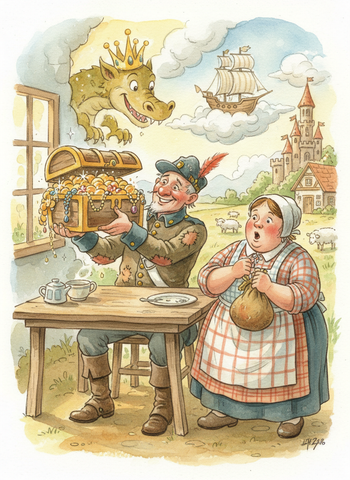
An old soldier tricks a foolish farmer's wife out of her husband's savings with a wildly unbelievable story.
There was an old soldier who had been long in the wars—so long, that he was quite out-at-elbows, and he did not know where to go to find a living. So he walked up moors, down glens, till at last he came to a farm, from which the good man had gone away to market. The wife of the farmer was a very foolish woman, who had been a widow when he married her; the farmer was foolish enough, too, and it is hard to say which of the two was the more foolish. When you've heard my tale you may decide.
Había una vez un viejo soldado que había estado mucho tiempo en las guerras —tanto tiempo que estaba hecho un andrajo—, y no sabía adónde ir para ganarse la vida. Así que caminó por páramos y bajó por valles, hasta que por fin llegó a una granja, de la cual el buen hombre se había ido al mercado. La esposa del granjero era una mujer muy tonta, que había sido viuda cuando él se casó con ella; el granjero también era bastante tonto, y es difícil decir cuál de los dos era más tonto. Cuando hayas oído mi cuento, tú decides.
Now before the farmer goes to market says he to his wife: “Here is ten pounds all in gold, take care of it till I come home.” If the man had not been a fool he would never have given the money to his wife to keep. Well, off he went in his cart to market, and the wife said to herself: “I will keep the ten pounds quite safe from thieves;” so she tied it up in a rag, and she put the rag up the parlour chimney.
Pues bien, antes de irse al mercado, el granjero le dice a su mujer: «Aquí tienes diez libras, todo en oro; guárdalas bien hasta que vuelva». Si el hombre no hubiera sido un tonto, nunca le habría dado el dinero a su mujer para que lo guardara. En fin, se fue en su carreta al mercado, y la mujer se dijo a sí misma: «Voy a guardar estas diez libras bien a salvo de los ladrones»; así que las envolvió en un trapo y metió el trapo en la chimenea de la sala.
“There,” said she, “no thieves will ever find it now, that is quite sure.”
«Ahí», dijo ella, «ningún ladrón las va a encontrar jamás, de eso estoy segura».
Jack Hannaford, the old soldier, came and rapped at the door.
Jack Hannaford, el viejo soldado, llegó y tocó a la puerta.
“Who is there?” asked the wife.
«¿Quién anda ahí?», preguntó la mujer.
“Jack Hannaford.”
«Jack Hannaford».
“Where do you come from?”
«¿De dónde vienes?»
“Paradise.”
«Del paraíso».
“Lord a' mercy! and maybe you've seen my old man there,” alluding to her former husband.
«¡Dios me ampare! Y a lo mejor viste allí a mi viejo», dijo, refiriéndose a su difunto marido.
“Yes, I have.”
«Sí, lo vi».
“And how was he a-doing?” asked the goody.
«¿Y cómo le iba?», preguntó la buena mujer.
“But middling; he cobbles old shoes, and he has nothing but cabbage for victuals.”
«Así así; remienda zapatos viejos, y no tiene más que repollo para comer».
“Deary me!” exclaimed the woman. “Didn't he send a message to me?”
«¡Ay, Dios mío!», exclamó la mujer. «¿No me mandó ningún recado?»
“Yes, he did,” replied Jack Hannaford. “He said that he was out of leather, and his pockets were empty, so you were to send him a few shillings to buy a fresh stock of leather.”
«Sí, lo hizo», respondió Jack Hannaford. «Dijo que se le había acabado el cuero y tenía los bolsillos vacíos, así que le mandaras unos chelines para comprar más cuero».
“He shall have them, bless his poor soul!” And away went the wife to the parlour chimney, and she pulled the rag with the ten pounds in it from the chimney, and she gave the whole sum to the soldier, telling him that her old man was to use as much as he wanted, and to send back the rest.
«¡Los va a tener, bendita sea su pobre alma!» Y la mujer corrió a la chimenea de la sala, sacó el trapo con las diez libras dentro, y le dio toda la suma al soldado, diciéndole que su viejo usara lo que necesitara y le mandara el resto.
It was not long that Jack waited after receiving the money; he went off as fast as he could walk.
No tardó mucho Jack, después de recibir el dinero; se marchó tan rápido como pudo caminar.
Presently the farmer came home and asked for his money. The wife told him that she had sent it by a soldier to her former husband in Paradise, to buy him leather for cobbling the shoes of the saints and angels of Heaven. The farmer was very angry, and he swore that he had never met with such a fool as his wife. But the wife said that her husband was a greater fool for letting her have the money.
Poco después llegó el granjero a casa y preguntó por su dinero. La mujer le contó que lo había mandado con un soldado a su primer marido en el paraíso, para que comprara cuero y remendara los zapatos de los santos y los ángeles del cielo. El granjero se puso furioso, y juró que nunca había conocido a una tonta como su mujer. Pero la mujer dijo que su marido era más tonto todavía por haberle dado el dinero para guardar.
There was no time to waste words; so the farmer mounted his horse and rode off after Jack Hannaford. The old soldier heard the horse's hoofs clattering on the road behind him, so he knew it must be the farmer pursuing him. He lay down on the ground, and shading his eyes with one hand, looked up into the sky, and pointed heavenwards with the other hand.
No había tiempo que perder con más palabras; así que el granjero montó a caballo y salió cabalgando tras Jack Hannaford. El viejo soldado oyó los cascos del caballo resonando en el camino detrás de él, así que supo que debía de ser el granjero persiguiéndolo. Se tumbó en el suelo, y protegiéndose los ojos con una mano, miró hacia el cielo y señaló hacia arriba con la otra.
“What are you about there?” asked the farmer, pulling up.
«¿Qué haces ahí?», preguntó el granjero, deteniéndose.
“Lord save you!” exclaimed Jack: “I've seen a rare sight.”
«¡Que el Señor te ampare!», exclamó Jack. «He visto algo extraordinario».
“What was that?”
«¿Qué fue?»
“A man going straight up into the sky, as if he were walking on a road.”
«Un hombre subiendo derecho hacia el cielo, como si caminara por un camino».
“Can you see him still?”
«¿Todavía lo puedes ver?»
“Yes, I can.”
«Sí, lo veo».
“Where?”
«¿Dónde?»
“Get off your horse and lie down.”
«Baja de tu caballo y túmbate».
“If you will hold the horse.”
«Si tú sujetas el caballo».
Jack did so readily.
Jack lo hizo enseguida.
“I cannot see him,” said the farmer.
«No lo veo», dijo el granjero.
“Shade your eyes with your hand, and you'll soon see a man flying away from you.”
«Protégete los ojos con la mano, y pronto verás a un hombre volando lejos de ti».
Sure enough he did so, for Jack leaped on the horse, and rode away with it. The farmer walked home without his horse.
Y en efecto así lo hizo, porque Jack saltó sobre el caballo y se marchó cabalgando con él. El granjero volvió a casa a pie, sin su caballo.
“You are a bigger fool than I am,” said the wife; “for I did only one foolish thing, and you have done two.”
«Eres más tonto que yo», dijo la mujer; «porque yo solo hice una tontería, y tú has hecho dos».
