How the Whale Got His Throat
A free B2-level English story for language learners, readable online in 7 languages, with an option to listen via the free Storyteller app.
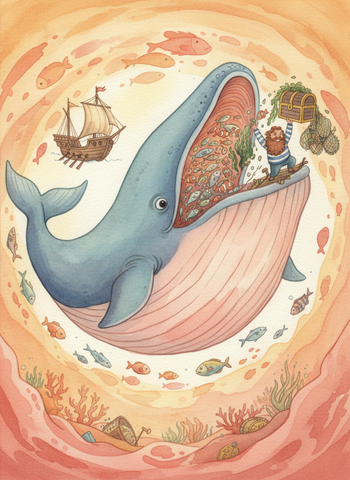
A hungry Whale swallows nearly every fish in the sea, then sets his sights on a shipwrecked sailor — and gets far more than he bargained for.
In the sea, once upon a time, O my Best Beloved, there was a Whale, and he ate fishes. He ate the starfish and the garfish, and the crab and the dab, and the plaice and the dace, and the skate and his mate, and the mackereel and the pickereel, and the really truly twirly-whirly eel. All the fishes he could find in all the sea he ate with his mouth—so!
En el mar, hubo una vez, oh Amadísimo mío, una Ballena, que comía peces. Comía la estrella de mar y el pez aguja, y el cangrejo y el lenguado, y la platija y el dace, y la raya y su pareja, y la caballa y el lucio joven, y la verdadera y auténtica anguila retorcida y girada. Todos los peces que podía encontrar en todo el mar se los comía con su boca —¡así!—.
Till at last there was only one small fish left in all the sea, and he was a small ‘Stute Fish, and he swam a little behind the Whale’s right ear, so as to be out of harm’s way. Then the Whale stood up on his tail and said, ‘I’m hungry.’ And the small ‘Stute Fish said in a small ‘stute voice, ‘Noble and generous Cetacean, have you ever tasted Man?’
Hasta que al fin no quedó en todo el mar más que un pececito, y era un pececito Sagaz, y nadaba un poco por detrás de la oreja derecha de la Ballena, para estar fuera de peligro. Entonces la Ballena se puso de pie sobre su cola y dijo: «Tengo hambre». Y el pececito Sagaz dijo con su vocecita sagaz: «Noble y generoso Cetáceo, ¿alguna vez has probado al Hombre?».
‘No,’ said the Whale. ‘What is it like?’
«No», dijo la Ballena. «¿A qué sabe?».
‘Nice,’ said the small ‘Stute Fish. ‘Nice but nubbly.’
«Rico», dijo el pececito Sagaz. «Rico pero con muchos bultitos».
‘Then fetch me some,’ said the Whale, and he made the sea froth up with his tail.
«Entonces tráeme uno», dijo la Ballena, e hizo que el mar espumeara con su cola.
‘One at a time is enough,’ said the ‘Stute Fish. ‘If you swim to latitude Fifty North, longitude Forty West (that is magic), you will find, sitting on a raft, in the middle of the sea, with nothing on but a pair of blue canvas breeches, a pair of suspenders (you must not forget the suspenders, Best Beloved), and a jack-knife, one ship-wrecked Mariner, who, it is only fair to tell you, is a man of infinite-resource-and-sagacity.’
«Con uno basta por ahora», dijo el pez Sagaz. «Si nadas hasta la latitud Cincuenta Norte, longitud Cuarenta Oeste (eso es magia), encontrarás, sentado en una balsa, en medio del mar, sin nada puesto salvo un par de calzones de lona azul, un par de tirantes (no debes olvidar los tirantes, Amadísimo mío), y una navaja, a un Marinero náufrago, quien, para serte justo, es un hombre de recursos-infinitos-y-sagacidad».
So the Whale swam and swam to latitude Fifty North, longitude Forty West, as fast as he could swim, and on a raft, in the middle of the sea, with nothing to wear except a pair of blue canvas breeches, a pair of suspenders (you must particularly remember the suspenders, Best Beloved), and a jack-knife, he found one single, solitary shipwrecked Mariner, trailing his toes in the water. (He had his mummy’s leave to paddle, or else he would never have done it, because he was a man of infinite-resource-and-sagacity.)
Así que la Ballena nadó y nadó hasta la latitud Cincuenta Norte, longitud Cuarenta Oeste, tan rápido como pudo nadar, y en una balsa, en medio del mar, sin nada que llevar puesto salvo un par de calzones de lona azul, un par de tirantes (debes recordar muy en especial los tirantes, Amadísimo mío), y una navaja, encontró a un único y solitario Marinero náufrago, que arrastraba los pies en el agua. (Tenía permiso de su mamá para chapotear, pues de lo contrario nunca lo habría hecho, porque era un hombre de recursos-infinitos-y-sagacidad).
Then the Whale opened his mouth back and back and back till it nearly touched his tail, and he swallowed the shipwrecked Mariner, and the raft he was sitting on, and his blue canvas breeches, and the suspenders (which you must not forget), and the jack-knife—He swallowed them all down into his warm, dark, inside cup-boards, and then he smacked his lips—so, and turned round three times on his tail.
Entonces la Ballena abrió la boca hacia atrás y atrás y atrás hasta que casi tocó su cola, y se tragó al Marinero náufrago, y la balsa en la que estaba sentado, y sus calzones de lona azul, y los tirantes (que no debéis olvidar), y la navaja —se los tragó todos hasta sus alacenas tibias y oscuras del interior, y luego se relamió los labios —así—, y giró tres veces sobre su cola.
But as soon as the Mariner, who was a man of infinite-resource-and-sagacity, found himself truly inside the Whale’s warm, dark, inside cup-boards, he stumped and he jumped and he thumped and he bumped, and he pranced and he danced, and he banged and he clanged, and he hit and he bit, and he leaped and he creeped, and he prowled and he howled, and he hopped and he dropped, and he cried and he sighed, and he crawled and he bawled, and he stepped and he lepped, and he danced hornpipes where he shouldn’t, and the Whale felt most unhappy indeed. (Have you forgotten the suspenders?)
Pero tan pronto como el Marinero, que era un hombre de recursos-infinitos-y-sagacidad, se encontró de verdad dentro de las alacenas tibias y oscuras de la Ballena, pataleó y brincó y golpeó y se sacudió, y saltó y bailó, y dio porrazos y campanazos, y golpeó y mordió, y se lanzó y se arrastró, y merodeó y aulló, y brincó y cayó, y lloró y suspiró, y gateó y berreó, y dio pasos y saltó, y bailó danzas marineras donde no debía, y la Ballena se sintió de lo más desdichada. (¿Os habéis olvidado de los tirantes?).
So he said to the ‘Stute Fish, ‘This man is very nubbly, and besides he is making me hiccough. What shall I do?’
Así que le dijo al pez Sagaz: «Este hombre tiene demasiados bultitos, y además me está haciendo tener hipo. ¿Qué debo hacer?».
‘Tell him to come out,’ said the ‘Stute Fish.
«Dile que salga», dijo el pez Sagaz.
So the Whale called down his own throat to the shipwrecked Mariner, ‘Come out and behave yourself. I’ve got the hiccoughs.’
Así que la Ballena llamó garganta abajo al Marinero náufrago: «Sal y compórtate. Tengo hipo».
‘Nay, nay!’ said the Mariner. ‘Not so, but far otherwise. Take me to my natal-shore and the white-cliffs-of-Albion, and I’ll think about it.’ And he began to dance more than ever.
«¡No, no!», dijo el Marinero. «Eso no, sino todo lo contrario. Llévame a mi costa natal y a los acantilados-blancos-de-Albión, y me lo pensaré». Y se puso a bailar más que nunca.
‘You had better take him home,’ said the ‘Stute Fish to the Whale. ‘I ought to have warned you that he is a man of infinite-resource-and-sagacity.’
«Más te vale llevarlo a casa», le dijo el pez Sagaz a la Ballena. «Debí haberte advertido que es un hombre de recursos-infinitos-y-sagacidad».
So the Whale swam and swam and swam, with both flippers and his tail, as hard as he could for the hiccoughs; and at last he saw the Mariner’s natal-shore and the white-cliffs-of-Albion, and he rushed half-way up the beach, and opened his mouth wide and wide and wide, and said, ‘Change here for Winchester, Ashuelot, Nashua, Keene, and stations on the Fitchburg Road;’ and just as he said ‘Fitch’ the Mariner walked out of his mouth.
Así que la Ballena nadó y nadó y nadó, con ambas aletas y su cola, con todas sus fuerzas por el hipo; y por fin vio la costa natal del Marinero y los acantilados-blancos-de-Albión, y se lanzó a mitad de camino playa arriba, y abrió la boca cada vez más y más y más, y dijo: «Transbordo aquí para Winchester, Ashuelot, Nashua, Keene, y estaciones de la línea de Fitchburg»; y justo cuando dijo «Fitch», el Marinero salió caminando de su boca.
But while the Whale had been swimming, the Mariner, who was indeed a person of infinite-resource-and-sagacity, had taken his jack-knife and cut up the raft into a little square grating all running criss-cross, and he had tied it firm with his suspenders (now, you know why you were not to forget the suspenders!), and he dragged that grating good and tight into the Whale’s throat, and there it stuck! Then he recited the following Sloka, which, as you have not heard it, I will now proceed to relate—
Pero mientras la Ballena había estado nadando, el Marinero, que era en verdad una persona de recursos-infinitos-y-sagacidad, había tomado su navaja y cortado la balsa en una pequeña rejilla cuadrada toda entrecruzada, y la había atado firme con sus tirantes (¡ahora ya sabéis por qué no debíais olvidar los tirantes!), y arrastró esa rejilla bien apretada hasta la garganta de la Ballena, ¡y allí se quedó atascada! Entonces recitó la siguiente Sloka, que, como no la habéis oído, procederé ahora a relatar—
By means of a grating I have stopped your ating.
Con una rejilla de mi invención he detenido tu digestión.
For the Mariner he was also an Hi-ber-ni-an. And he stepped out on the shingle, and went home to his mother, who had given him leave to trail his toes in the water; and he married and lived happily ever afterward. So did the Whale. But from that day on, the grating in his throat, which he could neither cough up nor swallow down, prevented him eating anything except very, very small fish; and that is the reason why whales nowadays never eat men or boys or little girls.
Pues el Marinero era también un Hi-ber-ni-ano. Y salió a la playa de guijarros, y volvió a casa con su madre, quien le había dado permiso de arrastrar los pies en el agua; y se casó y vivió feliz para siempre. Lo mismo hizo la Ballena. Pero desde aquel día, la rejilla en su garganta, que no podía ni toser para sacarla ni tragar para bajarla, le impidió comer nada excepto peces muy, muy pequeños; y esa es la razón por la cual las ballenas de hoy en día nunca comen hombres, ni niños, ni niñitas.
The small ‘Stute Fish went and hid himself in the mud under the Door-sills of the Equator. He was afraid that the Whale might be angry with him.
El pececito Sagaz se fue a esconder en el fango bajo los Umbrales del Ecuador. Tenía miedo de que la Ballena pudiera enfadarse con él.
The Sailor took the jack-knife home. He was wearing the blue canvas breeches when he walked out on the shingle. The suspenders were left behind, you see, to tie the grating with; and that is the end of that tale.
El Marinero se llevó la navaja a casa. Llevaba puestos los calzones de lona azul cuando salió caminando a la playa de guijarros. Los tirantes se quedaron atrás, como veis, para atar la rejilla; y ese es el final de ese cuento.
When the cabin port-holes are dark and green Because of the seas outside; When the ship goes wop (with a wiggle between) And the steward falls into the soup-tureen, And the trunks begin to slide; When Nursey lies on the floor in a heap, And Mummy tells you to let her sleep, And you aren’t waked or washed or dressed, Why, then you will know (if you haven’t guessed) You’re ‘Fifty North and Forty West!’
Cuando los ojos de buey del camarote están oscuros y verdosos A causa de los mares de afuera; Cuando el barco hace bamboleo (con un vaivén de por medio) Y el camarero cae dentro de la sopera, Y los baúles empiezan a resbalar; Cuando la Niñera yace en el suelo hecha un ovillo, Y Mamá te dice que la dejes dormir, Y a ti no te despiertan ni te lavan ni te visten, Pues entonces sabrás (si no lo has adivinado ya) Que estás en «¡Cincuenta Norte y Cuarenta Oeste!».
