The Miraculous Hen
A free B2-level English story for language learners, readable online in 7 languages, with an option to listen via the free Storyteller app.
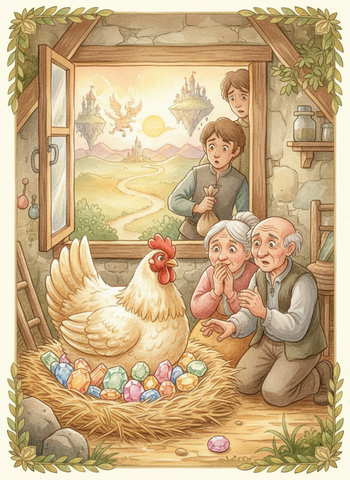
A poor old couple's hen begins laying jewels instead of eggs — a secret so precious it draws betrayal at home and sends two brothers on a perilous quest for kingdoms, magic, and revenge.
Beyond thrice-nine lands, in the thrice-tenth realm—it was not in our kingdom—once an old man and an old woman lived in great need and poverty. They had two sons, who were very young and as yet of no use for field work. So the old man got up himself, and himself did all the work; he went out and looked after the labourers, and for all that he could only earn a few pence.
Além de três vezes nove terras, no trigésimo reino — não era em nosso reino — vivia certa vez um velho e uma velha em grande necessidade e pobreza. Tinham dois filhos, ainda muito jovens e sem nenhuma utilidade para o trabalho no campo. Então o próprio velho se levantava, e ele mesmo fazia todo o trabalho; saía e cuidava dos trabalhadores, e com tudo isso só conseguia ganhar uns poucos centavos.
As he was going home one day he met a sorry drunkard, who had a hen in his hands. “Will you, old man, buy my hen?”
Enquanto voltava para casa um dia, encontrou um bêbado desgraçado, que tinha uma galinha nas mãos. "O senhor não quer comprar minha galinha, velho?"
“What do you want for it?”
"Quanto você quer por ela?"
“Give me fifty kopeks for it.”
"Me dê cinquenta copeques por ela."
“No, brother; take these few pence—that will be enough for you; you will get a pint and can drink it out on your way home and go to sleep.”
"Não, irmão; fique com estes poucos centavos — isso será o bastante para você; vai dar para comprar um litro e beber tudo no caminho de casa e ir dormir."
So the drunkard took the pence and gave the old man the hen.
Então o bêbado pegou os centavos e deu a galinha ao velho.
Then the old man returned home. But they were very hungry there; there was not a crust of bread. “Here,” he said, as he came in, to his wife, “here is a hen I have bought you.”
Depois o velho voltou para casa. Mas ali estavam todos com muita fome; não havia nem uma casca de pão. "Aqui está", disse ele, ao entrar, à sua esposa, "aqui está uma galinha que comprei para você."
But his wife turned on him fiercely and scolded him. “What an old fool you are! You must have gone utterly mad: our children are sitting down at home without any bread, and you buy a hen which you must feed!”
Mas a esposa se voltou contra ele com fúria e o repreendeu. "Que velho tolo você é! Deve ter enlouquecido de vez: nossos filhos estão sentados em casa sem nenhum pão, e você compra uma galinha que ainda vai precisar de comida!"
“Hold your tongue, foolish woman; does a hen eat so much? Why, she will lay us an egg and will bring us chicks; we can sell the chicks and then buy bread.”
"Fique quieta, mulher tola; será que uma galinha come tanto assim? Ora, ela vai botar um ovo para nós e vai nos trazer pintinhos; podemos vender os pintinhos e depois comprar pão."
So the old man made a little nest and he put the hen under the stove. In the morning he looked, and the hen had laid a jewel of absolutely natural colours. So the old man said to his wife, “Now, old lady; amongst other folks the hens lay eggs, but our hen lays jewels: what shall we do?”
Então o velho fez um pequeno ninho e colocou a galinha debaixo do fogão. Pela manhã ele foi olhar, e a galinha tinha botado uma joia de cores absolutamente naturais. Então o velho disse à esposa: "Ora, minha velha; entre as outras pessoas as galinhas botam ovos, mas a nossa galinha bota joias: o que faremos?"
“Take it into the city; possibly somebody may buy it.”
"Leve-a até a cidade; talvez alguém queira comprá-la."
So the old man went into the city, went into all the inns by turns and showed his precious stone. All the merchants gathered round him and began valuing the stone. They valued it and valued it, and it was at last bought for five hundred roubles.
Então o velho foi até a cidade, entrou em todas as pousadas, uma por uma, e mostrou sua pedra preciosa. Todos os mercadores se reuniram ao redor dele e começaram a avaliar a pedra. Avaliaram e avaliaram, e por fim ela foi comprada por quinhentos rublos.
From that day the old man went on trading in precious stones which his hen laid him, and he very soon became enriched, had himself inscribed into the merchants’ guild, put up a shop, hired apprentices, and set up seafaring ships to carry his wares into foreign lands. One day he was going into foreign parts, and he bade his wife have a great heed to the hen: “Treasure her more than your eyes; should she be lost, you shall forfeit your own head.”
Daquele dia em diante, o velho passou a negociar as pedras preciosas que sua galinha lhe botava, e logo enriqueceu, mandou se inscrever na guilda dos mercadores, montou uma loja, contratou aprendizes, e armou navios para levar suas mercadorias a terras estrangeiras. Um dia ele ia partir para terras estrangeiras, e pediu à esposa que tomasse grande cuidado com a galinha: "Trate-a com mais zelo que aos seus próprios olhos; se ela se perder, você perderá a própria cabeça."
As soon as he had gone the old woman began to think evil thoughts. For she was great friends with one of the young apprentices.
Assim que ele partiu, a velha começou a pensar pensamentos maus. Pois era muito amiga de um dos jovens aprendizes.
“Where do you get these precious stones from?” the apprentice asked her.
"De onde você tira essas pedras preciosas?" perguntou o aprendiz.
“Oh, it is our hen that lays them.”
"Ah, é a nossa galinha que as bota."
So the apprentice took the hen, looked, and under the right wing he saw written in gold: “Whoever eats this hen’s head shall become a king, and whoever eats her liver shall spit out gold.”
Então o aprendiz pegou a galinha, olhou, e sob a asa direita viu escrito em dourado: "Quem comer a cabeça desta galinha se tornará rei, e quem comer seu fígado vai cuspir ouro."
So he told the wife, “Bake me the hen for supper.”
Então ele disse à esposa: "Asse essa galinha para o jantar."
“Oh, my dear friend, how can I? My husband will be coming back and will punish me.”
"Ah, meu querido amigo, como posso fazer isso? Meu marido vai voltar e vai me castigar."
But the apprentice would not listen to any argument. “Bake it,” he said—that was all.
Mas o aprendiz não quis ouvir nenhum argumento. "Asse", disse ele — e isso foi tudo.
The next day the old woman got supper ready, made ready to twist the hen’s neck and to roast it for supper with the head and the liver. The cook twisted the hen’s neck and put her into the oven, and himself went out. But in that time the two little children of the house, who were at school, ran in, looked into the oven, and wanted to nibble. The elder brother ate the head and the youngest ate the liver.
No dia seguinte, a velha preparou o jantar, se preparou para torcer o pescoço da galinha e assá-la para o jantar, com cabeça e fígado inclusos. A cozinheira torceu o pescoço da galinha e a colocou no forno, e ela mesma saiu. Mas nesse meio-tempo, os dois filhinhos da casa, que estavam na escola, entraram correndo, olharam dentro do forno, e quiseram beliscar um pouco. O irmão mais velho comeu a cabeça e o mais novo comeu o fígado.
When supper-time came, the hen was put on the table, but when the apprentice saw that both the head and the liver were missing he was very angry, quarrelled with the old woman and went home. The old woman followed him and wheedled, but he still insisted: “You bring your children, take their liver out and brains, and give them me for supper; otherwise I will have nothing to do with you.”
Quando chegou a hora do jantar, a galinha foi colocada na mesa, mas quando o aprendiz viu que tanto a cabeça quanto o fígado estavam faltando, ficou muito irritado, brigou com a velha e foi para casa. A velha o seguiu e tentou adulá-lo, mas ele continuou insistindo: "Traga seus filhos, tire-lhes o fígado e os miolos, e dê-os para mim de jantar; senão não quero mais nada com você."
So the old woman put her children to bed, called the cook and bade him take them whilst they were asleep into the wood, there kill them and extract their liver and their brains and get them ready for supper. The cook took the children into the slumbrous forest, stopped, and made ready to whet the knife.
Então a velha colocou seus filhos para dormir, chamou a cozinheira e mandou que os levasse, enquanto dormiam, até o bosque, ali os matasse e lhes extraísse o fígado e os miolos, e os preparasse para o jantar. A cozinheira levou os meninos até a floresta sonolenta, parou, e se preparou para afiar a faca.
The boys woke up and asked, “Why are you sharpening the knife?”
Os meninos acordaram e perguntaram: "Por que você está afiando a faca?"
“Because your mother has bidden me take out your liver and brains and cook them.”
"Porque sua mãe me mandou tirar seu fígado e seus miolos e cozinhá-los."
“Oh, grandfather, little dove, do not slay us; we will give you all the gold you desire, only pity us and let us free.” So the younger brother filled his skirt with gold, and the cook was contented with this and he set them free.
"Ah, vovô, pombinho, não nos mate; vamos lhe dar todo o ouro que desejar, só tenha pena de nós e nos deixe livres." Então o irmão mais novo encheu a saia de ouro, e a cozinheira ficou satisfeita com isso e os deixou livres.
So the boys went forth into the forest and he turned back. Fortunately for him a bitch came his way, so he took her two puppies, took their livers and brains, roasted them and gave them for supper. The apprentice was very pleased with the dish, swallowed it all, and became neither a king nor a king’s son, but simply a fool.
Então os meninos partiram floresta adentro e ela voltou. Felizmente para ela, uma cadela cruzou seu caminho, então ela pegou os dois filhotes da cadela, tirou-lhes o fígado e os miolos, os assou e os serviu para o jantar. O aprendiz ficou muito satisfeito com o prato, engoliu tudo, e não se tornou nem rei nem filho de rei, mas simplesmente um tolo.
The boys went out of the wood on the broad road, and went whither their eyes gazed—maybe far, maybe short, they went. Soon the road divided into two, and a column stood there, and on the column it was written:
Os meninos saíram do bosque para a estrada larga, e foram para onde seus olhos apontavam — talvez longe, talvez perto, seguiram andando. Logo a estrada se dividiu em duas, e havia uma coluna ali, e na coluna estava escrito:
“WHO GOES TO THE RIGHT SHALL RECEIVE A KINGDOM, WHO GOES TO THE LEFT SHALL RECEIVE MUCH OF EVIL AND OF GRIEF, BUT HE SHALL MARRY A FAIR PRINCESS.”
"QUEM FOR PARA A DIREITA RECEBERÁ UM REINO, QUEM FOR PARA A ESQUERDA RECEBERÁ MUITO DE MAL E DE DOR, MAS SE CASARÁ COM UMA BELA PRINCESA."
So the brothers considered this inscription, and decided to go in different directions; the elder went to the right and the younger to the left.
Então os irmãos consideraram essa inscrição, e decidiram seguir em direções diferentes; o mais velho foi para a direita e o mais novo para a esquerda.
The elder went on and on, and soon came to an unknown capital city. He also saw a mass of people, only they were all mourning and sad. So he begged shelter of a poor old widow. “Will you protect,” he said, “a foreigner from the dark night?”
O mais velho seguiu e seguiu, e logo chegou a uma capital desconhecida. Viu também uma multidão de gente, só que todos estavam de luto e tristes. Então pediu abrigo a uma pobre velha viúva. "A senhora abrigaria", disse ele, "um estrangeiro da noite escura?"
“I should be very glad to have you,” she said, “but I cannot put you anywhere, I am so closely packed.”
"Eu ficaria muito feliz em recebê-lo", disse ela, "mas não tenho onde colocá-lo, estou tão apertada de espaço."
“Do let me in, bábushka; I am such a simple youth, just as you are; you can find me some small space, some kind of nook for the night.”
"Deixe-me entrar, bábushka; sou um rapaz tão simples quanto a senhora; pode achar algum cantinho para mim, algum lugarzinho para passar a noite."
So the old woman admitted him, and they began to speak.
Então a velha o admitiu, e começaram a conversar.
“Why, bábushka,” the stranger asked, “is there such a throng in the city, why are rooms so dear, and why are the people all mourning and melancholy?”
"Ora, bábushka", perguntou o forasteiro, "por que há tanta multidão na cidade, por que os quartos estão tão caros, e por que as pessoas estão todas de luto e melancólicas?"
“Well, our king has just died, and the boyárs have sent the town-crier out to announce that old and young are to assemble, and each of them is to have a candle, and with the candles they are to go into the cathedral, and whosesoever’s candle lights of itself is to be king.”
"Bem, nosso rei acabou de morrer, e os boiardos mandaram o pregoeiro anunciar que jovens e velhos devem se reunir, e cada um deve levar uma vela, e com as velas devem ir à catedral, e aquele cuja vela se acender sozinha será o rei."
So in the morning the boy got up, washed, prayed to God, said the grace for the bread and salt and the soft bed which his hostess had given him, and went into the cathedral. When he got there, if you had been there three years you could not have counted all those people. And he took a candle in his hand, and it lit up at once. So they all burst upon him and began to blow out his candle, to damp it, but the flame lit all the brighter. There was no help for it: they acknowledged him as their king, and dressed him in golden apparel and led him to the palace.
Então, pela manhã, o rapaz se levantou, lavou-se, orou a Deus, agradeceu pelo pão e pelo sal e pela cama macia que sua anfitriã lhe dera, e foi até a catedral. Quando chegou lá, mesmo que ficasse três anos, não conseguiria contar todas aquelas pessoas. E pegou uma vela na mão, e ela se acendeu na hora. Então todos se atiraram sobre ele e começaram a soprar sua vela, a abafá-la, mas a chama ardia ainda mais brilhante. Não havia jeito: reconheceram-no como rei, vestiram-no com trajes de ouro e o levaram até o palácio.
But the younger brother, who had turned to the left, heard that there was a fair princess in a certain kingdom who was indescribably lovely. But she was very grudging, and she announced in all countries that she would only marry the man who could feed her army for three whole years; yet every one had to try his luck. So the boy went there, and he went on his way, went on the broad road. And he spat into his little bag, and spat it full of pure gold.
Já o irmão mais novo, que tinha ido para a esquerda, ouviu dizer que havia uma bela princesa em certo reino que era de uma beleza indescritível. Mas ela era muito mesquinha, e anunciou em todos os países que só se casaria com o homem que conseguisse alimentar seu exército por três anos inteiros; ainda assim, todos tinham de tentar a sorte. Então o rapaz foi até lá, e seguiu seu caminho, foi pela estrada larga. E cuspiu dentro de sua sacolinha, e a encheu de ouro puro cuspindo.
Well, it may be long, it may be short, it may be near, it may be far, but he at last reached the fair princess, and he said he would accomplish her task. He had no need to ask for gold, he simply had to spit and there it was. For three years he maintained the princess’s army, gave it food and drink and dress.
Bem, pode ter sido longe, pode ter sido perto, mas por fim ele chegou até a bela princesa, e disse que cumpriria sua tarefa. Não precisava pedir ouro, bastava cuspir e ali estava. Por três anos manteve o exército da princesa, deu-lhe comida, bebida e vestimenta.
So the time came for a jolly feast and for the wedding. But the princess was still full of wiles. She asked herself and she sought to know whence God had sent him such enormous wealth. So she invited him to be her guest, received him, honoured him. And the doughty youth fell sick, and he vomited up the liver of the hen, and the Tsarévna swallowed it. From that day gold fell from her lips, and she would not have her bridegroom with her. “What shall I do with this ignoramus?” she asked her boyárs, and she asked her generals. “He has had the idiotic idea of wanting to marry me.”
Então chegou a hora de uma alegre festa e do casamento. Mas a princesa ainda estava cheia de artimanhas. Perguntava a si mesma e procurava saber de onde Deus lhe havia enviado tamanha riqueza. Então o convidou para ser seu hóspede, recebeu-o, honrou-o. E o valente rapaz adoeceu, e vomitou o fígado da galinha, e a Tsarevna o engoliu. Daquele dia em diante, ouro caía de seus lábios, e ela não quis mais ter o noivo junto de si. "O que devo fazer com esse ignorante?" perguntou aos seus boiardos, e perguntou aos seus generais. "Ele teve a ideia idiota de querer se casar comigo."
So the boyárs said he must be hung, and the generals said he must be shot. But the Tsarévna had a better idea—that he ought to be sent to hell.
Então os boiardos disseram que ele devia ser enforcado, e os generais disseram que ele devia ser fuzilado. Mas a Tsarevna teve uma ideia melhor — que ele devia ser mandado para o inferno.
So the doughty youth escaped and once more set forth on his road. And he had only one thought in his mind, how he should make himself wise and revenge himself on the Tsarévna for her unkind jest. So he went on and went on, and he came into the dreamy wood, and he looked and he saw three men fighting with their fists.
Então o valente rapaz escapou e mais uma vez partiu pelo seu caminho. E tinha apenas um pensamento na cabeça, como se tornar sábio e se vingar da Tsarevna por sua cruel zombaria. Seguiu e seguiu, e chegou ao bosque sonhador, e olhou e viu três homens brigando aos socos.
“What are you fighting about?”
"Por que vocês estão brigando?"
“We have three finds in the road, and we cannot divide them; every one wants them for himself.”
"Encontramos três achados na estrada, e não conseguimos dividi-los; cada um os quer só para si."
“What are the finds? what are you contending for?”
"Que achados são esses? Pelo que vocês estão disputando?"
“Look, this is a barrel: you only have to knock it, and a soldier leaps out of its mouth. This is a flying carpet: wherever you think it will take you. And this is a whip: strike a maiden and say ‘You have been a maiden, now become a mare,’ and she will become a mare at once.”
"Olhe, isto é um barril: basta bater nele, e um soldado salta de sua boca. Este é um tapete voador: onde você pensar, ele o leva para lá. E este é um chicote: chicoteie uma donzela e diga 'Você foi donzela, agora se torne égua', e ela se tornará égua na hora."
“These are valuable gifts, and they are hard to divide. But this is the way out: I will send an arrow in this direction, and you all run after it; he who reaches it first shall have the barrel, and the second shall have the flying carpet, and the third shall have the whip.”
"Estes são presentes valiosos, e são difíceis de dividir. Mas há uma saída: vou atirar uma flecha nesta direção, e vocês todos correm atrás dela; quem chegar primeiro fica com o barril, e o segundo fica com o tapete voador, e o terceiro fica com o chicote."
“Very well; shoot the dart.”
"Muito bem; atire a flecha."
So the youth sent out the arrow very far. The three darted after it and ran, and they never looked up. But the doughty youth took the barrel and the whip, sat upon the flying carpet, waved it one end, and he rose higher than the forest that stood there, lower than the clouds above, and he flew whither he would.
Então o rapaz atirou a flecha bem longe. Os três dispararam atrás dela e correram, e nunca olharam para cima. Mas o valente rapaz pegou o barril e o chicote, sentou-se no tapete voador, agitou uma ponta dele, e se ergueu mais alto que a floresta que estava ali, mais baixo que as nuvens acima, e voou para onde quisesse.
So he went back to the forbidden lands of the fair princess, began beating the barrel, and an enormous army came out; infantry, cavalry and artillery, with cannon and with powder waggons. And the mighty host rolled on and rolled on. The doughty youth asked for a horse, mounted it, and went up to his army and commanded it. The drums beat out and the trumpets sounded, and the army went at a pace.
Então voltou às terras proibidas da bela princesa, começou a bater no barril, e um exército enorme saiu de dentro dele; infantaria, cavalaria e artilharia, com canhões e carroças de pólvora. E a poderosa hoste avançava e avançava. O valente rapaz pediu um cavalo, montou nele, e foi até seu exército e o comandou. Os tambores rufaram e as trombetas soaram, e o exército avançou em marcha.
Then the Tsarévna saw from her rooms and was very much frightened, and sent her boyárs and generals to ask for peace. The good youth bade these ambassadors be seized, had them cruelly and savagely punished and sent them back to the Tsarévna, who was to come herself and ask for a reconciliation.
Então a Tsarevna viu de seus aposentos e ficou muito assustada, e mandou seus boiardos e generais pedir paz. O bom rapaz mandou que esses embaixadores fossem capturados, mandou puni-los com crueldade e selvageria e os mandou de volta à Tsarevna, que deveria vir ela mesma pedir uma reconciliação.
Well, there was no help for it: so the Tsarévna herself got out of her carriage, recognised him and swooned. But he took the whip, struck her on the back: “You are a maiden, now become a mare!” And the Tsarévna turned into a mare. He bridled and rode her, and went to the kingdom of his elder brother. He galloped at a full pace, put both spurs into her back and used a scourge of three iron rods, and the army followed him, an unbelievable host.
Bem, não havia jeito: então a própria Tsarevna desceu de sua carruagem, o reconheceu e desmaiou. Mas ele pegou o chicote, bateu nas costas dela: "Você é uma donzela, agora se torne égua!" E a Tsarevna se transformou numa égua. Ele a enfreou e montou nela, e foi até o reino de seu irmão mais velho. Galopou em disparada, cravou as duas esporas nas costas dela e usou um açoite de três varas de ferro, e o exército o seguiu, uma hoste inacreditável.
It may be long, it may be short, at last they came to the boundary, and the doughty youth stopped, collected his army into the barrel, and went to the capital. He went straight to the royal palace, and the king himself saw him and looked at the mare and began to wonder: “What is this great hero approaching? I have never seen such a fine mare in all my life.” So he sent his generals to trade for that horse.
Pode ter sido longe, pode ter sido perto, por fim chegaram à fronteira, e o valente rapaz parou, recolheu seu exército de volta para dentro do barril, e foi até a capital. Foi direto ao palácio real, e o próprio rei o viu e olhou para a égua e começou a se maravilhar: "Que grande herói é este que se aproxima? Nunca vi uma égua tão fina em toda a minha vida." Então mandou seus generais negociarem por aquele cavalo.
“No, what an envious king you have!” said the youth. “It would evidently be out of the question in your city to come here with a young wife; if you are so greedy for a mare, you would certainly take away my wife.”
"Não, que rei invejoso o senhor tem!" disse o rapaz. "Seria evidentemente impossível, em sua cidade, vir até aqui com uma jovem esposa; se o senhor é tão ganancioso por uma égua, certamente levaria embora minha esposa."
Then he went to the palace and said, “Hail, brother!”
Então foi até o palácio e disse: "Salve, irmão!"
“Oh, I never knew you!”
"Ah, eu nunca o reconheci!"
So they set to kissing each other.
Então se puseram a se beijar um ao outro.
“What sort of barrel have you?”
"Que tipo de barril é esse que você tem?"
“That is for drinking. How should I journey forth on the road otherwise?”
"Isso é para beber. Como eu viajaria pela estrada de outro jeito?"
“And the carpet?”
"E o tapete?"
“Sit down and you will find out.”
"Sente-se e vai descobrir."
So they sat on the flying carpet, and the younger brother shook it at the corner and they flew higher than the forest, lower than the wandering cloud, straight back to their own country. So they flew back, took a room with their father, and as to who they were they never told their father and mother. So they then thought they would give a feast to all the christened world. They assembled all the people in countless hosts, and for three whole days they gave food and drink to all without requital, without any charge.
Então se sentaram no tapete voador, e o irmão mais novo o sacudiu num canto e voaram mais alto que a floresta, mais baixo que a nuvem errante, direto de volta para sua própria terra. Então voaram de volta, alugaram um quarto com o pai deles, e quanto a quem eram, nunca contaram ao pai e à mãe. Então pensaram em dar uma festa para todo o mundo cristão. Reuniram todo o povo em hostes incontáveis, e por três dias inteiros deram comida e bebida a todos sem cobrar nada, sem qualquer taxa.
And afterwards every one began saying had any one a tale of wonder to tell; let him start. But no one would say: “We, it is said, are strange folk, but——”
E depois, todos começaram a dizer que, se alguém tivesse uma história maravilhosa para contar, que começasse. Mas ninguém queria falar: "Dizem que somos gente estranha, mas——"
“Well, I will tell you a story,” said the younger brother; “only do not talk until the end. Whoever interrupts three times is to be ruthlessly punished.” So they all agreed.
"Bem, eu vou lhes contar uma história", disse o irmão mais novo; "só não falem até o fim. Quem interromper três vezes será punido sem piedade." Então todos concordaram.
And he began to tell how the two old folks had lived together, how they had had a hen which laid jewels, and how the mother had made friends with the apprentice. “What a lie!” interrupted the mistress. But the son went on with his tale. And he narrated how they had twisted the hen’s neck, and the mother again interrupted. At last the story went up to the point when the old woman wished to take away the children, and again she would not stand it: “It is untrue!” she said. “Could ever such a thing happen? Could ever a mother wish to be torn from her children?”
E ele começou a contar como os dois velhos tinham vivido juntos, como tinham tido uma galinha que botava joias, e como a mãe tinha se tornado amiga do aprendiz. "Que mentira!" interrompeu a patroa. Mas o filho continuou sua história. E narrou como tinham torcido o pescoço da galinha, e a mãe interrompeu de novo. Por fim a história chegou ao ponto em que a velha quis levar embora os filhos, e de novo ela não aguentou: "Isso é mentira!" disse ela. "Como poderia acontecer uma coisa dessas? Como poderia uma mãe querer se separar dos próprios filhos?"
“Obviously, it is possible. Look at us, mother; we are your children.”
"Obviamente, é possível. Olhe para nós, mãe; somos seus filhos."
Then the whole story came out, and the father bade his wife be chopped up into bits. He tied the apprentice to the tail of horses, and the horses broke in every direction and scattered his bones over the fields. “Let the dog die a dog’s death!” said the old man. And he gave all his property to the poor and went to live in his elder son’s kingdom.
Então toda a história veio à tona, e o pai mandou que sua esposa fosse cortada em pedaços. Amarrou o aprendiz à cauda de cavalos, e os cavalos dispararam em todas as direções e espalharam seus ossos pelos campos. "Que o cão morra como um cão!" disse o velho. E deu todos os seus bens aos pobres e foi viver no reino de seu filho mais velho.
But the younger son smote his mare with the back of his hand and said, “You are a mare; now become a maiden!” So the mare turned into the fair Tsarévna. They made peace, became friends and wedded. It was a magnificent wedding.
Mas o filho mais novo bateu na sua égua com as costas da mão e disse: "Você é uma égua; agora se torne donzela!" E a égua se transformou na bela Tsarevna. Fizeram as pazes, tornaram-se amigos e se casaram. Foi um casamento magnífico.
I was there, I drank mead and it flowed up to my beard, but none came into my mouth.
Eu estava lá, bebi hidromel que escorreu até minha barba, mas nenhuma gota entrou na minha boca.
