Hansel and Gretel
A free B2-level English story for language learners, readable online in 7 languages, with an option to listen via the free Storyteller app.
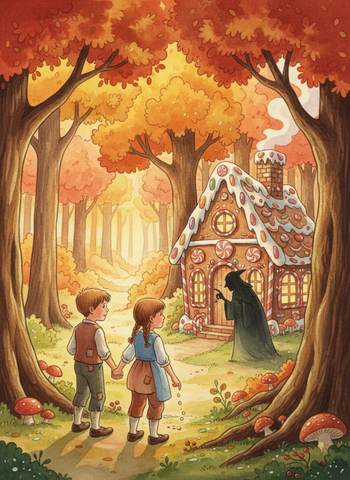
Left in the forest by their own parents, two clever siblings must outwit a stranger whose cottage hides a dangerous secret.
Hard by a great forest dwelt a poor wood-cutter with his wife and his two children. The boy was called Hansel and the girl Gretel. He had little to bite and to break, and once when great dearth fell on the land, he could no longer procure even daily bread. Now when he thought over this by night in his bed, and tossed about in his anxiety, he groaned and said to his wife: ‘What is to become of us? How are we to feed our poor children, when we no longer have anything even for ourselves?’
Cerca de un gran bosque vivía un pobre leñador con su esposa y sus dos hijos. El niño se llamaba Hansel y la niña Gretel. Tenía poco que llevarse a la boca, y una vez, cuando cayó una gran hambruna sobre la tierra, ya no podía conseguir ni siquiera el pan de cada día. Y cuando de noche, en su cama, pensaba en esto y se agitaba lleno de angustia, suspiraba y le decía a su esposa: «¿Qué será de nosotros? ¿Cómo alimentaremos a nuestros pobres hijos, si ya no tenemos nada ni siquiera para nosotros mismos?»
‘I’ll tell you what, husband,’ answered the woman, ‘early tomorrow morning we will take the children out into the forest to where it is the thickest; there we will light a fire for them, and give each of them one more piece of bread, and then we will go to our work and leave them alone. They will not find the way home again, and we shall be rid of them.’ ‘No, wife,’ said the man, ‘I will not do that; how can I bear to leave my children alone in the forest?—the wild animals would soon come and tear them to pieces.’
«Te diré una cosa, marido», respondió la mujer, «mañana temprano llevaremos a los niños al bosque, a la parte más espesa; allí les encenderemos un fuego, y les daremos a cada uno un pedazo más de pan, y luego nos iremos a trabajar y los dejaremos solos. No encontrarán el camino de vuelta a casa, y nos libraremos de ellos.» «No, mujer», dijo el hombre, «eso no lo haré; ¿cómo podría soportar dejar solos a mis hijos en el bosque? Pronto vendrían las fieras y los harían pedazos.»
‘O, you fool!’ said she, ‘then we must all four die of hunger, you may as well plane the planks for our coffins,’ and she left him no peace until he consented. ‘But I feel very sorry for the poor children, all the same,’ said the man.
«¡Ay, qué tonto eres!», dijo ella, «entonces moriremos los cuatro de hambre, y bien podrías ir cepillando ya las tablas para nuestros ataúdes», y no le dio paz hasta que él consintió. «Pero de todos modos, siento mucha pena por los pobres niños», dijo el hombre.
The two children had also not been able to sleep for hunger, and had heard what their stepmother had said to their father. Gretel wept bitter tears, and said to Hansel: ‘Now all is over with us.’ ‘Be quiet, Gretel,’ said Hansel, ‘do not distress yourself, I will soon find a way to help us.’ And when the old folks had fallen asleep, he got up, put on his little coat, opened the door below, and crept outside.
Los dos niños tampoco habían podido dormir de hambre, y habían oído lo que su madrastra le había dicho a su padre. Gretel lloró amargas lágrimas, y le dijo a Hansel: «Ahora sí que todo se ha acabado para nosotros.» «Calla, Gretel», dijo Hansel, «no te aflijas, pronto encontraré la manera de ayudarnos.» Y cuando los mayores se hubieron dormido, se levantó, se puso su abriguito, abrió la puerta de abajo y se deslizó afuera.
The moon shone brightly, and the white pebbles which lay in front of the house glittered like real silver pennies. Hansel stooped and stuffed the little pocket of his coat with as many as he could get in. Then he went back and said to Gretel: ‘Be comforted, dear little sister, and sleep in peace, God will not forsake us,’ and he lay down again in his bed.
La luna brillaba con fuerza, y los guijarros blancos que había frente a la casa relucían como auténticas monedas de plata. Hansel se agachó y se llenó el bolsillo del abrigo con todos los que pudo meter. Luego volvió y le dijo a Gretel: «Ten consuelo, hermanita querida, y duerme en paz, Dios no nos abandonará», y volvió a acostarse en su cama.
When day dawned, but before the sun had risen, the woman came and awoke the two children, saying: ‘Get up, you sluggards! we are going into the forest to fetch wood.’ She gave each a little piece of bread, and said: ‘There is something for your dinner, but do not eat it up before then, for you will get nothing else.’ Gretel took the bread under her apron, as Hansel had the pebbles in his pocket. Then they all set out together on the way to the forest.
Cuando amaneció, pero antes de que el sol hubiera salido, vino la mujer y despertó a los dos niños, diciendo: «¡Levantaos, holgazanes! Vamos al bosque a buscar leña.» Le dio a cada uno un pedacito de pan, y dijo: «Ahí tenéis algo para el mediodía, pero no os lo comáis antes, porque no vais a recibir nada más.» Gretel se guardó el pan bajo el delantal, ya que Hansel llevaba los guijarros en el bolsillo. Luego partieron todos juntos camino del bosque.
When they had walked a short time, Hansel stood still and peeped back at the house, and did so again and again. His father said: ‘Hansel, what are you looking at there and staying behind for? Pay attention, and do not forget how to use your legs.’
Cuando habían caminado un rato, Hansel se detuvo y miró hacia atrás, hacia la casa, y volvió a hacerlo una y otra vez. Su padre dijo: «Hansel, ¿qué miras ahí y por qué te quedas atrás? Presta atención y no olvides usar las piernas.»
‘Ah, father,’ said Hansel, ‘I am looking at my little white cat, which is sitting up on the roof, and wants to say goodbye to me.’ The wife said: ‘Fool, that is not your little cat, that is the morning sun which is shining on the chimneys.’ Hansel, however, had not been looking back at the cat, but had been constantly throwing one of the white pebble-stones out of his pocket on the road.
«Ay, padre», dijo Hansel, «estoy mirando a mi gatito blanco, que está sentado en el tejado y quiere despedirse de mí.» La mujer dijo: «Tonto, ese no es tu gatito, es el sol de la mañana que brilla sobre las chimeneas.» Hansel, sin embargo, no había estado mirando al gato, sino que había estado tirando constantemente uno de los guijarros blancos de su bolsillo al camino.
When they had reached the middle of the forest, the father said: ‘Now, children, pile up some wood, and I will light a fire that you may not be cold.’ Hansel and Gretel gathered brushwood together, as high as a little hill. The brushwood was lighted, and when the flames were burning very high, the woman said: ‘Now, children, lay yourselves down by the fire and rest, we will go into the forest and cut some wood. When we have done, we will come back and fetch you away.’
Cuando llegaron al centro del bosque, el padre dijo: «Ahora, niños, apilad algo de leña, y yo encenderé un fuego para que no paséis frío.» Hansel y Gretel juntaron ramas hasta formar un montón tan alto como una pequeña colina. Encendieron las ramas, y cuando las llamas ardían muy alto, la mujer dijo: «Ahora, niños, echaos junto al fuego y descansad; nosotros iremos al bosque a cortar leña. Cuando hayamos terminado, volveremos a buscaros.»
Hansel and Gretel sat by the fire, and when noon came, each ate a little piece of bread, and as they heard the strokes of the wood-axe they believed that their father was near. It was not the axe, however, but a branch which he had fastened to a withered tree which the wind was blowing backwards and forwards.
Hansel y Gretel se sentaron junto al fuego, y cuando llegó el mediodía, cada uno comió un pedacito de pan, y como oían los golpes del hacha creyeron que su padre estaba cerca. Sin embargo, no era el hacha, sino una rama que él había atado a un árbol seco, y que el viento mecía de un lado a otro.
And as they had been sitting such a long time, their eyes closed with fatigue, and they fell fast asleep. When at last they awoke, it was already dark night. Gretel began to cry and said: ‘How are we to get out of the forest now?’ But Hansel comforted her and said: ‘Just wait a little, until the moon has risen, and then we will soon find the way.’ And when the full moon had risen, Hansel took his little sister by the hand, and followed the pebbles which shone like newly-coined silver pieces, and showed them the way.
Y como llevaban tanto tiempo sentados, se les cerraron los ojos de cansancio y se quedaron profundamente dormidos. Cuando por fin despertaron, ya era noche cerrada. Gretel se echó a llorar y dijo: «¿Cómo saldremos ahora del bosque?» Pero Hansel la consoló y dijo: «Espera un poco, hasta que salga la luna, y entonces encontraremos pronto el camino.» Y cuando salió la luna llena, Hansel tomó de la mano a su hermanita, y siguió los guijarros que brillaban como monedas de plata recién acuñadas, y les mostraron el camino.
They walked the whole night long, and by break of day came once more to their father’s house. They knocked at the door, and when the woman opened it and saw that it was Hansel and Gretel, she said: ‘You naughty children, why have you slept so long in the forest?—we thought you were never coming back at all!’ The father, however, rejoiced, for it had cut him to the heart to leave them behind alone.
Caminaron toda la noche, y al romper el día llegaron de nuevo a la casa de su padre. Llamaron a la puerta, y cuando la mujer la abrió y vio que eran Hansel y Gretel, dijo: «Niños traviesos, ¿por qué habéis dormido tanto en el bosque? ¡Pensábamos que no volveríais nunca!» El padre, en cambio, se alegró, pues le había dolido en el alma dejarlos solos.
Not long afterwards, there was once more great dearth throughout the land, and the children heard their mother saying at night to their father: ‘Everything is eaten again, we have one half loaf left, and that is the end. The children must go, we will take them farther into the wood, so that they will not find their way out again; there is no other means of saving ourselves!’
No mucho después, hubo de nuevo una gran hambruna en toda la tierra, y los niños oyeron a su madre decirle de noche a su padre: «Ya nos hemos comido todo, solo nos queda media hogaza, y eso es el final. Los niños tienen que irse; los llevaremos más adentro del bosque, para que no encuentren el camino de vuelta; ¡no hay otra manera de salvarnos!»
The man’s heart was heavy, and he thought: ‘It would be better for you to share the last mouthful with your children.’ The woman, however, would listen to nothing that he had to say, but scolded and reproached him. He who says A must say B, likewise, and as he had yielded the first time, he had to do so a second time also.
El corazón del hombre se llenó de pesar, y pensó: «Sería mejor que compartieras el último bocado con tus hijos.» La mujer, sin embargo, no quiso escuchar nada de lo que él tenía que decir, y lo regañó y le hizo reproches. Quien dice A debe decir B también, y como había cedido la primera vez, tuvo que ceder también la segunda.
The children, however, were still awake and had heard the conversation. When the old folks were asleep, Hansel again got up, and wanted to go out and pick up pebbles as he had done before, but the woman had locked the door, and Hansel could not get out. Nevertheless he comforted his little sister, and said: ‘Do not cry, Gretel, go to sleep quietly, the good God will help us.’
Los niños, sin embargo, seguían despiertos y habían oído la conversación. Cuando los mayores se quedaron dormidos, Hansel se levantó de nuevo, y quiso salir a recoger guijarros como había hecho antes, pero la mujer había cerrado la puerta con llave, y Hansel no pudo salir. Aun así, consoló a su hermanita, y dijo: «No llores, Gretel, duerme tranquila, el buen Dios nos ayudará.»
Early in the morning came the woman, and took the children out of their beds. Their piece of bread was given to them, but it was still smaller than the time before. On the way into the forest Hansel crumbled his in his pocket, and often stood still and threw a morsel on the ground.
Temprano por la mañana vino la mujer y sacó a los niños de sus camas. Les dieron su pedazo de pan, pero era todavía más pequeño que la vez anterior. En el camino hacia el bosque, Hansel desmenuzó el suyo en el bolsillo, y a menudo se detenía y dejaba caer una miga al suelo.
‘Hansel, why do you stop and look round?’ said the father, ‘go on.’ ‘I am looking back at my little pigeon which is sitting on the roof, and wants to say goodbye to me,’ answered Hansel. ‘Fool!’ said the woman, ‘that is not your little pigeon, that is the morning sun that is shining on the chimney.’ Hansel, however little by little, threw all the crumbs on the path.
«Hansel, ¿por qué te detienes y miras alrededor?», dijo el padre, «sigue andando.» «Estoy mirando hacia atrás a mi palomita, que está sentada en el tejado y quiere despedirse de mí», respondió Hansel. «¡Tonto!», dijo la mujer, «esa no es tu palomita, es el sol de la mañana que brilla sobre la chimenea.» Hansel, sin embargo, fue tirando poco a poco todas las migas por el camino.
The woman led the children still deeper into the forest, where they had never in their lives been before. Then a great fire was again made, and the mother said: ‘Just sit there, you children, and when you are tired you may sleep a little; we are going into the forest to cut wood, and in the evening when we are done, we will come and fetch you away.’
La mujer llevó a los niños todavía más adentro del bosque, adonde nunca habían estado en toda su vida. Entonces se encendió de nuevo un gran fuego, y la madre dijo: «Quedaos ahí sentados, niños, y cuando os canséis podéis dormir un poco; nosotros iremos al bosque a cortar leña, y por la tarde, cuando hayamos terminado, vendremos a buscaros.»
When it was noon, Gretel shared her piece of bread with Hansel, who had scattered his by the way. Then they fell asleep and evening passed, but no one came to the poor children. They did not awake until it was dark night, and Hansel comforted his little sister and said: ‘Just wait, Gretel, until the moon rises, and then we shall see the crumbs of bread which I have strewn about, they will show us our way home again.’
Cuando llegó el mediodía, Gretel compartió su pedazo de pan con Hansel, que había esparcido el suyo por el camino. Luego se durmieron y pasó la tarde, pero nadie vino a buscar a los pobres niños. No despertaron hasta que fue noche cerrada, y Hansel consoló a su hermanita y dijo: «Espera, Gretel, hasta que salga la luna, y entonces veremos las migas de pan que he esparcido, nos mostrarán el camino de vuelta a casa.»
When the moon came they set out, but they found no crumbs, for the many thousands of birds which fly about in the woods and fields had picked them all up. Hansel said to Gretel: ‘We shall soon find the way,’ but they did not find it. They walked the whole night and all the next day too from morning till evening, but they did not get out of the forest, and were very hungry, for they had nothing to eat but two or three berries, which grew on the ground. And as they were so weary that their legs would carry them no longer, they lay down beneath a tree and fell asleep.
Cuando salió la luna se pusieron en marcha, pero no encontraron ninguna miga, pues los muchos miles de pájaros que vuelan por los bosques y los campos se las habían comido todas. Hansel le dijo a Gretel: «Pronto encontraremos el camino», pero no lo encontraron. Caminaron toda la noche y todo el día siguiente, de la mañana a la noche, pero no lograron salir del bosque, y tenían mucha hambre, pues no tenían nada que comer salvo dos o tres bayas que crecían en el suelo. Y como estaban tan cansados que las piernas ya no los sostenían, se tumbaron bajo un árbol y se quedaron dormidos.
It was now three mornings since they had left their father’s house. They began to walk again, but they always came deeper into the forest, and if help did not come soon, they must die of hunger and weariness.
Ya habían pasado tres mañanas desde que salieron de casa de su padre. Comenzaron a caminar de nuevo, pero siempre se adentraban más en el bosque, y si la ayuda no llegaba pronto, morirían de hambre y cansancio.
When it was mid-day, they saw a beautiful snow-white bird sitting on a bough, which sang so delightfully that they stood still and listened to it. And when its song was over, it spread its wings and flew away before them, and they followed it until they reached a little house, on the roof of which it alighted; and when they approached the little house they saw that it was built of bread and covered with cakes, but that the windows were of clear sugar.
Cuando llegó el mediodía, vieron un hermoso pájaro blanco como la nieve posado en una rama, que cantaba tan deliciosamente que se detuvieron a escucharlo. Y cuando terminó su canto, desplegó las alas y voló delante de ellos, y ellos lo siguieron hasta que llegaron a una casita, en cuyo tejado se posó; y cuando se acercaron a la casita vieron que estaba hecha de pan y cubierta de pasteles, pero que las ventanas eran de azúcar transparente.
‘We will set to work on that,’ said Hansel, ‘and have a good meal. I will eat a bit of the roof, and you Gretel, can eat some of the window, it will taste sweet.’ Hansel reached up above, and broke off a little of the roof to try how it tasted, and Gretel leant against the window and nibbled at the panes. Then a soft voice cried from the parlour:
«Vamos a ponernos manos a la obra», dijo Hansel, «y a darnos un buen banquete. Yo comeré un poco del tejado, y tú, Gretel, puedes comer algo de la ventana, sabrá dulce.» Hansel alargó la mano hacia arriba y arrancó un poco del tejado para probarlo, y Gretel se apoyó en la ventana y mordisqueó los cristales. Entonces una voz suave gritó desde la sala:
‘Nibble, nibble, gnaw, Who is nibbling at my little house?’
«Roe, roe, ratoncito, ¿quién roe mi casita?»
The children answered:
Los niños respondieron:
‘The wind, the wind, The heaven-born wind,’
«El viento, el viento, el viento celestial,»
and went on eating without disturbing themselves. Hansel, who liked the taste of the roof, tore down a great piece of it, and Gretel pushed out the whole of one round window-pane, sat down, and enjoyed herself with it. Suddenly the door opened, and a woman as old as the hills, who supported herself on crutches, came creeping out. Hansel and Gretel were so terribly frightened that they let fall what they had in their hands.
y siguieron comiendo sin perturbarse. Hansel, a quien le gustaba el sabor del tejado, arrancó un gran trozo de él, y Gretel sacó de un empujón todo un cristal redondo de la ventana, se sentó y disfrutó de él. De pronto se abrió la puerta, y una mujer tan vieja como las colinas, que se apoyaba en muletas, salió arrastrándose. Hansel y Gretel se asustaron tan terriblemente que dejaron caer lo que tenían en las manos.
The old woman, however, nodded her head, and said: ‘Oh, you dear children, who has brought you here? do come in, and stay with me. No harm shall happen to you.’ She took them both by the hand, and led them into her little house. Then good food was set before them, milk and pancakes, with sugar, apples, and nuts. Afterwards two pretty little beds were covered with clean white linen, and Hansel and Gretel lay down in them, and thought they were in heaven.
La vieja, sin embargo, asintió con la cabeza, y dijo: «Ay, queridos niños, ¿quién os ha traído hasta aquí? Entrad, y quedaos conmigo. No os pasará nada malo.» Los tomó a ambos de la mano, y los condujo a su casita. Entonces les sirvieron buena comida, leche y tortitas, con azúcar, manzanas y nueces. Después, dos camitas bonitas se cubrieron con ropa de cama blanca y limpia, y Hansel y Gretel se acostaron en ellas, y pensaron que estaban en el cielo.
The old woman had only pretended to be so kind; she was in reality a wicked witch, who lay in wait for children, and had only built the little house of bread in order to entice them there. When a child fell into her power, she killed it, cooked and ate it, and that was a feast day with her. Witches have red eyes, and cannot see far, but they have a keen scent like the beasts, and are aware when human beings draw near. When Hansel and Gretel came into her neighbourhood, she laughed with malice, and said mockingly: ‘I have them, they shall not escape me again!’
La vieja solo había fingido ser tan amable; en realidad era una bruja malvada, que acechaba a los niños, y solo había construido la casita de pan para atraerlos hasta allí. Cuando un niño caía en su poder, lo mataba, lo cocinaba y se lo comía, y ese era para ella un día de fiesta. Las brujas tienen los ojos rojos, y no pueden ver de lejos, pero tienen un olfato agudo como el de las bestias, y saben cuándo se acercan los seres humanos. Cuando Hansel y Gretel llegaron cerca de ella, se rió con malicia, y dijo burlonamente: «Los tengo, ¡esta vez no se me escaparán!»
Early in the morning before the children were awake, she was already up, and when she saw both of them sleeping and looking so pretty, with their plump and rosy cheeks she muttered to herself: ‘That will be a dainty mouthful!’ Then she seized Hansel with her shrivelled hand, carried him into a little stable, and locked him in behind a grated door. Scream as he might, it would not help him.
Muy de mañana, antes de que los niños despertaran, ya estaba levantada, y cuando los vio a ambos durmiendo y con un aspecto tan bonito, con sus mejillas rollizas y sonrosadas, murmuró para sí: «¡Qué bocado tan exquisito será ese!» Entonces agarró a Hansel con su mano arrugada, lo llevó a un pequeño establo y lo encerró tras una puerta enrejada. Por más que gritara, de nada le serviría.
Then she went to Gretel, shook her till she awoke, and cried: ‘Get up, lazy thing, fetch some water, and cook something good for your brother, he is in the stable outside, and is to be made fat. When he is fat, I will eat him.’ Gretel began to weep bitterly, but it was all in vain, for she was forced to do what the wicked witch commanded.
Luego fue a ver a Gretel, la sacudió hasta que despertó, y exclamó: «¡Levántate, holgazana, trae agua y cocina algo bueno para tu hermano, está en el establo ahí fuera, y hay que engordarlo. Cuando esté gordo, me lo comeré.» Gretel se echó a llorar amargamente, pero todo fue en vano, pues se vio obligada a hacer lo que la malvada bruja ordenaba.
And now the best food was cooked for poor Hansel, but Gretel got nothing but crab-shells. Every morning the woman crept to the little stable, and cried: ‘Hansel, stretch out your finger that I may feel if you will soon be fat.’ Hansel, however, stretched out a little bone to her, and the old woman, who had dim eyes, could not see it, and thought it was Hansel’s finger, and was astonished that there was no way of fattening him. When four weeks had gone by, and Hansel still remained thin, she was seized with impatience and would not wait any longer.
Y así se cocinaba la mejor comida para el pobre Hansel, pero Gretel no recibía más que cáscaras de cangrejo. Cada mañana la mujer se acercaba arrastrándose al pequeño establo, y gritaba: «Hansel, saca el dedo para que sienta si pronto estarás gordo.» Hansel, sin embargo, le sacaba un huesecillo, y la vieja, que tenía la vista turbia, no podía verlo, y pensaba que era el dedo de Hansel, y se asombraba de que no hubiera manera de engordarlo. Cuando pasaron cuatro semanas y Hansel seguía tan flaco, se armó de impaciencia y no quiso esperar más.
‘Now, then, Gretel,’ she cried to the girl, ‘stir yourself, and bring some water. Let Hansel be fat or lean, tomorrow I will kill him, and cook him.’ Ah, how the poor little sister did lament when she had to fetch the water, and how her tears did flow down her cheeks! ‘Dear God, do help us,’ she cried. ‘If the wild beasts in the forest had but devoured us, we should at any rate have died together.’ ‘Just keep your noise to yourself,’ said the old woman, ‘it won’t help you at all.’
«Vamos, Gretel», le gritó a la niña, «muévete, y trae agua. Que Hansel esté gordo o flaco, mañana lo mataré y lo cocinaré.» Ay, cómo se lamentaba la pobre hermanita al tener que ir a buscar el agua, ¡y cómo le corrían las lágrimas por las mejillas! «Dios querido, ayúdanos», exclamó. «Si al menos las fieras del bosque nos hubieran devorado, al menos habríamos muerto juntos.» «Guárdate tus lamentos para ti», dijo la vieja, «de nada te van a servir.»
Early in the morning, Gretel had to go out and hang up the cauldron with the water, and light the fire. ‘We will bake first,’ said the old woman, ‘I have already heated the oven, and kneaded the dough.’ She pushed poor Gretel out to the oven, from which flames of fire were already darting. ‘Creep in,’ said the witch, ‘and see if it is properly heated, so that we can put the bread in.’ And once Gretel was inside, she intended to shut the oven and let her bake in it, and then she would eat her, too.
Muy de mañana, Gretel tuvo que salir a colgar el caldero con el agua y encender el fuego. «Primero vamos a hornear», dijo la vieja, «ya he calentado el horno y he amasado la masa.» Empujó a la pobre Gretel hacia el horno, del que ya brotaban llamas de fuego. «Métete dentro», dijo la bruja, «y mira si está bien caliente, para que podamos meter el pan.» Y en cuanto Gretel estuviera dentro, pensaba cerrar el horno y dejarla hornearse allí, y luego se la comería a ella también.
But Gretel saw what she had in mind, and said: ‘I do not know how I am to do it; how do I get in?’ ‘Silly goose,’ said the old woman. ‘The door is big enough; just look, I can get in myself!’ and she crept up and thrust her head into the oven. Then Gretel gave her a push that drove her far into it, and shut the iron door, and fastened the bolt. Oh! then she began to howl quite horribly, but Gretel ran away and the godless witch was miserably burnt to death.
Pero Gretel adivinó sus intenciones, y dijo: «No sé cómo hacerlo; ¿cómo entro?» «Gansa tonta», dijo la vieja. «La puerta es bastante grande; mira, yo misma puedo entrar», y se acercó arrastrándose y metió la cabeza en el horno. Entonces Gretel le dio un empujón que la lanzó bien adentro, y cerró la puerta de hierro, y echó el cerrojo. ¡Ay! Entonces empezó a aullar de un modo espantoso, pero Gretel salió corriendo y la impía bruja ardió miserablemente hasta morir.
Gretel, however, ran like lightning to Hansel, opened his little stable, and cried: ‘Hansel, we are saved! The old witch is dead!’ Then Hansel sprang like a bird from its cage when the door is opened. How they did rejoice and embrace each other, and dance about and kiss each other!
Gretel, sin embargo, corrió como un rayo hacia Hansel, abrió su pequeño establo, y gritó: «¡Hansel, estamos salvados! ¡La vieja bruja ha muerto!» Entonces Hansel saltó como un pájaro que sale de su jaula cuando se abre la puerta. ¡Cómo se alegraron, y se abrazaron, y bailaron, y se besaron el uno al otro!
And as they had no longer any need to fear her, they went into the witch’s house, and in every corner there stood chests full of pearls and jewels. ‘These are far better than pebbles!’ said Hansel, and thrust into his pockets whatever could be got in, and Gretel said: ‘I, too, will take something home with me,’ and filled her pinafore full. ‘But now we must be off,’ said Hansel, ‘that we may get out of the witch’s forest.’
Y como ya no tenían por qué temerle, entraron en la casa de la bruja, y en cada rincón había cofres llenos de perlas y joyas. «¡Esto es mucho mejor que los guijarros!», dijo Hansel, y se llenó los bolsillos con todo lo que pudo caber en ellos, y Gretel dijo: «Yo también me llevaré algo a casa», y se llenó el delantal. «Pero ahora tenemos que irnos», dijo Hansel, «para salir del bosque de la bruja.»
When they had walked for two hours, they came to a great stretch of water. ‘We cannot cross,’ said Hansel, ‘I see no foot-plank, and no bridge.’ ‘And there is also no ferry,’ answered Gretel, ‘but a white duck is swimming there: if I ask her, she will help us over.’ Then she cried:
Cuando habían caminado dos horas, llegaron a una gran extensión de agua. «No podemos cruzar», dijo Hansel, «no veo tablón ni puente.» «Y tampoco hay barca», respondió Gretel, «pero allí nada un pato blanco: si se lo pido, nos ayudará a cruzar.» Entonces exclamó:
‘Little duck, little duck, dost thou see, Hansel and Gretel are waiting for thee? There’s never a plank, or bridge in sight, Take us across on thy back so white.’
«Patito, patito, ¿ves acaso que Hansel y Gretel te esperan aquí? No hay tablón ni puente a la vista, llévanos al otro lado sobre tu blanco lomo.»
The duck came to them, and Hansel seated himself on its back, and told his sister to sit by him. ‘No,’ replied Gretel, ‘that will be too heavy for the little duck; she shall take us across, one after the other.’ The good little duck did so, and when they were once safely across and had walked for a short time, the forest seemed to be more and more familiar to them, and at length they saw from afar their father’s house.
El pato se acercó a ellos, y Hansel se sentó en su lomo, y le dijo a su hermana que se sentara a su lado. «No», respondió Gretel, «eso será demasiado pesado para el patito; que nos lleve al otro lado, uno tras otro.» Así lo hizo el buen patito, y cuando ya habían cruzado a salvo y habían caminado un rato, el bosque les fue pareciendo cada vez más conocido, y por fin vieron a lo lejos la casa de su padre.
Then they began to run, rushed into the parlour, and threw themselves round their father’s neck. The man had not known one happy hour since he had left the children in the forest; the woman, however, was dead. Gretel emptied her pinafore until pearls and precious stones ran about the room, and Hansel threw one handful after another out of his pocket to add to them. Then all anxiety was at an end, and they lived together in perfect happiness. My tale is done, there runs a mouse; whosoever catches it, may make himself a big fur cap out of it.
Entonces echaron a correr, se precipitaron en la sala y se echaron al cuello de su padre. El hombre no había tenido una sola hora feliz desde que dejó a los niños en el bosque; la mujer, en cambio, había muerto. Gretel vació su delantal hasta que perlas y piedras preciosas rodaron por toda la habitación, y Hansel sacó un puñado tras otro de su bolsillo para añadirlas. Entonces se acabó toda preocupación, y vivieron juntos en perfecta felicidad. Mi cuento ha terminado, allí corre un ratón; quien lo atrape, podrá hacerse con él un gran gorro de piel.
