A Service of Love
A free B2-level English story for language learners, readable online in 7 languages, with an option to listen via the free Storyteller app.
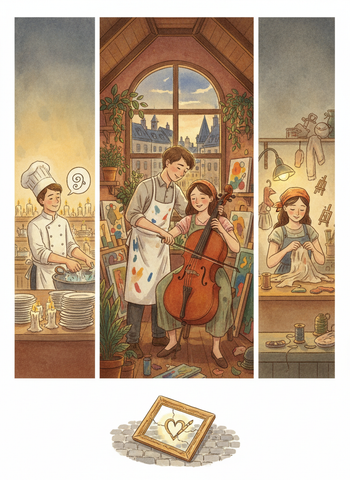
A struggling painter and his musician wife each quietly take on menial work to support the other's art, spinning charming lies to hide the sacrifice — until an accident lets the truth slip out.
When one loves one’s Art no service seems too hard.
Cuando se ama el propio Arte ningún servicio parece demasiado duro.
That is our premise. This story shall draw a conclusion from it, and show at the same time that the premise is incorrect. That will be a new thing in logic, and a feat in story-telling somewhat older than the great wall of China.
Esa es nuestra premisa. Este relato sacará una conclusión de ella, y mostrará al mismo tiempo que la premisa es incorrecta. Eso será algo nuevo en lógica, y una proeza narrativa algo más antigua que la gran muralla de China.
Joe Larrabee came out of the post-oak flats of the Middle West pulsing with a genius for pictorial art. At six he drew a picture of the town pump with a prominent citizen passing it hastily. This effort was framed and hung in the drug store window by the side of the ear of corn with an uneven number of rows. At twenty he left for New York with a flowing necktie and a capital tied up somewhat closer.
Joe Larrabee salió de las llanuras de robles del Medio Oeste rebosante de un genio para el arte pictórico. A los seis años dibujó un cuadro de la bomba del pueblo con un ciudadano prominente pasando apresuradamente frente a ella. Aquel esfuerzo fue enmarcado y colgado en el escaparate de la farmacia, junto a una mazorca de maíz con un número impar de hileras. A los veinte se marchó a Nueva York con una corbata ondeante y un capital algo más atado en corto.
Delia Caruthers did things in six octaves so promisingly in a pine-tree village in the South that her relatives chipped in enough in her chip hat for her to go “North” and “finish.” They could not see her f—, but that is our story.
Delia Caruthers hacía cosas en seis octavas de forma tan prometedora en un pueblito de pinos del Sur que sus parientes reunieron lo suficiente, echándolo en su sombrero de paja, para que pudiera ir al «Norte» y «perfeccionarse». No podían ver su fut—, pero esa es nuestra historia.
Joe and Delia met in an atelier where a number of art and music students had gathered to discuss chiaroscuro, Wagner, music, Rembrandt’s works, pictures, Waldteufel, wall paper, Chopin and Oolong.
Joe y Delia se conocieron en un taller donde varios estudiantes de arte y música se habían reunido a discutir sobre el claroscuro, Wagner, la música, las obras de Rembrandt, los cuadros, Waldteufel, el papel de pared, Chopin y el té Oolong.
Joe and Delia became enamoured one of the other, or each of the other, as you please, and in a short time were married—for (see above), when one loves one’s Art no service seems too hard.
Joe y Delia se enamoraron el uno del otro, o cada uno del otro, como prefieran, y en poco tiempo se casaron—pues (véase más arriba), cuando se ama el propio Arte ningún servicio parece demasiado duro.
Mr. and Mrs. Larrabee began housekeeping in a flat. It was a lonesome flat—something like the A sharp way down at the left-hand end of the keyboard. And they were happy; for they had their Art, and they had each other. And my advice to the rich young man would be—sell all thou hast, and give it to the poor—janitor for the privilege of living in a flat with your Art and your Delia.
El señor y la señora Larrabee comenzaron su vida doméstica en un piso. Era un piso solitario—algo así como el la sostenido allá abajo, en el extremo izquierdo del teclado. Y eran felices; pues tenían su Arte, y se tenían el uno al otro. Y mi consejo para el joven rico sería—vende todo lo que tienes, y dáselo al conserje de los pobres por el privilegio de vivir en un piso con tu Arte y tu Delia.
Flat-dwellers shall indorse my dictum that theirs is the only true happiness. If a home is happy it cannot fit too close—let the dresser collapse and become a billiard table; let the mantel turn to a rowing machine, the escritoire to a spare bedchamber, the washstand to an upright piano; let the four walls come together, if they will, so you and your Delia are between. But if home be the other kind, let it be wide and long—enter you at the Golden Gate, hang your hat on Hatteras, your cape on Cape Horn and go out by the Labrador.
Los habitantes de pisos suscribirán mi dictamen de que la suya es la única verdadera felicidad. Si un hogar es feliz, no puede ser demasiado estrecho—que el tocador se derrumbe y se convierta en mesa de billar; que la repisa de la chimenea se transforme en máquina de remo, el escritorio en alcoba de invitados, el lavamanos en un piano vertical; que las cuatro paredes se junten, si quieren, con tal de que tú y tu Delia estéis dentro. Pero si el hogar es del otro tipo, que sea ancho y largo—entra por la Puerta Dorada, cuelga tu sombrero en el cabo Hatteras, tu capa en el cabo de Hornos y sal por el Labrador.
Joe was painting in the class of the great Magister—you know his fame. His fees are high; his lessons are light—his high-lights have brought him renown. Delia was studying under Rosenstock—you know his repute as a disturber of the piano keys.
Joe pintaba en la clase del gran Magister—ya conocéis su fama. Sus honorarios son altos; sus lecciones son ligeras—sus toques de luz le han traído renombre. Delia estudiaba con Rosenstock—ya conocéis su reputación como alborotador de las teclas del piano.
They were mighty happy as long as their money lasted. So is every—but I will not be cynical. Their aims were very clear and defined. Joe was to become capable very soon of turning out pictures that old gentlemen with thin side-whiskers and thick pocketbooks would sandbag one another in his studio for the privilege of buying. Delia was to become familiar and then contemptuous with Music, so that when she saw the orchestra seats and boxes unsold she could have sore throat and lobster in a private dining-room and refuse to go on the stage.
Eran inmensamente felices mientras les duró el dinero. Como todo el—pero no seré cínico. Sus objetivos eran muy claros y definidos. Joe pronto sería capaz de producir cuadros por los que caballeros ancianos de finas patillas y gruesas billeteras se emboscarían unos a otros en su estudio por el privilegio de comprarlos. Delia se familiarizaría con la Música y luego la despreciaría, de modo que cuando viera las butacas y palcos de la orquesta sin vender pudiera tener dolor de garganta y comer langosta en un comedor privado y negarse a salir a escena.
But the best, in my opinion, was the home life in the little flat—the ardent, voluble chats after the day’s study; the cozy dinners and fresh, light breakfasts; the interchange of ambitions—ambitions interwoven each with the other’s or else inconsiderable—the mutual help and inspiration; and—overlook my artlessness—stuffed olives and cheese sandwiches at 11 p.m.
Pero lo mejor, en mi opinión, era la vida hogareña en el pequeño piso—las ardientes y locuaces charlas después del estudio del día; las cenas acogedoras y los desayunos ligeros y frescos; el intercambio de ambiciones—ambiciones entrelazadas la una con la otra o, en su defecto, insignificantes—la ayuda mutua y la inspiración; y—perdonad mi ingenuidad—las aceitunas rellenas y los sándwiches de queso a las once de la noche.
But after a while Art flagged. It sometimes does, even if some switchman doesn’t flag it. Everything going out and nothing coming in, as the vulgarians say. Money was lacking to pay Mr. Magister and Herr Rosenstock their prices. When one loves one’s Art no service seems too hard. So, Delia said she must give music lessons to keep the chafing dish bubbling.
Pero al cabo de un tiempo el Arte flaqueó. A veces ocurre, aunque ningún guardavía lo detenga. Todo salía y nada entraba, como dicen los vulgares. Faltaba dinero para pagar los precios del señor Magister y del Herr Rosenstock. Cuando se ama el propio Arte ningún servicio parece demasiado duro. Así que Delia dijo que debía dar clases de música para mantener la cazuela burbujeando.
For two or three days she went out canvassing for pupils. One evening she came home elated.
Durante dos o tres días salió a buscar alumnas. Una noche volvió a casa exultante.
“Joe, dear,” she said, gleefully, “I’ve a pupil. And, oh, the loveliest people! General—General A. B. Pinkney’s daughter—on Seventy-first street. Such a splendid house, Joe—you ought to see the front door! Byzantine I think you would call it. And inside! Oh, Joe, I never saw anything like it before.
—Joe, querido —dijo, radiante—, tengo una alumna. Y, oh, ¡la gente más encantadora! La hija del General—del General A. B. Pinkney—en la calle Setenta y uno. ¡Una casa tan espléndida, Joe—deberías ver la puerta principal! Bizantina, creo que la llamarías. ¡Y por dentro! Oh, Joe, nunca había visto nada semejante antes.
“My pupil is his daughter Clementina. I dearly love her already. She’s a delicate thing—dresses always in white; and the sweetest, simplest manners! Only eighteen years old. I’m to give three lessons a week; and, just think, Joe! $5 a lesson. I don’t mind it a bit; for when I get two or three more pupils I can resume my lessons with Herr Rosenstock. Now, smooth out that wrinkle between your brows, dear, and let’s have a nice supper.”
»Mi alumna es su hija Clementina. Ya la quiero muchísimo. Es una cosita delicada—viste siempre de blanco; y los modales más dulces y sencillos. Solo tiene dieciocho años. Voy a darle tres lecciones por semana; y, ¡imagínate, Joe! Cinco dólares por lección. No me importa en absoluto; porque cuando consiga dos o tres alumnas más podré retomar mis lecciones con Herr Rosenstock. Ahora, alisa esa arruga entre tus cejas, querido, y cenemos algo rico.
“That’s all right for you, Dele,” said Joe, attacking a can of peas with a carving knife and a hatchet, “but how about me? Do you think I’m going to let you hustle for wages while I philander in the regions of high art? Not by the bones of Benvenuto Cellini! I guess I can sell papers or lay cobblestones, and bring in a dollar or two.”
—Eso está muy bien para ti, Dele —dijo Joe, atacando una lata de guisantes con un cuchillo de trinchar y un hacha—, pero ¿qué hay de mí? ¿Crees que voy a dejar que te esfuerces por un salario mientras yo ando de flâneur por los dominios del alto arte? ¡Ni por los huesos de Benvenuto Cellini! Supongo que puedo vender periódicos o colocar adoquines, y traer uno o dos dólares.
Delia came and hung about his neck.
Delia vino y se le colgó del cuello.
“Joe, dear, you are silly. You must keep on at your studies. It is not as if I had quit my music and gone to work at something else. While I teach I learn. I am always with my music. And we can live as happily as millionaires on $15 a week. You mustn’t think of leaving Mr. Magister.”
—Joe, querido, eres un tonto. Debes seguir con tus estudios. No es como si yo hubiera dejado mi música para dedicarme a otra cosa. Mientras enseño, aprendo. Estoy siempre con mi música. Y podemos vivir tan felices como millonarios con quince dólares a la semana. No debes ni pensar en dejar al señor Magister.
“All right,” said Joe, reaching for the blue scalloped vegetable dish. “But I hate for you to be giving lessons. It isn’t Art. But you’re a trump and a dear to do it.”
—Está bien —dijo Joe, alcanzando la fuente de verduras azul festoneada—. Pero me molesta que estés dando lecciones. Eso no es Arte. Pero eres un encanto y una santa por hacerlo.
“When one loves one’s Art no service seems too hard,” said Delia.
—Cuando se ama el propio Arte ningún servicio parece demasiado duro —dijo Delia.
“Magister praised the sky in that sketch I made in the park,” said Joe. “And Tinkle gave me permission to hang two of them in his window. I may sell one if the right kind of a moneyed idiot sees them.”
—Magister elogió el cielo de ese boceto que hice en el parque —dijo Joe—. Y Tinkle me dio permiso para colgar dos en su escaparate. Puede que venda uno si el idiota adinerado adecuado los ve.
“I’m sure you will,” said Delia, sweetly. “And now let’s be thankful for Gen. Pinkney and this veal roast.”
—Estoy segura de que lo harás —dijo Delia, dulcemente—. Y ahora demos gracias por el General Pinkney y este asado de ternera.
During all of the next week the Larrabees had an early breakfast. Joe was enthusiastic about some morning-effect sketches he was doing in Central Park, and Delia packed him off breakfasted, coddled, praised and kissed at 7 o’clock. Art is an engaging mistress. It was most times 7 o’clock when he returned in the evening.
Durante toda la semana siguiente los Larrabee desayunaron temprano. Joe estaba entusiasmado con unos bocetos de efectos matutinos que estaba haciendo en Central Park, y Delia lo despachaba desayunado, mimado, elogiado y besado a las siete en punto. El Arte es una amante cautivadora. Casi siempre eran las siete cuando él volvía por la noche.
At the end of the week Delia, sweetly proud but languid, triumphantly tossed three five-dollar bills on the 8×10 (inches) centre table of the 8×10 (feet) flat parlour.
Al final de la semana Delia, dulcemente orgullosa pero lánguida, arrojó triunfalmente tres billetes de cinco dólares sobre la mesita central de veinte por veinticinco (centímetros) del salón de veinte por veinticinco (decímetros) del piso.
“Sometimes,” she said, a little wearily, “Clementina tries me. I’m afraid she doesn’t practise enough, and I have to tell her the same things so often. And then she always dresses entirely in white, and that does get monotonous. But Gen. Pinkney is the dearest old man! I wish you could know him, Joe. He comes in sometimes when I am with Clementina at the piano—he is a widower, you know—and stands there pulling his white goatee. ‘And how are the semiquavers and the demisemiquavers progressing?’ he always asks.
—A veces —dijo, un poco cansada—, Clementina me pone a prueba. Me temo que no practica lo suficiente, y tengo que decirle las mismas cosas con demasiada frecuencia. Y además siempre viste enteramente de blanco, y eso resulta monótono. Pero el General Pinkney es el anciano más encantador. Ojalá pudieras conocerlo, Joe. A veces entra cuando estoy con Clementina al piano—es viudo, ya sabes—y se queda ahí de pie tirándose de la perilla blanca. «¿Y cómo van las semicorcheas y las fusas?», siempre pregunta.
“I wish you could see the wainscoting in that drawing-room, Joe! And those Astrakhan rug portières. And Clementina has such a funny little cough. I hope she is stronger than she looks. Oh, I really am getting attached to her, she is so gentle and high bred. Gen. Pinkney’s brother was once Minister to Bolivia.”
»Ojalá pudieras ver el revestimiento de madera de esa sala, Joe. Y esos cortinajes de alfombra de astracán. Y Clementina tiene una tosecita tan graciosa. Espero que sea más fuerte de lo que parece. Oh, de verdad que le voy tomando cariño, es tan gentil y de tan buena crianza. El hermano del General Pinkney fue una vez Ministro en Bolivia.
And then Joe, with the air of a Monte Cristo, drew forth a ten, a five, a two and a one—all legal tender notes—and laid them beside Delia’s earnings.
Y entonces Joe, con aire de Montecristo, sacó un billete de diez, uno de cinco, uno de dos y uno de un dólar—todos de curso legal—y los colocó junto a las ganancias de Delia.
“Sold that watercolour of the obelisk to a man from Peoria,” he announced overwhelmingly.
—Vendí esa acuarela del obelisco a un hombre de Peoria —anunció, abrumador.
“Don’t joke with me,” said Delia, “not from Peoria!”
—No bromees conmigo —dijo Delia—, ¡no de Peoria!
“All the way. I wish you could see him, Dele. Fat man with a woollen muffler and a quill toothpick. He saw the sketch in Tinkle’s window and thought it was a windmill at first. He was game, though, and bought it anyhow. He ordered another—an oil sketch of the Lackawanna freight depot—to take back with him. Music lessons! Oh, I guess Art is still in it.”
—Directo de allí. Ojalá pudieras verlo, Dele. Un hombre gordo con una bufanda de lana y un palillo de dientes de pluma. Vio el boceto en el escaparate de Tinkle y al principio pensó que era un molino de viento. Pero tuvo agallas, y de todos modos lo compró. Encargó otro—un boceto al óleo del depósito de carga de la Lackawanna—para llevárselo. ¡Clases de música! Oh, creo que el Arte todavía anda por ahí.
“I’m so glad you’ve kept on,” said Delia, heartily. “You’re bound to win, dear. Thirty-three dollars! We never had so much to spend before. We’ll have oysters to-night.”
—Me alegra tanto que hayas seguido —dijo Delia, con entusiasmo—. Estás destinado a triunfar, querido. ¡Treinta y tres dólares! Nunca habíamos tenido tanto para gastar. Cenaremos ostras esta noche.
“And filet mignon with champignons,” said Joe. “Where is the olive fork?”
—Y filete miñón con champiñones —dijo Joe—. ¿Dónde está el tenedor de las aceitunas?
On the next Saturday evening Joe reached home first. He spread his $18 on the parlour table and washed what seemed to be a great deal of dark paint from his hands.
El sábado siguiente por la noche Joe llegó primero a casa. Extendió sus dieciocho dólares sobre la mesa del salón y se lavó lo que parecía una gran cantidad de pintura oscura de las manos.
Half an hour later Delia arrived, her right hand tied up in a shapeless bundle of wraps and bandages.
Media hora después llegó Delia, con la mano derecha envuelta en un fardo informe de vendajes y paños.
“How is this?” asked Joe after the usual greetings. Delia laughed, but not very joyously.
—¿Qué es esto? —preguntó Joe tras los saludos de siempre. Delia se rio, pero no muy alegremente.
“Clementina,” she explained, “insisted upon a Welsh rabbit after her lesson. She is such a queer girl. Welsh rabbits at 5 in the afternoon. The General was there. You should have seen him run for the chafing dish, Joe, just as if there wasn’t a servant in the house. I know Clementina isn’t in good health; she is so nervous. In serving the rabbit she spilled a great lot of it, boiling hot, over my hand and wrist. It hurt awfully, Joe. And the dear girl was so sorry!”
—Clementina —explicó— insistió en un Welsh rabbit después de su lección. Es una muchacha tan rara. Welsh rabbits a las cinco de la tarde. El General estaba allí. Deberías haberlo visto correr por la cazuela, Joe, como si no hubiera un solo sirviente en la casa. Sé que Clementina no está bien de salud; es tan nerviosa. Al servir el rabbit derramó una gran cantidad, hirviendo, sobre mi mano y mi muñeca. Me dolió muchísimo, Joe. ¡Y la pobre muchacha lo sintió tanto!
“But Gen. Pinkney!—Joe, that old man nearly went distracted. He rushed downstairs and sent somebody—they said the furnace man or somebody in the basement—out to a drug store for some oil and things to bind it up with. It doesn’t hurt so much now.”
»Pero el General Pinkney—Joe, aquel anciano casi se volvió loco. Bajó corriendo las escaleras y envió a alguien—dijeron que el fogonero o alguien del sótano—a una farmacia por aceite y cosas para vendarla. Ya no duele tanto ahora.
“What’s this?” asked Joe, taking the hand tenderly and pulling at some white strands beneath the bandages.
—¿Qué es esto? —preguntó Joe, tomando la mano con ternura y tirando de unas hebras blancas bajo las vendas.
“It’s something soft,” said Delia, “that had oil on it. Oh, Joe, did you sell another sketch?” She had seen the money on the table.
—Es algo suave —dijo Delia— que tenía aceite. Oh, Joe, ¿vendiste otro boceto? —Había visto el dinero sobre la mesa.
“Did I?” said Joe; “just ask the man from Peoria. He got his depot to-day, and he isn’t sure but he thinks he wants another parkscape and a view on the Hudson. What time this afternoon did you burn your hand, Dele?”
—¿Que si lo hice? —dijo Joe—; solo pregúntale al hombre de Peoria. Recibió su depósito hoy, y no está seguro, pero cree que quiere otro paisaje de parque y una vista del Hudson. ¿A qué hora de esta tarde te quemaste la mano, Dele?
“Five o’clock, I think,” said Dele, plaintively. “The iron—I mean the rabbit came off the fire about that time. You ought to have seen Gen. Pinkney, Joe, when—”
—A las cinco, creo —dijo Dele, con voz plañidera—. La plancha—quiero decir el rabbit se apartó del fuego más o menos a esa hora. Deberías haber visto al General Pinkney, Joe, cuando—
“Sit down here a moment, Dele,” said Joe. He drew her to the couch, sat beside her and put his arm across her shoulders.
—Siéntate aquí un momento, Dele —dijo Joe. La llevó al sofá, se sentó junto a ella y le pasó el brazo por los hombros.
“What have you been doing for the last two weeks, Dele?” he asked.
—¿Qué has estado haciendo estas dos últimas semanas, Dele? —preguntó.
She braved it for a moment or two with an eye full of love and stubbornness, and murmured a phrase or two vaguely of Gen. Pinkney; but at length down went her head and out came the truth and tears.
Ella resistió por un momento o dos con una mirada llena de amor y obstinación, y murmuró una frase u otra vagamente sobre el General Pinkney; pero al fin agachó la cabeza y salió la verdad, junto con las lágrimas.
“I couldn’t get any pupils,” she confessed. “And I couldn’t bear to have you give up your lessons; and I got a place ironing shirts in that big Twenty-fourth street laundry. And I think I did very well to make up both General Pinkney and Clementina, don’t you, Joe? And when a girl in the laundry set down a hot iron on my hand this afternoon I was all the way home making up that story about the Welsh rabbit. You’re not angry, are you, Joe? And if I hadn’t got the work you mightn’t have sold your sketches to that man from Peoria.”
—No pude conseguir ninguna alumna —confesó—. Y no podía soportar que dejaras tus lecciones; así que conseguí un puesto planchando camisas en aquella gran lavandería de la calle Veinticuatro. Y creo que me salió bastante bien inventar tanto al General Pinkney como a Clementina, ¿no crees, Joe? Y cuando una muchacha de la lavandería dejó caer una plancha caliente sobre mi mano esta tarde, todo el camino a casa lo pasé inventando esa historia del Welsh rabbit. No estás enfadado, ¿verdad, Joe? Y si no hubiera conseguido ese trabajo quizás no habrías podido vender tus bocetos a ese hombre de Peoria.
“He wasn’t from Peoria,” said Joe, slowly.
—No era de Peoria —dijo Joe, despacio.
“Well, it doesn’t matter where he was from. How clever you are, Joe—and—kiss me, Joe—and what made you ever suspect that I wasn’t giving music lessons to Clementina?”
—Bueno, no importa de dónde fuera. Qué listo eres, Joe—y—bésame, Joe—¿y qué te hizo sospechar que no le estaba dando clases de música a Clementina?
“I didn’t,” said Joe, “until to-night. And I wouldn’t have then, only I sent up this cotton waste and oil from the engine-room this afternoon for a girl upstairs who had her hand burned with a smoothing-iron. I’ve been firing the engine in that laundry for the last two weeks.”
—No sospeché nada —dijo Joe—, hasta esta noche. Y no lo habría hecho ni entonces, salvo que mandé subir esta estopa de algodón y aceite de la sala de calderas esta tarde para una muchacha de arriba que se había quemado la mano con una plancha. Llevo dos semanas alimentando la caldera de esa lavandería.
“And then you didn’t—”
—Entonces tú no—
“My purchaser from Peoria,” said Joe, “and Gen. Pinkney are both creations of the same art—but you wouldn’t call it either painting or music.”
—Mi comprador de Peoria —dijo Joe— y el General Pinkney son ambos creaciones de un mismo arte—pero no lo llamarías ni pintura ni música.
And then they both laughed, and Joe began:
Y entonces ambos se rieron, y Joe empezó:
“When one loves one’s Art no service seems—”
—Cuando se ama el propio Arte ningún servicio parece—
But Delia stopped him with her hand on his lips. “No,” she said—“just ‘When one loves.’”
Pero Delia lo detuvo poniéndole la mano en los labios. —No —dijo—, solo «cuando se ama».
