What Was Still Good
A free C1-level English story for language learners, readable online in English, with an option to listen via the free Storyteller app.
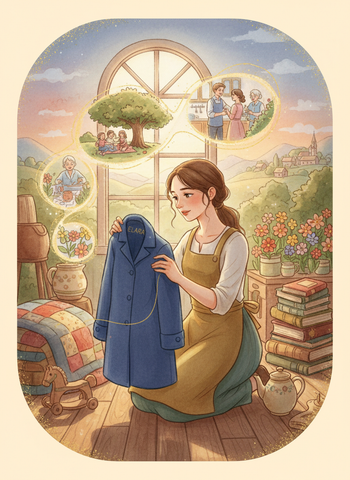
A donation-shelter worker who reads strangers' lives through the objects they give away finds a carefully folded coat with a stitched name and no explanation attached to it.
Wendell sorted donations on Tuesdays and Thursdays, and after six years at the shelter's intake counter, he had stopped being surprised by what people decided they no longer needed. What still caught him, occasionally, was the order in which things arrived. It was never one item alone, but whole clusters that told you, if you paid attention, exactly what had happened in someone's life that month.
A wedding dress, a blender, and four picture frames meant a divorce, usually, though the timing varied. A crib, unused bottles, and a stack of parenting books, still in their shrink wrap, meant something he preferred not to guess at and rarely asked about. Work boots, a hard hat, and a thermos arriving together on the same Thursday meant a job gone bad. It had ended badly enough that a person wanted the whole uniform gone, not sold, not saved for spare parts, simply out of the house.
He had a system for sorting, official and unofficial. Officially, items went into three bins: sellable, recyclable, unsellable. Unofficially, Wendell also sorted by what he privately called the object's temperature. Had it clearly been given away in anger, in grief, or in simple tidiness? Most often it was the plainer, more common case: a person finally getting around to a closet they'd meant to clear for years.
The coat came in on a Tuesday in November, good wool, barely worn, with a name tag stitched inside the collar in careful cursive: R. Okonjo. Had it been dropped in the general bin with everything else, Wendell might never have noticed it at all. Instead it had been folded with unusual care and placed on top, the way a person sets down something they still respect even as they let it go.
He held it a moment longer than the job required. There was no note, no explanation attached to the stitching, only the coat itself and whatever question it was quietly declining to answer. Wendell had learned, over six years, not to invent stories for donations that hadn't offered him one — the temptation was constant, and almost always wrong.
What he could say, with more confidence, was narrower and truer. Someone had once cared enough about this coat to sew their name into it, and had since decided, for reasons the coat itself would never reveal, that it belonged to someone else's winter now. That was the whole of what the object could honestly tell him, and Wendell had come to think that was not a small thing to know about a stranger.
He priced it fairly, hung it on the coat rack near the door, and moved on to a box of mismatched mugs waiting behind it. By Thursday, the coat was gone, sold to someone he never saw and would never think to ask about. Only the name tag stayed with him, R. Okonjo, turning over in his mind on the drive home like a question with no available answer, and no real need for one.
