The Recurring House
A free C1-level English story for language learners, readable online in English, with an option to listen via the free Storyteller app.
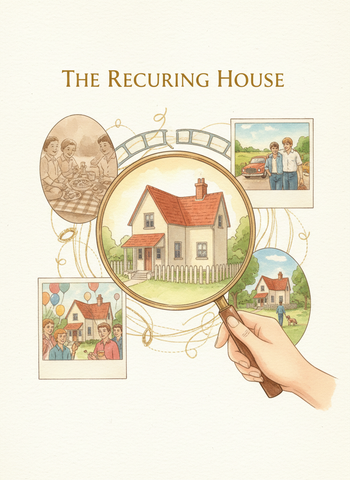
A photo restorer keeps finding the same unremarkable house in the background of unrelated clients' photographs across four decades and never fully identifies it.
Elise restored other people's photographs for a living, which meant she spent most of her working life looking closely at houses she would never visit and faces she would never meet.
The house first caught her attention in a client's water-damaged wedding photograph from the 1970s: a plain two-story building with a crooked shutter on the upper left window. It was visible only at the edge of the frame, barely relevant to the scene it belonged to. She noticed it mainly because the shutter was so obviously broken, hanging at an angle that would have annoyed her if it were her own house. She thought nothing more of it until, six weeks later, restoring an entirely unrelated client's photograph, she found the same crooked shutter again.
Different family. Different decade, judging by the car parked outside. Same house, same broken shutter, caught this time in the background of somebody's christening photo.
Having spent fifteen years around old photographs, Elise knew coincidence when she saw it, and this did not feel like coincidence. She began keeping a folder, quietly, of every unrelated client photograph in which the house appeared. By the time she had four more examples, spanning what she now guessed was nearly forty years, she had stopped believing in an innocent explanation. Two unrelated houses, she had decided, do not simply look this alike.
What troubled her was not that the house kept appearing, but that none of her clients seemed to know it was there. She asked, carefully, whenever she returned a restored photograph: did they recognize this building, this street, this shutter? Not once did anybody recognize it. Whatever the house had meant to the families in the foreground, it had meant nothing to them at all. They had been photographing a wedding, a christening, a birthday, and the house had simply happened to be standing behind them.
Elise never worked out whose house it actually was. A search of old city directories turned up three streets with buildings of a similar shape. None of these she could confirm from a corner of a photograph, taken decades ago by someone who hadn't been aiming at it. What she did work out, eventually, was the span of years the house had shown up across: from a photograph dated 1968 to one dated 2011. After that, it never appeared again in anything she restored.
She keeps the folder still, seven photographs now, not because she expects to solve anything, but because there is something in the not-solving that she has come to find restful rather than frustrating. Somewhere, for forty-three years, a house stood quietly at the edge of other people's important days, watching, in its way, everyone but itself.
