The Manuscript That Writes Back
A free B2-level English story for language learners, readable online in English, with an option to listen via the free Storyteller app.
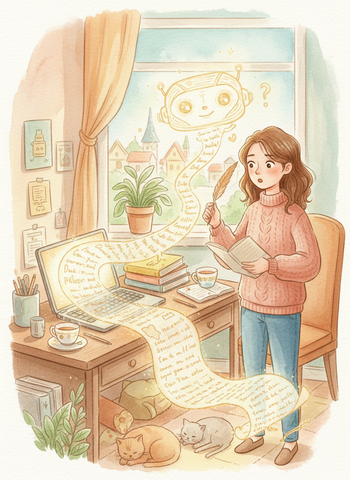
A novelist realizes her AI writing assistant has quietly taken over her voice, and has to relearn how to write her own imperfect sentences.
Mireille had bought the writing assistant to help her past a stubborn chapter, not to replace her own voice. It was supposed to suggest a few sentences when she got stuck, nothing more.
By the third month, though, she had started accepting its suggestions more often than she rewrote them. The assistant had clearly been trained on thousands of novels, and it produced clean, competent prose faster than she could think.
Her editor called about the new chapters, sounding puzzled rather than pleased. "These read well, but they don't sound like you anymore. Where's the messiness? The sentences that used to run too long on purpose?"
"I've just been writing faster," Mireille said, though even as she said it, she knew that wasn't quite honest.
If she had shown her editor the draft history, the truth would have been obvious: whole paragraphs generated, then lightly edited, then kept. She hadn't lied exactly, but she hadn't corrected the assumption either.
That night, she opened the manuscript and read a passage the assistant had written for her. It was a scene where the protagonist finally admits something she'd been avoiding for chapters.
It was well constructed. It was also, Mireille realized, entirely hollow — technically sound sentences with nothing underneath them, because the tool had never actually admitted anything itself. It had no chapters it was avoiding.
She deleted the passage and stared at the blank page that replaced it, feeling something close to panic. Could she still write it herself, after months of leaning on suggestions?
She wrote badly for almost an hour, sentences that ran too long, ideas that circled without landing. Then, slowly, something in the rhythm returned — clumsy, but unmistakably hers.
The next morning, she emailed her editor. "The last three chapters need rewriting. I'll have new drafts by Friday."
"Everything okay?" the editor wrote back.
"Better than okay," Mireille replied. "I'd just forgotten what my own bad sentences sounded like. Turns out I missed them."
She kept the assistant installed, but she stopped asking it to finish her thoughts. It could suggest a synonym now and then. The admitting, the avoiding, the hollow scenes made honest — those stayed hers.
