The Analog Rebellion
A free C1-level English story for language learners, readable online in English, with an option to listen via the free Storyteller app.
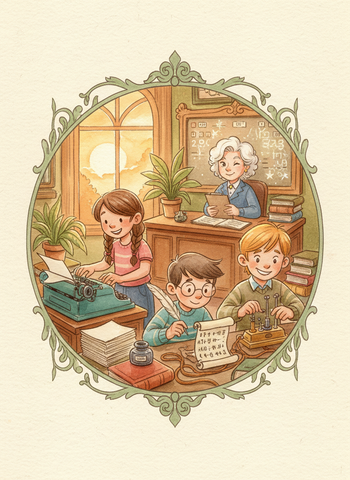
After a professor bans laptops, her students escalate into typewriters, quills, and Morse code, unaware she is secretly ranking their commitment.
Dr. Marlowe banned laptops from her seminar in the second week of term, citing a study on note-taking that half the class suspected she had invented on the spot.
"Longhand or nothing," she said, and returned to her podium as if the matter were now permanently closed.
It was not. Bellamy, who considered himself only a mild instigator, brought a manual typewriter to the following class, purely, he insisted, to comply with the letter of the new rule. Dr. Marlowe watched him carry it in, said nothing, and let him type through the entire ninety minutes, the room clattering around every one of her sentences.
By the fourth week, what had started as Bellamy's private joke had become a genuine, if unspoken, competition. A classmate brought an actual quill and a small bottle of ink, apologizing sincerely for the occasional splatter. Another began taking notes exclusively in shorthand, flipping her notebook shut whenever Dr. Marlowe walked past, as if guarding state secrets. Someone, memorably, tried Morse code for a single class before admitting defeat.
Not once did Dr. Marlowe ask anyone to stop. Had she found any of it genuinely disruptive, she would have said so within the first ten minutes of the typewriter's debut. Instead, she seemed, if anything, subtly delighted by an arms race she had accidentally started.
"I banned laptops," she told a colleague in the hallway, within Bellamy's overhearing, "and now I'm teaching a seminar that occasionally sounds like a newsroom from 1955. I have never once considered lifting the rule."
What none of the students realized, until a classmate let it slip near the end of the term, was that Dr. Marlowe had been quietly keeping her own log of every analog method attempted, ranked by what she called "commitment to the bit."
The quill, she noted, showed real dedication but poor practicality. The shorthand student, in her private ranking, had shown actual skill worth taking seriously. Bellamy's typewriter, however, topped the list, less for its cleverness than for the sheer, defiant nerve of hauling twelve pounds of machinery up three flights of stairs twice a week.
On the last day of the seminar, Dr. Marlowe read the ranking aloud, without warning, to a room that had no idea it was being evaluated on a scale that had nothing to do with grades.
"Congratulations, Bellamy," she said, deadpan, over the sound of the room's stunned laughter. "You have won an entirely unofficial contest with an entirely unofficial prize."
The prize turned out to be a single ribbon spool for his typewriter, wrapped, somewhat absurdly, in exam paper.
Bellamy kept it on his desk long after the semester ended, more proud of it, if he was honest, than of the actual grade the course eventually gave him.
