How to Tell a Story
A free B2-level English story for language learners, readable online in 7 languages, with an option to listen via the free Storyteller app.
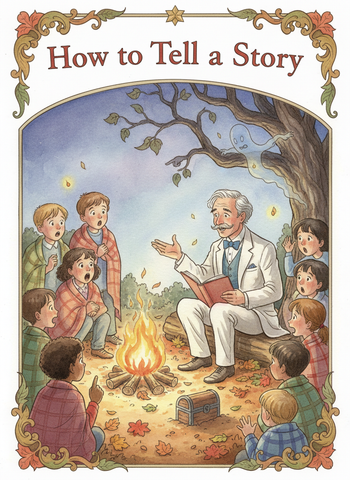
Mark Twain breaks down the secret art of the American humorous story — deadpan delivery, a buried punchline, and a perfectly timed pause — then proves his point with his own spine-tingling campfire tale.
The Humorous Story an American Development.—Its Difference from Comic and Witty Stories.
La historia humorística, una creación estadounidense.—Su diferencia con las historias cómicas e ingeniosas.
I do not claim that I can tell a story as it ought to be told. I only claim to know how a story ought to be told, for I have been almost daily in the company of the most expert story-tellers for many years.
No pretendo poder contar una historia como debería contarse. Solo pretendo saber cómo debería contarse una historia, pues he pasado casi a diario, durante muchos años, en compañía de los narradores más expertos.
There are several kinds of stories, but only one difficult kind—the humorous. I will talk mainly about that one. The humorous story is American, the comic story is English, the witty story is French. The humorous story depends for its effect upon the manner of the telling; the comic story and the witty story upon the matter.
Hay varios tipos de historias, pero solo uno es difícil: el humorístico. Hablaré principalmente de ese. La historia humorística es estadounidense, la historia cómica es inglesa, la historia ingeniosa es francesa. La historia humorística depende, para su efecto, de la manera de contarla; la historia cómica y la ingeniosa, del contenido.
The humorous story may be spun out to great length, and may wander around as much as it pleases, and arrive nowhere in particular; but the comic and witty stories must be brief and end with a point. The humorous story bubbles gently along, the others burst.
La historia humorística puede alargarse cuanto se quiera, y puede divagar tanto como le plazca, y no llegar a ninguna parte en concreto; pero las historias cómicas e ingeniosas deben ser breves y terminar con un remate. La historia humorística burbujea suavemente; las otras estallan.
The humorous story is strictly a work of art—high and delicate art—and only an artist can tell it; but no art is necessary in telling the comic and the witty story; anybody can do it. The art of telling a humorous story—understand, I mean by word of mouth, not print—was created in America, and has remained at home.
La historia humorística es estrictamente una obra de arte —un arte elevado y delicado— y solo un artista puede contarla; pero no se necesita ningún arte para contar la historia cómica y la ingeniosa; cualquiera puede hacerlo. El arte de contar una historia humorística —entiéndase, de viva voz, no impresa— se creó en Estados Unidos, y allí se ha quedado.
The humorous story is told gravely; the teller does his best to conceal the fact that he even dimly suspects that there is anything funny about it; but the teller of the comic story tells you beforehand that it is one of the funniest things he has ever heard, then tells it with eager delight, and is the first person to laugh when he gets through. And sometimes, if he has had good success, he is so glad and happy that he will repeat the “nub” of it and glance around from face to face, collecting applause, and then repeat it again. It is a pathetic thing to see.
La historia humorística se cuenta con seriedad; el narrador hace todo lo posible por ocultar el hecho de que ni siquiera sospecha vagamente que hay algo divertido en ella; pero el narrador de la historia cómica te advierte de antemano que es una de las cosas más graciosas que ha oído jamás, luego la cuenta con ávido deleite, y es el primero en reírse cuando termina. Y a veces, si ha tenido buen éxito, está tan contento y feliz que repite el «meollo» del asunto y mira de rostro en rostro, recogiendo aplausos, y luego lo repite de nuevo. Es cosa patética de ver.
Very often, of course, the rambling and disjointed humorous story finishes with a nub, point, snapper, or whatever you like to call it. Then the listener must be alert, for in many cases the teller will divert attention from that nub by dropping it in a carefully casual and indifferent way, with the pretence that he does not know it is a nub.
Muy a menudo, claro está, la historia humorística, divagante y deshilvanada, termina con un meollo, un remate, un chasquido, o como quiera llamársele. Entonces el oyente debe estar alerta, pues en muchos casos el narrador desviará la atención de ese remate soltándolo de manera cuidadosamente casual e indiferente, aparentando que no sabe que es un remate.
Artemus Ward used that trick a good deal; then when the belated audience presently caught the joke he would look up with innocent surprise, as if wondering what they had found to laugh at. Dan Setchell used it before him, Nye and Riley and others use it to-day.
Artemus Ward usaba mucho ese truco; luego, cuando el público rezagado por fin captaba el chiste, él alzaba la vista con inocente sorpresa, como preguntándose qué habían encontrado tan gracioso. Dan Setchell lo usó antes que él, y Nye y Riley y otros lo usan hoy en día.
But the teller of the comic story does not slur the nub; he shouts it at you—every time. And when he prints it, in England, France, Germany, and Italy, he italicizes it, puts some whooping exclamation-points after it, and sometimes explains it in a parenthesis. All of which is very depressing, and makes one want to renounce joking and lead a better life.
Pero el narrador de la historia cómica no atenúa el remate; te lo grita, cada vez. Y cuando lo imprime, en Inglaterra, Francia, Alemania e Italia, lo pone en cursiva, le añade sonoros signos de exclamación, y a veces lo explica entre paréntesis. Todo lo cual resulta muy deprimente, y hace que a uno le entren ganas de renunciar a las bromas y llevar una vida mejor.
Let me set down an instance of the comic method, using an anecdote which has been popular all over the world for twelve or fifteen hundred years. The teller tells it in this way:
Permítanme presentar un ejemplo del método cómico, usando una anécdota que ha sido popular en todo el mundo durante doce o quince siglos. El narrador la cuenta de esta manera:
THE WOUNDED SOLDIER.
EL SOLDADO HERIDO.
In the course of a certain battle a soldier whose leg had been shot off appealed to another soldier who was hurrying by to carry him to the rear, informing him at the same time of the loss which he had sustained; whereupon the generous son of Mars, shouldering the unfortunate, proceeded to carry out his desire. The bullets and cannon-balls were flying in all directions, and presently one of the latter took the wounded man's head off—without, however, his deliverer being aware of it. In no long time he was hailed by an officer, who said:
En el transcurso de cierta batalla, un soldado al que le habían volado una pierna de un disparo pidió a otro soldado que pasaba corriendo que lo llevara a la retaguardia, informándole al mismo tiempo de la pérdida que había sufrido; ante lo cual el generoso hijo de Marte, cargándolo sobre los hombros, procedió a cumplir su deseo. Las balas y las balas de cañón volaban en todas direcciones, y pronto una de estas últimas le arrancó la cabeza al herido, sin que, sin embargo, su salvador se diera cuenta. No pasó mucho tiempo antes de que un oficial lo detuviera, diciéndole:
“Where are you going with that carcass?”
«¿A dónde vas con ese cadáver?».
“To the rear, sir—he's lost his leg!”
«A la retaguardia, señor… ¡ha perdido la pierna!».
“His leg, forsooth?” responded the astonished officer; “you mean his head, you booby.”
«¿La pierna, dices?», respondió el oficial asombrado; «te refieres a la cabeza, so bobo».
Whereupon the soldier dispossessed himself of his burden, and stood looking down upon it in great perplexity. At length he said:
Ante lo cual el soldado se deshizo de su carga, y se quedó mirándola hacia abajo con gran perplejidad. Por fin dijo:
“It is true, sir, just as you have said.” Then after a pause he added, “But he TOLD me IT WAS HIS LEG—”
«Es cierto, señor, tal como usted dice». Luego, tras una pausa, añadió: «Pero él ME DIJO que era su PIERNA…».
Here the narrator bursts into explosion after explosion of thunderous horse-laughter, repeating that nub from time to time through his gaspings and shriekings and suffocatings.
Aquí el narrador estalla en explosión tras explosión de estruendosas carcajadas, repitiendo aquel remate de vez en cuando entre jadeos, chillidos y ahogos.
It takes only a minute and a half to tell that in its comic-story form; and isn't worth the telling, after all. Put into the humorous-story form it takes ten minutes, and is about the funniest thing I have ever listened to—as James Whitcomb Riley tells it.
Solo toma minuto y medio contarla en su forma de historia cómica; y, a fin de cuentas, no vale la pena contarla. Puesta en forma de historia humorística, toma diez minutos, y es de las cosas más graciosas que he escuchado jamás, tal como la cuenta James Whitcomb Riley.
He tells it in the character of a dull-witted old farmer who has just heard it for the first time, thinks it is unspeakably funny, and is trying to repeat it to a neighbor. But he can't remember it; so he gets all mixed up and wanders helplessly round and round, putting in tedious details that don't belong in the tale and only retard it; taking them out conscientiously and putting in others that are just as useless; making minor mistakes now and then and stopping to correct them and explain how he came to make them.
La cuenta en el papel de un viejo granjero de mente torpe que acaba de oírla por primera vez, la encuentra indeciblemente graciosa, e intenta repetírsela a un vecino. Pero no logra recordarla; así que se hace un lío y divaga sin remedio de aquí para allá, metiendo detalles tediosos que no pertenecen al relato y solo lo retrasan; quitándolos con escrúpulo y poniendo otros igual de inútiles; cometiendo pequeños errores de vez en cuando y deteniéndose a corregirlos y explicar cómo llegó a cometerlos.
Remembering things which he forgot to put in in their proper place and going back to put them in there; stopping his narrative a good while in order to try to recall the name of the soldier that was hurt, and finally remembering that the soldier's name was not mentioned, and remarking placidly that the name is of no real importance, anyway—better, of course, if one knew it, but not essential, after all—and so on, and so on, and so on.
Recordando cosas que olvidó poner en su lugar correcto y volviendo atrás para ponerlas allí; deteniendo su relato un buen rato para tratar de recordar el nombre del soldado que resultó herido, y por fin recordando que el nombre del soldado no se mencionaba, y comentando con placidez que el nombre no tiene ninguna importancia real, de todos modos —mejor, claro, si uno lo supiera, pero no esencial, después de todo— y así sucesivamente, y así sucesivamente.
The teller is innocent and happy and pleased with himself, and has to stop every little while to hold himself in and keep from laughing outright; and does hold in, but his body quakes in a jelly-like way with interior chuckles; and at the end of the ten minutes the audience have laughed until they are exhausted, and the tears are running down their faces.
El narrador está inocente y feliz y complacido consigo mismo, y tiene que detenerse cada tanto para contenerse y no soltar la carcajada; y se contiene, pero su cuerpo tiembla como gelatina con risillas internas; y al cabo de los diez minutos el público ha reído hasta quedar exhausto, y las lágrimas les corren por el rostro.
The simplicity and innocence and sincerity and unconsciousness of the old farmer are perfectly simulated, and the result is a performance which is thoroughly charming and delicious. This is art and fine and beautiful, and only a master can compass it; but a machine could tell the other story.
La sencillez, la inocencia, la sinceridad y la inconsciencia del viejo granjero están perfectamente simuladas, y el resultado es una actuación absolutamente encantadora y deliciosa. Esto es arte, fino y hermoso, y solo un maestro puede lograrlo; pero una máquina podría contar la otra historia.
To string incongruities and absurdities together in a wandering and sometimes purposeless way, and seem innocently unaware that they are absurdities, is the basis of the American art, if my position is correct. Another feature is the slurring of the point. A third is the dropping of a studied remark apparently without knowing it, as if one were thinking aloud. The fourth and last is the pause.
Enhebrar incongruencias y absurdos, de manera divagante y a veces sin propósito, y parecer inocentemente inconsciente de que son absurdos, es la base del arte estadounidense, si mi tesis es correcta. Otro rasgo es la atenuación del remate. Un tercero es soltar un comentario premeditado aparentemente sin saberlo, como si uno pensara en voz alta. El cuarto y último es la pausa.
Artemus Ward dealt in numbers three and four a good deal. He would begin to tell with great animation something which he seemed to think was wonderful; then lose confidence, and after an apparently absent-minded pause add an incongruous remark in a soliloquizing way; and that was the remark intended to explode the mine—and it did.
Artemus Ward recurría bastante a los rasgos tercero y cuarto. Comenzaba a contar con gran animación algo que parecía considerar maravilloso; luego perdía confianza, y tras una pausa aparentemente distraída añadía un comentario incongruente en tono de soliloquio; y ese era el comentario destinado a hacer estallar la mina, y así lo hacía.
For instance, he would say eagerly, excitedly, “I once knew a man in New Zealand who hadn't a tooth in his head”—here his animation would die out; a silent, reflective pause would follow, then he would say dreamily, and as if to himself, “and yet that man could beat a drum better than any man I ever saw.”
Por ejemplo, decía con avidez y emoción: «Una vez conocí a un hombre en Nueva Zelanda que no tenía ni un diente en la boca»; aquí su animación se apagaba; seguía una pausa silenciosa y reflexiva, y luego decía con aire soñador, como para sí mismo: «y sin embargo ese hombre tocaba el tambor mejor que ningún otro hombre que haya visto jamás».
The pause is an exceedingly important feature in any kind of story, and a frequently recurring feature, too. It is a dainty thing, and delicate, and also uncertain and treacherous; for it must be exactly the right length—no more and no less—or it fails of its purpose and makes trouble. If the pause is too short the impressive point is passed, and [and if too long] the audience have had time to divine that a surprise is intended—and then you can't surprise them, of course.
La pausa es un elemento sumamente importante en cualquier tipo de historia, y un elemento que se repite con frecuencia además. Es cosa delicada y sutil, y también incierta y traicionera; pues debe tener exactamente la duración correcta —ni más ni menos— o falla en su propósito y causa problemas. Si la pausa es demasiado corta, el punto impactante pasa desapercibido, y si es demasiado larga, el público ha tenido tiempo de adivinar que se pretende una sorpresa, y entonces ya no se les puede sorprender, claro está.
On the platform I used to tell a negro ghost story that had a pause in front of the snapper on the end, and that pause was the most important thing in the whole story. If I got it the right length precisely, I could spring the finishing ejaculation with effect enough to make some impressible girl deliver a startled little yelp and jump out of her seat—and that was what I was after. This story was called “The Golden Arm,” and was told in this fashion. You can practise with it yourself—and mind you look out for the pause and get it right.
En el escenario solía contar una historia de fantasmas que tenía una pausa justo antes del remate final, y esa pausa era lo más importante de toda la historia. Si le daba exactamente la duración correcta, podía soltar la exclamación final con efecto suficiente para hacer que alguna muchacha impresionable soltara un gritito sobresaltado y saltara de su asiento, y eso era lo que yo buscaba. Esta historia se llamaba «El brazo de oro», y se contaba de esta manera. Puedes practicarla tú mismo, y cuida bien la pausa, dándole la duración justa.
THE GOLDEN ARM.
EL BRAZO DE ORO.
Once 'pon a time dey wuz a monsus mean man, en he live 'way out in de prairie all 'lone by hisself, 'cep'n he had a wife. En bimeby she died, en he tuck en toted her way out dah in de prairie en buried her. Well, she had a golden arm—all solid gold, fum de shoulder down. He wuz pow'ful mean—pow'ful; en dat night he couldn't sleep, Gaze he want dat golden arm so bad.
Érase una vez un hombre de lo más ruin, que vivía solo, muy lejos, en la pradera, salvo que tenía esposa. Y con el tiempo ella murió, y él la cargó y la llevó hasta allá lejos en la pradera y la enterró. Pues bien, ella tenía un brazo de oro, todo de oro macizo, desde el hombro hacia abajo. Él era de lo más ruin, muy ruin; y aquella noche no pudo dormir, de tantas ganas que le entraron de ese brazo de oro.
When it come midnight he couldn't stan' it no mo'; so he git up, he did, en tuck his lantern en shoved out thoo de storm en dug her up en got de golden arm; en he bent his head down 'gin de win', en plowed en plowed en plowed thoo de snow. Den all on a sudden he stop (make a considerable pause here, and look startled, and take a listening attitude) en say: “My LAN', what's dat!”
Cuando llegó la medianoche ya no pudo más; así que se levantó, tomó su farol y salió a la tormenta, la desenterró y consiguió el brazo de oro; y agachando la cabeza contra el viento, avanzó y avanzó y avanzó entre la nieve. Entonces, de repente, se detuvo (hacer aquí una pausa considerable, y poner cara de sobresalto, y adoptar actitud de escucha) y dijo: «¡Válgame, qué es eso!».
En he listen—en listen—en de win' say (set your teeth together and imitate the wailing and wheezing singsong of the wind), “Bzzz-z-zzz”—en den, way back yonder whah de grave is, he hear a voice! he hear a voice all mix' up in de win' can't hardly tell 'em 'part—“Bzzz-zzz—W-h-o—g-o-t—m-y—g-o-l-d-e-n arm?—zzz—zzz—W-h-o g-o-t m-y g-o-l-d-e-n arm!” (You must begin to shiver violently now.)
Y escuchó, y escuchó, y el viento decía (apretar los dientes e imitar el gemido y el silbido cantarín del viento): «Bzzz-z-zzz»; y entonces, allá atrás donde estaba la tumba, ¡oyó una voz! Oyó una voz toda mezclada con el viento, que apenas podía distinguirse: «Bzzz-zzz—¿Q-u-i-é-n se l-l-e-v-ó m-i b-r-a-z-o d-e o-r-o?—zzz—zzz—¿Q-u-i-é-n se l-l-e-v-ó m-i b-r-a-z-o d-e o-r-o!» (Ahora debes empezar a temblar con violencia.)
En he begin to shiver en shake, en say, “Oh, my! OH, my lan'!” en de win' blow de lantern out, en de snow en sleet blow in his face en mos' choke him, en he start a-plowin' knee-deep towards home mos' dead, he so sk'yerd—en pooty soon he hear de voice agin, en (pause) it 'us comin' after him! “Bzzz—zzz—zzz—W-h-o—g-o-t m-y—g-o-l-d-e-n—arm?”
Y empezó a temblar y a estremecerse, y a decir: «¡Ay, Dios mío! ¡AY, Dios mío!»; y el viento apagó el farol, y la nieve y el aguanieve le azotaban la cara y casi lo ahogaban, y arrancó a avanzar hacia casa hundido hasta las rodillas, medio muerto de tanto miedo; y pronto volvió a oír la voz de nuevo, y (pausa) ¡venía tras él! «Bzzz—zzz—zzz—¿Q-u-i-é-n se l-l-e-v-ó m-i b-r-a-z-o d-e o-r-o?»
When he git to de pasture he hear it agin closter now, en a-comin'!—a-comin' back dah in de dark en de storm—(repeat the wind and the voice). When he git to de house he rush up-stairs en jump in de bed en kiver up, head and years, en lay dah shiverin' en shakin'—en den way out dah he hear it agin!—en a-comin'! En bimeby he hear (pause—awed, listening attitude)—pat—pat—pat—hit's acomin' up-stairs! Den he hear de latch, en he know it's in de room!
Cuando llegó al pastizal la oyó de nuevo, más cerca ahora, ¡y viniendo! —viniendo de vuelta allá en la oscuridad y la tormenta (repetir el viento y la voz). Cuando llegó a la casa, subió corriendo las escaleras y saltó a la cama y se tapó, cabeza y orejas, y quedó allí temblando y estremeciéndose; y entonces, allá lejos, ¡la volvió a oír! ¡Y venía! Y al poco tiempo oyó (pausa, actitud sobrecogida, de escucha): pat—pat—pat, ¡venía subiendo las escaleras! Entonces oyó el picaporte, ¡y supo que estaba en la habitación!
Den pooty soon he know it's a-stannin' by de bed! (Pause.) Den—he know it's a-bendin' down over him—en he cain't skasely git his breath! Den—den—he seem to feel someth' n c-o-l-d, right down 'most agin his head! (Pause.)
Entonces, muy pronto, supo que estaba parada junto a la cama. (Pausa.) Entonces, supo que se inclinaba sobre él, ¡y apenas podía respirar! Entonces, entonces, sintió algo f-r-í-o, justo casi contra su cabeza. (Pausa.)
Den de voice say, right at his year—“W-h-o g-o-t—m-y—g-o-l-d-e-n arm?” (You must wail it out very plaintively and accusingly; then you stare steadily and impressively into the face of the farthest-gone auditor—a girl, preferably—and let that awe-inspiring pause begin to build itself in the deep hush. When it has reached exactly the right length, jump suddenly at that girl and yell, “You've got it!”)
Entonces la voz dijo, justo junto a su oído: «¿Q-u-i-é-n se l-l-e-v-ó m-i b-r-a-z-o d-e o-r-o?» (Debes gemirlo de manera muy lastimera y acusadora; luego debes mirar fijamente e impresionantemente al rostro del oyente más ensimismado —una muchacha, preferiblemente— y dejar que esa pausa sobrecogedora se construya en el hondo silencio. Cuando haya alcanzado exactamente la duración correcta, salta de golpe hacia esa muchacha y grita: «¡TÚ LO TIENES!»)
If you've got the pause right, she'll fetch a dear little yelp and spring right out of her shoes. But you must get the pause right; and you will find it the most troublesome and aggravating and uncertain thing you ever undertook.
Si has dado con la pausa correcta, ella soltará un lindo gritito y saltará fuera de sus zapatos. Pero debes acertar con la pausa; y descubrirás que es lo más problemático, exasperante e incierto que hayas emprendido jamás.
